Showing posts with label Machine Building. Show all posts

Friday, 25 September 2026

Rethinking valve platform architecture?

Addresses growing demand for higher airflow in automation.

Across factory automation, packaging, water treatment, and automotive manufacturing, machine builders are facing a familiar challenge: higher airflow demands in increasingly compact machine designs. Moving to a larger valve platform can solve the airflow problem but introduces new complexity — different interfaces, different configurations, and disruption to established machine architectures. Emerson has developed the AVENTICS™ XV05 High Flow Valve System to address this gap directly.

Their XV05 High Flow variant delivers up to 1,200 L/min — enabling OEMs and machine builders to achieve greater airflow capacity without moving to a larger valve system.

Now available globally, the XV05 High Flow is an extension of the established AVENTICS XV platform — the same architecture, the same electrical connection options, the same communication protocols, and the same modularity that machine builders already rely on. The difference is flow capacity: up to 1,200 L/min, compared to 1,000 L/min for the standard XV05. Larger ports and dedicated high-flow fittings deliver the increased airflow where applications demand it, while compatibility with the standard XV05 means High Flow and standard modules can be combined within a single valve system.

The XV05 High Flow is available in front-, top-, and bottom-ported configurations, giving design engineers the flexibility to integrate higher airflow capacity into new and existing machine layouts without redesigning the broader pneumatic architecture. Applications well suited to the new variant include pilot valve systems for process valves in water treatment, package molding equipment, slicing and cutting units requiring high actuator force, cleaning systems, pneumatically driven winches in oil and gas operations, and automotive manufacturing equipment with high airflow requirements.


• See also Next Generation Pneumatic Valves.(24/2/2025) 

@AVENTICS @EmersonExchange @Emerson_News @EMR_Automation @mepaxIntPR #PAuto #Machine_Building

Wednesday, 16 September 2026

New initiative to foster technology co-operation to innovation.

First phase of this initiative is focused on enabling part manufacturers to start production preparation before machine delivery.

Meet at the Machine is a new initiative from Siemens, designed to bring together machine builders, software and automation technologies to accelerate innovation across the machine tool industry and help manufacturers achieve productivity faster. It provides a framework for Siemens and machine builders to jointly deliver integrated machining solutions that address real manufacturing challenges. The initiative is designed to make manufacturing customers more productive and enhance quality and performance. It brings engineering software, automation hardware and machine expertise together in one solution, helping machine builders deliver differentiated value.

Manufacturers today face increasing complexity, workforce shortages and growing pressure to become productive faster. While advances in software, automation and digitalization continue to create new opportunities, many manufacturers still face challenges connecting those technologies into efficient production workflows.

Siemens believes the next step in machining innovation is creating a continuous digital thread that connects engineering, programming, virtual validation and execution to deliver next-level productivity starting from the first machine power-on. By improving the flow of data across the part manufacturing lifecycle, organizations can reduce complexity, accelerate ramp-up and create a foundation for continuous improvement.

“Manufacturing truth has always ultimately been at the machine,” said Mark Hindsbo, head of Operations Software at Siemens. “By bringing together engineering software, automation hardware and machine expertise, we enable our customers and users to be productive faster, accelerate return on investment and reduce ramp-up time by up to 50 percent.”

Built in collaboration with TRAK Machine Tools, the first phase of this initiative is focused on enabling part manufacturers to be productive from day one. It addresses one of the most common challenges manufacturers face when purchasing a new machine: the time required to move from machine delivery to productive machining. The solution combines software, automation and machine expertise into a connected workflow that allows manufacturers to program, simulate and validate production while a machine is still being built.

“When our customers invest in a new machine, their goal is to achieve productivity and business results as quickly as possible,” said Steve Pinto, president, TRAK Machine Tools. “Meet at the Machine creates a new model for collaboration focused on customer outcomes, and we are proud to be the first partner helping bring this vision to life.”

Traditionally, many programming, validation and training activities begin only after a machine is installed. The new initiative shifts these activities earlier in the process, allowing manufacturers to prepare for production before physical machine delivery and helping reduce ramp-up time.

Through the initiative, Siemens plans to work with machine builders to develop future solutions that address key manufacturing challenges through collaborative innovation.


@siemensindustry @prototrak @Siemens @siemens_press #PAuto #MachineBuild #Manufacturing

Tuesday, 15 September 2026

Simplified digital I/O module.

As automated machines become more capable, the amount of decentralised I/O required increases. Conventional approaches often rely on multiple dedicated input and output modules, increasing hardware, commissioning and the number of additional components that machine builders and system integrators must engineer, stock and support.

Festo addresses this challenge with a new configurable digital I/O module for the CPX-AP-I decentralised I/O platform. Designated CPX-AP-I-16DIO M12 (or M12 for short), the new module enables more efficient use of decentralised I/O across a machine.

The new M12 configurable digital I/O module provides 16 channels that can each be configured as a digital input or digital output to match application requirements. Users can configure the module channel by channel, divide it into eight inputs and eight outputs, or configure all 16 channels as outputs. Selected output channels provide up to 500 mA for high-current devices.

The module comes with a default 16-input configuration for immediate installation and commissioning, while output functions are enabled through software parameterisation. Individual LED indicators on each channel simplify commissioning and troubleshooting by providing clear operating and diagnostic status.

The M12 module gives machine builders greater freedom to design around the needs of the application instead of the limitations of fixed I/O modules. A single M12 module can support a wider range of machine configurations, reducing the number of module variants that must be specified, stocked, and maintained over the life of a machine.

The new module is part of Festo’s CPX-AP-I decentralised I/O platform, a high-performance system that distributes I/O, valve terminals, and IO-Link devices throughout a machine. Supporting up to 80 modules over distances of up to 50 m between modules, the platform reduces wiring, simplifies modular machine architectures, and allows machine builders to expand or reconfigure systems without redesigning the entire control architecture.

Expanding connectivity with CC-Link IE Field Basic.
Festo has also introduced a new CPX-AP-I bus node supporting CC-Link IE Field Basic, expanding the platform’s connectivity for Mitsubishi Electric Automation environments. Widely used throughout Asia, the industrial Ethernet protocol enables machine builders to integrate CPX-AP-I decentralised I/O into Mitsubishi PLC architectures without additional gateways or custom engineering.

The new bus node allows machine builders to retain the same CPX-AP-I decentralised I/O architecture while changing only the network interface for Mitsubishi Electric systems. The result is less engineering effort, faster machine adaptation for regional markets, and a common automation platform that supports multiple industrial Ethernet protocols, including EtherNet/IP, PROFINET, EtherCAT, Modbus TCP, and now CC-Link IE Field Basic.


@FestoGB @festo_global #PAuto #IO

Wednesday, 18 June 2025

Industrial PCs.

Panel PCs, web panels, displays and box PCs in a consistent design - attractive for machine and plant engineering.

Wachendorff Prozesstechnik offers a future-proof hardware platform for machine and plant manufacturers with two high-performance series of industrial PCs. The product lines include panel PCs, web panels, displays and box PCs, which are characterized by a uniform and modern design. The design is consistent across all device categories, enabling machine and system manufacturers to implement a clear corporate design right down to the operating and display level of their machines - an increasingly important factor in mechanical engineering and series production.

In addition, the series offers an exceptionally wide range of display sizes from 10.1 inches to 32.0 inches - a spectrum that is rarely found on the market in this range. This allows machine builders to choose exactly the right size for different applications and operating concepts - from compact machine controls to large-format control stations.

The industrial PCs from Wachendorff Prozesstechnik have been specially developed for industrial use: Robust workmanship for 24/7 continuous operation, powerful hardware components for demanding applications and long-term availability for investment security.


@mepaxIntPR #wachendorff-automation #PAuto  

Monday, 27 November 2023

Software for autonomous machine development.

The software offering from Danfoss has been formalised for autonomous off-highway machinery. Designed for in-house engineering teams at original equipment manufacturers and distributors, A+ software reduces development time and costs.

A+ software consists of preprogrammed and pretested software blocks built into Danfoss’ XM100 autonomous controller hardware. Each block covers key areas such as perception, positioning, and navigation. A+ software enables users to add autonomous functionality by integrating the blocks into their machine applications, eliminating the need to develop software from scratch.

This software is offered in two tiers: A+ Essentials and A+ Advanced. Included with a PLUS+1 professional license, A+ Essentials provides basic software tools and blocks to get users started on autonomous machine development. A+ Advanced is a paid solution that provides advanced software blocks and access to future A+ Advanced features and updates.

“Autonomous functionality is improving machine performance and safety and helping relieve labor shortages across a number of industries, particularly specialty agriculture, animal husbandry and airport ground support. The benefits of autonomy are wide-ranging, making it a powerful solution,” said Peter Bleday, head of Autonomy, Danfoss Power Solutions. “OEMs that adopt autonomous functionality early stand to gain a significant advantage. With our new A+ software, we can help OEMs get to market faster with machines that stand out from the competition. Danfoss has both the solutions and the expertise needed to guide companies on the road to autonomy.”

In addition to software, Danfoss offers engineering services and a broad portfolio of hardware required for autonomous functionality. The company’s Autonomous Custom Engineering Services team can help OEMs by providing hardware selection support and full or partial machine programming. Danfoss components such as steer-by-wire, e-steering, electronics, telematics, machine interfaces, controllers, and hydraulics provide a comprehensive solution.


@DanfossPower @Danfoss @NapierPR #Automation #PAuto

Friday, 27 May 2022

PACs increase ROI for machine builders.

Emerson has released its PACSystems™ RSTi-EP CPE200 programmable automation controllers (PAC). This new family of compact PACs helps original equipment manufacturers (OEM) successfully meet customer requirements by minimising the need for specialised software engineering talent. CPE200 controllers will deliver large programmable logic controller (PLC) capability in a small, cost-effective, IIoT-ready form factor so machine manufacturers do not need to sacrifice performance for price.

To stay competitive, today’s OEM machine builders must provide equipment that is ready to support analytics and give end users competitive advantage through increased efficiency, speed and quality. However, as builders develop innovative solutions for material handling, life sciences and more, they can struggle to program and deliver machine control systems on time and within budget with the performance, security and flexible connectivity customers require. The CPE200 series solves these problems with security-by-design, open programming and open communications built in to simplify connectivity to external analytics software platforms while reducing cost and complexity for OEMs and end users.

“Gaining a competitive edge in today’s marketplace means having the flexibility to connect to the wide array of equipment end users employ as part of their proprietary processes, and supporting secure, open connectivity to allow easy access to on-premises and cloud-hosted analytics platforms,” said Jeff Householder, president of Emerson’s machine automation solutions business. “The CPE200 series controllers take advantage of Emerson’s cybersecure-by-design architecture, common programming capabilities, and IIoT readiness to provide options currently missing in legacy compact PLCs.”

The controllers offer open communications through native, pre-licensed support for OPC UA Secure and other common industrial protocols for flexible connectivity over high-speed Gigabit Ethernet. IEC 61131 programming languages and C, the world’s most popular and easiest-to-use programming language, help engineers write and run the high-performance algorithms that enable proprietary production strategies and advanced automation technologies.

@EMR_Automation @Emerson_News @HHC_Lewis #PAuto #OEM

Friday, 22 April 2022

Saving time and cost for machine builders.

Innovation doesn’t always come at a price.

Simple innovations to improve existing pneumatics technology can make a real difference to the way we build and commission machines, according to industrial automation specialist Festo.

Steve Sands, Head of Product Management at Festo GB, says: “Innovation can come in many forms and isn’t restricted to technical features. Human factors like usability, convenience and safety are tangible areas for development and improvement. Overall costs, machine assembly and build times, on-site commissioning costs and maintenance times are also areas requiring innovative solutions.”

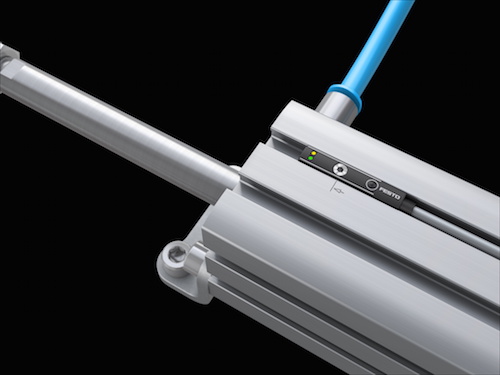
Festo cites the simple cylinder sensor switch as a prime example. These devices are mounted on most pneumatic cylinders and provide sensor feedback. They are most frequently used when the cylinder reaches its advance or retract end-positions and, less frequently, in mid-position: for example, when a cylinder movement has cleared an overlap position. Cylinder switches may appear to be an automation commodity beyond advancement – but there is room for improvement.

“Mounting a cylinder sensor on the bench is straightforward enough, but once the actuator is installed into the machine you often can’t see the end final positions,” explains Sands. “It can be even harder when access is required inside the machine guarding, at height or in difficult to reach locations. In these circumstances, accessing the sensor Allen key position adjustment or observing the indicator LED can be physically impossible.

Clearly, final setting and adjustment of cylinder sensors is problematic and time-consuming, particularly on machines with multiple cylinders, yet it can make a big difference to long-term reliability and operating lifetime. Festo has developed an innovative solution to aid the correct installation of pneumatic cylinders."

Suitable for all compatible T-slot cylinder grooves, the SDBT-MSX is the first auto-teach cylinder switch that learns the required switching position simply by cycling the machine four times during set-up. No in-situ adjustment is required: instead the switch is simply dropped into place in the approximate required position. The fitter sets the sensor up by aligning the cylinder with an integral sensor mark. Once the cylinder is fitted into position on the machine and the sensor is wired in, it’s LEDs will indicate that the switching point is not yet saved. Cycling the machine, including this actuator, just four times enables the self-teach function. The optimum switching position is learnt by the sensor and saved.

This technology has several other benefits for users going beyond the basic, standard operation. These include the ability to manually teach-in a position using the integrated capacitive teach button and the ability to re-assign the switching operation from PNP to NPN and also from Normally Open to Normally Closed operation. Even the switching window can be adjusted from the pre-set 2mm to any length up to 15mm if the application requires it. This is where purchasing, stores and maintenance can gain – one cylinder sensor for all applications.

Concludes Sands: “It is reassuring to know that even in the most commonplace areas of automation, innovation is thriving and will have a real positive impact on users. Faster assembly times, more reliable switching, plus less time stretching, going up ladders or lying under machines have got to be welcome improvements.”

And of course price is important. The SDBT-MSX is manufactured in-house by Festo at virtually the same cost as standard sensors. Innovation doesn’t always come at a price.

@FestoGB @festo_global @Publitek #PAuto #MachineBuilding

Friday, 12 November 2021

Products for machine builders, industrial control and safety.

Foremost Electronics is continuing to grow its product offering into the industrial and automation markets with increased cooperation with IDEC. 

L-R, Alan Vincent, Sales Director, 4most
Mike Pearman Distribution Manager, IDEC.
Alan Vincent
, Sales Director of Foremost, comments, “We are very pleased to increase our long-standing relationship with IDEC. Foremost already supply a wide range of products from Global brands to industrial and automation system builders placing us at the heart of the markets IDEC has targeted for growth and new products.”

IDEC are putting greater focus on machine building, industrial control and safety which are markets already served by Foremost with a wide range complementary products such as enclosures and cable glands.

They have recently introduced a number of key products and solutions, dedicated to industrial specialists allowing them to benefit from: time saving, safer working environments and simplified operations.

The KW2D RFID Reader smartly manages access, traceability and user authority for machines and devices or inspection history and can track entry/exit at work areas. The RFID technology solution is a perfect mix between compact technology and smart design to manage the mode of safe operation as specified in ISO 16090. By connecting with devices such as touch panels and PLCs, the RFID reader can be used for a wide variety of applications.

The HT3P Safety COMMANDER™ can convert a tablet computer into an industrial HMI with safety functions such as a hardwired three-position enabling switch and E-stop. It is a lightweight, compact, and secure solution for teaching, programming and maintenance of robots and systems. It combines flexibility and safety while saving the costs of bespoke teaching pendants or permanent touch panels in each workplace.

IDEC 3rd Genration Emergency-stop Switches ensure the safety of personnel and machinery. Unlike traditional E-stop switches, IDEC X-series E-stops utilize exclusive “Safe Break Action” that turns the machine off if a failure occurs within the E-stop itself.

Control panel switches with push-in terminals save assembly time and manufacturing costs. Wiring time can be reduced by up to 55% with IDEC PUSH-IN technology. Terminals equipped with this technology are easy to wire, thanks to a tool-less yet safe and secure connection. This guarantees excellent contact safety, even in demanding applications, with vibration & shock resistance.

@4MostElectronic @IDECUSA @proactivefleet #PAuto #Electrics

Wednesday, 25 August 2021

Resolving media disruptions in data transfer.

Today’s ecosystem of industrial automation is characterised by many media disruptions during the processing and transfer of documentation. It is essential to resolve these issues within the development process for machines and plant systems – via targeted collaboration among all stakeholders and systems. Data created in the engineering process must be shared with everyone involved in the process. The ideal goal: machine builders and system integrators, control cabinet manufacturers, component manufacturers and also the machine or plant system operator all work networked together.


Operators of production facilities, machine builders and system integrators, control cabinet manufacturers and component manufacturers all have one thing in common: they all work together along the value chain, from the planning through to operating a finished machine or plant system – and continuously exchange information in the process.

The ecosystem of industrial automation
What does this process – the collaboration among the various process participants – look like today? In the planning phase, the characteristics of the desired machine or plant system are described. If the company has particular supplier specifications, these are also detailed and then passed on to the operator, who takes the specifications into account when designing the machine or system. The planning phase is followed by the preplanning process. Additional information such as devices, release lists from Excel, specifications in Word or preplanning tools such as Eplan Preplanning are taken into account and, in turn, are used by the basic engineering designers to prepare a quote, for instance. In the case of more complex production lines, this is traditionally taken care of by a system integrator, who is also responsible for the detailed engineering and for generating electrical and fluid-power schematics.

The new Eplan Platform 2022 with a completely redesigned user interface: the practical ribbon bars using modern technology flexibly adapt to the application.

Data is enriched in the Eplan Project
The project created with systems of the Eplan Platform – Eplan Electric P8 or Eplan Fluid, for example – is now transferred to the control cabinet manufacturer. This manufacturer creates the virtual prototype of the switchgear system in the form of a 3D assembly of the control cabinet using Eplan Pro Panel. The control cabinet is then built, approved and commissioned by the operator. With the delivery of the switchgear system, the control cabinet manufacturer processes are complete. The company hands over the Eplan Project, which has been enriched with data, back to the machine builder or system integrator, who then commissions the machine or plant system based on the final project data. The project is then made available to the operator, who can access the current documentation, for instance using Eplan eView, in the event that servicing or maintenance becomes necessary, and who can digitally document any changes using the redlining function as needed.

This process describes the daily work in this ecosystem of industrial automation. The challenge, however, is that all the data for an automation project is created and added at various stations along the value chain. Often, all the project participants are working with partially inconsistent data, which ends up making the process even more time consuming and error prone. For instance, the drive power of a motor is changed at some later point in a project, but this change isn’t taken into account when the machine or plant system is commissioned. As a result, the documentation is not up to date.

All changes in a project are centrally available in Eplan eView. The advantages are obvious: project documentation is always up to date – along the entire product life cycle and into operation and service scenarios.

A “data container” as the central source of information
This is where Eplan comes in: the systems of the upcoming Eplan Platform 2022, in combination with the new Eplan eManage cloud service, network together machine builders and system integrators, control cabinet manufacturers, component manufacturers and the operators of machines or plant systems. Eplan CEO Sebastian Seitz explains: “We connect companies with their clients and suppliers via the cloud, for easy and secure data sharing. The Eplan Project as the central, digital model of an automation solution supplies all processes with the necessary data. What we’re talking about is a sort of ‘data container’ that is fed from the systems of the Eplan Platform. This generates added value in the digitised collaboration of all participants – through secure data transfer and central access to the Eplan Project.” A new feature includes the connection to the cloud via Eplan ePulse, which also significantly facilitates mobile working in design and engineering.

An important building block is device data, which is provided on the Eplan Data Portal. What matters here is the quality and depth of the data, something being intensively advanced with the Data Standard.

Cross-project collaboration via the cloud
Using the new Eplan eManage, projects can easily be uploaded to the cloud and managed and shared from there. More specifically, this brings together the worlds of on-premises software and the cloud. Clear access rights via role management ensure data security and provide flexibility for accessing projects. Users of Eplan Electric P8 and Eplan Pro Panel can conveniently upload their projects to the cloud and transfer them to the Eplan Platform for further processing. This is accomplished without the time-consuming sending of project data via email or using an FTP server. And the centralised, clear availability in the cloud also enables all project participants to search quickly for specific content. With Eplan eView, all the changes in a project are centrally available. The advantages are obvious: project documentation is always up to date – along the entire product life cycle and into operation and service scenarios. 

High-quality digital device data is a key factor in:

• Processing orders in shop floor management and deriving production orders.
• Controlling automated machine fleets (Rittal Automation Systems).
• Providing information to partially automated workstations (for instance, simplifying wiring processes with Eplan Smart Wiring).

An important component of this method of working is device data, which is provided on the Eplan Data Portal. Seitz says, “What matters here is the quality and depth of the data, something we are intensively advancing with the Data Standard.” Comprehensive, integrated and end-to-end digital data serves as a project accelerator. And don’t forget, the data are consistent and the data transfer is secure.

Seitz continues: “With these optimised processes and increased efficiency, companies can optimise their machine and plant system design processes and sustainably increase the availability of their machines and plant systems. Collaboration among all participants ultimately increases the quality of the data and thus the added value.”

@EPLAN_global @mepaxIntPR #PAuto 

Monday, 23 August 2021

Filter options for machine builders.

Schaffner has extended its popular FN3270 series to provide more options for machine builders. Building on the strengths of the very successful FN3270 filter range the new FN3271 filter is an extremely compact and lightweight filter design requiring minimum mounting space in installations and cabinets.

15 different filter models are available to meet the specific needs and deployment for most industrial applications. These include industrial viable speed electrical power drive systems, motor drives and systems containing frequency inverters and servo drives.

With its enhanced performance the FN3271 offers an ideal solution for EMC challenges, where the impedance at the connection to the noise source is high (> 100 Ohm). The internal configuration of the FN3271 is optimised for this application. For applications with low impedances at the noise source the existing FN3270 remains the option of choice.

These new EMC filters provide the attenuation performance required to fulfil EN 61800-3/A11 and the filter performance is guaranteed under full load operating conditions. Solid, touch-safe terminal blocks are fitted to all filter models from 10 to 100 A, offering sufficient contacting cross section according to the EN 60204-1 installation standard.

To improve the safely of installations optional transparent protective covers are available for all filters with busbars from 150 to 1000 A. These provide protection to the installer, operator, or inspector by avoiding accidental contact with live conductors. The protective covers can easily be retrofitted even if the filter is already installed and connected.

@proactivefleet #Schaffner #PAuto

Monday, 21 June 2021

Din mounted PSU with indication.

The latest addition to PULS Power's CP20 series of high efficiency and compact 24V, 20A 1-phase DIN-Rail power supplies is now available. The new CP20.248 extends their portfolio by adding a power supply with an integrated display. The LED display means a reliable and inexpensive condition monitoring feature can be integrated into almost any system allowing users to benefit immediately from faster fault diagnosis and increased system availability.


Marco van der Linden, UK Country Manager for PULS Power, comments, "The display on our new CP20 20A DIN-Rail power supply provides panel builders, system designers and integrators with a unique system monitoring tool without having to find extra space to add additional measuring or monitoring equipment to a system. Secure power for the data store ensures all measurements are available in the event of a system failure. A further model in the series, a 24V, 10A version will also be available soon."

The display shows important status information about the power supply for commissioning and maintenance and can display real-time information and recorded data. The real-time data supplied by the CP20.248 includes the input and output voltage, output current, operating hours and temperature inside the device. The recorded data gives users insight into the number of transients on the input side as well as minimum and maximum voltage and temperature values fand more. This information can help the system engineer optimise an entire application in terms of reliability and to identify the cause of faults or errors more efficiently. The display and data storage have an independent power source ensuring that all the information is still available, even if the power supply fails.

For remote status monitoring two relay contacts for DC-OK and alarm signals are provided. Two additional inputs allow the power supply to be put into an energy-saving standby mode using the remote ON / OFF function and automatic load sharing in parallel operation for greater power output can be realised. Parallel operation ensures an optimised temperature balance between the connected power supplies, prolonging the service life of the devices.

All CP20 versions share the same compact housing with dimensions of 48x124x127mm (WxHxD) which includes the space required for the integrated display. This is made possible by a very high efficiency of 95.6%. As a result of the low power losses, less heat is generated in the housing and the clearance and creepage distances can be reduced.

The PULS CP20has an operating temperature range from -25°C to +70°C, 50% extra output power for up to 5s, has fully international safety agency approvals and a 3-year warranty.

Applications for the PULS CP20 include industrial systems and machine building, SMART buildings and factories, Industry 4.0, security and CCTV, instrumentation and measuring systems.

@PULSPowerSupply @proactivefleet #PAuto 

Thursday, 4 March 2021

Solenoid Valves for compact machine designs.

ASCO™ Series 256/356 offers smaller footprint, up to 40% reduced power consumption and up to 30% higher pressure ratings
A range of two-way and three-way solenoid valves has been launched by Emerson.  These valves support original equipment manufacturers’ (OEMs) need to develop more compact machines and equipment without compromising on fluid control performance. The optimized body design and internal flow path of the new ASCO™ Series 256/356 not only provides a smaller footprint, but also reduced power consumption and increased pressure ratings critical in industrial and commercial applications.

“Emerson has engineered the Series 256/356 from the ground up, creating a range of solenoid valves that sets a new benchmark in fluid control technology by decreasing overall footprint and power consumption while also increasing pressure ratings,” said Erik VanLaningham, vice president of global marketing for Emerson’s industrial automation business. “These performance improvements are complemented by an extended choice of body materials and connection options. This provides OEMs with the broadest range of options from a trusted single-source supplier to reliably meet their diverse application demands.”

The reduced overall footprint of the Series 256/356 helps OEMs optimize the internal layout of their equipment, enabling more high-performance fluid control options to be integrated into a smaller and sleeker final product. This is especially important for manufacturers of coffee machines and other beverage dispensers; heating, ventilation and air conditioning; pumps and compressors; welding equipment; and analytical and medical devices.

Achieving comparative pressure ratings in a smaller valve typically results in increased power consumption, but the Series 256/356 reduces energy use by as much as 40%. This enables OEMs to apply a smaller valve while matching or improving on the fluid control performance of the previous version and make significant energy savings.

The pressure rating of some versions of the redesigned Series 256/356 has increased by up to 30% compared to the previous versions, enabling them to be used in more demanding applications, such as high-pressure washers and hydrogen fuel dispensers. The performance of the DC voltage version is now similar to that of the AC voltage version, enabling overall system costs to be reduced by eliminating the need to convert to AC power to maximize solenoid valve performance.

The Series 256/356 offers an expanded selection of body materials, including lead-free brass, stainless-steel and an engineered composite material that is 20% lighter than brass and meets global health and safety standards for food and beverage applications. The valves are dust-tight, IP67-rated and submersible in up to one meter of water, making them suitable for harsh environments, increasing reliability and extending the life of machinery. Third-party approvals for a wide variety of industry standards, such as NSF 169 and EC 1934 for food and beverage applications, helps OEMs reduce the time-to-market for new products.

The Series 256/356 has multiple end-connector options and flexible electrical connections, reducing installation time by up to 40% and making service and maintenance much easier.

@ASCO_EU @ASCOValve @Emerson_News #PAuto #Machine

Tuesday, 26 May 2020

Servo Drives with Developer Kit.

A new developer kit from Festo enables system designers and machine builders to familiarise themselves with the functions and application possibilities of the company’s CMMT servo drives.

The Festo CMMT developer kit allows users to explore the ease of installation, powerful networking capabilities and simple commissioning software available to help them specify and become familiar with the configuration of the best servo drive for their application.

Festo’s CMMT range of servo drives includes the high power CMMT-AS and the miniature CMMT-ST, which needs less than half the installation space. The developer kit provides users with a risk-free application development tool that enables them to try out CMMT servo drive capabilities and evaluate the connectivity available through Festo’s Automation Suite at their own pace. It also enables easy replication across the range functionally at a very low initial outlay.

The developer-kit contains:

  • The CMMT-ST extra low voltage servo drive controller
  • An EMMS-ST-42 servo motor
  • Encoder cable (1.5 m)
  • Motor cable (1.5 m)

The CMMT-ST servo drive controller makes connectivity simple. Users choose between EtherCAT, PROFINET, EtherNet/IP and Modbus protocols to integrate the CMMT servo drive seamlessly into the system environment of their chosen PLC. Necessary plug-ins and function blocks are provided – at no additional cost – for integration into host systems such as Festo, Siemens, Beckhoff, Rockwell and Omron environments.

Users of the developer kit can utilise Festo’s free “Positioning Drives” software to quickly size and select the correct components. They can then use the Automation Suite software for quick and easy commissioning of the drive system in just five steps. The positioning drives project can be imported into the Automation Suite, making the commissioning process even easier. E-Plan schematics and macros are also provided in the package, enabling developers to see how easy it is to speed up technical documentation using these tools.

For those who require support, Festo is offering a series of ‘how to’ videos available on the YouTube channel "Festo Service". These video tutorials show how to configure and commission the servo components and can be viewed on a smartphone or tablet, enabling the correct sequence to be followed at any time to suit the user, day or night. One-to-one online commissioning support is also available through the Application Support engineering team on your first system.

#Pauto @festo_global @Publitek

Monday, 26 August 2019

Simple joining process.

Kistler's new NCFE servopress solution is specifically designed for simple joining processes to deliver a cost-effective alternative to conventional pneumatic or hydraulic systems.

Compared to hydraulic or pneumatic units, the NCFE module offers impressively low energy consumption, simple handling and fast commissioning for applications in the measuring range from 10 to 80 kN.

The NCFE module is a cost-effective, off the shelf joining system using integrated sensor technology that gives users the benefit of complete end-to-end monitoring and control of the entire joining process. Installation and handling are made much simpler, so machine builders can design custom systems which deliver low energy consumption and flexibility.

The joining process is controlled by Kistler's maXYmos NC system, which evaluates and documents the force/displacement curves for joining and press-fit processes in conjunction with the joining modules and the matching IndraDrive servo amplifier. The patterns of measurement curves can be used to monitor the quality of a single production step, a sub-assembly or an entire product, with control in real time via SERCOS III. The benefits of optimal cycle times can be achieved with maximum repeat precision. Downtime is minimized and machine availability is increased boosting productivity for the entire manufacturing process.

The Kistler NCFE module offers significantly greater efficiency than hydraulic and pneumatic joining processes. Savings potential with the electrical process is about 77% as compared to hydraulic and about 90% to pneumatic processes. Further cost savings accrue from the minimal maintenance needs of the NCFE system and 100% quality control in real time virtually eliminating rejects during production.

#Kistler #Manufacturing

Wednesday, 24 January 2018

IIoT Gateway for Machine Builders.

The eWON Flexy 205 is a versatile Industrial Internet of Things (IIoT) gateway and remote access router from HMS that is designed for machine builders. In addition to VPN remote access with eWON Talk2M remote connectivity services, it allows you to enable alarm notifications, machine data reading, historical logging in order to monitor and collect vital key performance indicators (KPIs) for analysis and predictive maintenance.

On top of these functionalities, it can be tailored to meet your specific connectivity needs by adding extension cards, now or when a future need arises. You can make it as simple or full-featured as you need it to be. In addition, it is also possible to integrate data into your own systems or cloud platforms using the Talk2M application programing interface (API), HTTPs scripting or MQTT to name a few protocols that are supported.

“Machine builders are now looking to include value-added services by collecting data in addition to remote access. At the same time, it needs to have a compact form factor to fit inside their electrical cabinet” says Jon Jacobsen, Marketing Manager for the eWON Business Unit. “Combined with the selection of extension cards and the compatibility with major PLC brands, it makes this device the ideal IIoT gateway for machine builders”.

HMS and eWON are also proud to team up with world-class IIoT Software partners to provide turnkey, secure and powerful IIoT solutions for performance monitoring, reporting, analytics and maintenance features to give sense to data collected from industrial equipment. All these IIoT partner software are tested and verified to be used with eWON Flexy 205.

 @ewonrouters #Pauto #IoT

Friday, 27 August 2010

Sensors now support 0 to 10Vdc analog voltage output

Output options extended on rugged single/dual output rotary position sensors for factory automation applications

Penny + Giles has expanded the output options of the company’s rugged SRH501P and SRH502P contactless rotary position sensors. The newly announced analog voltage output options make these sensors ideal for use in Factory Automated systems and Process Control machinery.

P&G contactless rotary position sensorsWith their newly offered support for 0 to 10Vdc analog voltage output, a signal commonly used by machine controllers and recording instruments, the rugged Hall effect-based SRH501P and SRH502P sensors significantly expand their application range.

Both the single output SRH501P and the dual output SRH502P feature a programmable sensor. Designed for use in extreme environments, these sensors are based on contactless Hall effect technology, which enable them to operate in high dither vibration conditions with no deterioration of the sensing element. Their resistance to shock and vibration makes these sensors ideal for many position monitoring applications in a wide range of machine applications in factory automated systems and process control machinery.

With the 0-10Vdc output option, the sensors can operate from a 13.5-30Vdc unregulated power supply. They are available factory-programmed with any one of 341 different angles from 20 degrees up to 360 degrees, in one degree increments. The SRH501P and SRH502P provide 12 bit resolution (0.025%) over the selected measuring range.

OEMs can also specify the measurement range and output in a clockwise or anticlockwise direction. The dual output SRH502P can be set up to have independent measurement ranges for each output channel.

These sensors are easy to install and feature very low maximum output signal noise rated at
1 mV rms so they require no additional signal filtering on the output signal. Both sensors are mechanically interchangeable with the Penny + Giles SRS880 and SRH880 rotary sensors, enabling existing users to quickly and simply upgrade to higher sophistication and a greater level of control.

The sensors are offered available in a marine-grade cast aluminum housing with 87.5mm diameter flange and 12mm diameter shaft. An optional lever arm kit is also available and can be attached to the sensor’s operating shaft.

This new expanded output versions of the SRH501P and SRH502P are supplied with a screened multi-core connecting cable (option S), available in lengths of 1, 5 or 10 metres. They are sealed to IP69K for increased protection in harsh environments and to prevent the ingress of dust, water and pressure jets. The sensors are designed with a wide operating temperature range of -40 to +115°C – more than adequate for the majority of factory automation applications

Thursday, 13 May 2010

Image capture & processing for 3D X-ray inspection system

Stemmer Imaging has supplied GÖPEL electronic with machine vision systems for use in its new OptiCon X-Line 3D X-ray inspection system for simultaneous inspection of both sides of double sided printed circuit boards. Parallel image capture allows real time 3D X-ray image reconstruction from 2D images taken at different angles at production line speeds.

At the heart of the image capture system is a 3D parallel X-Ray detector developed in-house by GÖPEL. This allows the simultaneous capture of images from nine different directions in a 12 bit grey scale with a maximum object resolution of 10 µm per pixel. The detector hardware achieves continuous data rates of up to 40 gigapixels/s.

Following hardware-based image integration and pre-processing there are 360 megapixels/s distributed over nine angles of observation available for further processing in the PC. In the reconstruction process, the image data are converted into a 3D output of typically 24 megapixels/s. As each projection captures a different region of the board, the board is moved under the X-ray beam so that all the required angles of observation are observed sequentially.

With reconstruction requiring a 64 bit PC platform, they worked closely with GÖPEL engineers. The Sales & Marketing Director, Mark Williamson, said: "This is a classic example of Stemmer working in partnership with an OEM customer. Our involvement extended far beyond the supply of the basic components. Our technical expertise was essential to ensure seamless integration of frame grabbers, 64 bit drivers and other image processing components to meet the required demands of speed and accuracy".

Tuesday, 16 March 2010

Newport Spectra-Physics at Advanced Manufacturing

Leveraging decades of experience in motion control technology, Newport, exhibiting at Machine Building & Automation(MB&A) co-exhibition, has developed its high performance Hexapod 6-axis micropositioning system. Driven by six industry-proven, high performance DC servo motor driven LTA actuators that have been enhanced to specifically match requirements, the Hexapod features an innovative design of anti-friction coated spherical joints to provide more than five-times higher rigidity and twice the load capacity of other hexapods of a similar size.

The Hexapod’s electronic controller is a special version of the Newport XPS advanced multi-axis controller which accurately masters the synchronised transformations from cartesian input co-ordinates to the motion of the Hexapod legs. In addition, the XPS also provides advanced features including instrument grade I/Os, hardware-based input triggers, event triggers, high-speed on-the-fly data acquisition, fast TCP/IP communication, and integrated TCL programming language for on-board processes. All these features improve accuracy and throughput, making the programmer’s life much easier.

The powerful controller also provides a freely definable virtual pivot point as a standard feature and offers much more in relocating not only the pivot point, but the entire co-ordinate system. In addition, two user-definable co-ordinate systems are provided, called tool (moves with the Hexapod) and work (stationary co-ordinate systems). Incremental displacements are possible in either one of these systems in user-friendly cartesian co-ordinates, and positions can be easily calculated from one system to the other by a function call. Such functionality provides a new way of mastering Hexapod motions without the need for complex external co-ordinate transformations.

More exhibits at Advanced Manufacturing UK.

Monday, 8 March 2010

HEPCOMotion at Advanced Manufacturing

The notion that any type of linear actuator can be chosen for any axis in an X-Y-Z system will be challenged by HepcoMotion at this year’s show (MBA). The demands on each of the axes vary considerably so a ‘one-type-fits-all’ approach will ultimately compromise performance, reliability and service life of the overall system.

On a specially developed demonstration unit, HepcoMotion will show that with the correct choice of linear actuator, each axis will operate optimally. The company has developed a family of actuators to address the different characteristics in each axis. If required, these elements can then be incorporated into a chassis made from its comprehensive MCS machine construction system and given intelligent control through HepcoMotion’s partnership with Smart Drive.

The demonstrator will show the HepcoMotion PDU2 linear actuator operating as the X-axis foundation of the system. This popular product features the ultra-high performance Herculane wheel technology in a compact and cost-effective belt driven unit.

As a Y-axis typically requires high load capacity and stiffness against twisting loads, the PDU2M with high moment load capacity will feature. And the needs of the Z-axis are different again, with enhanced linear force and higher gearing a common requirement.

The new PSD80 is the ideal choice for the task, with drive from a super-smooth stainless steel lead screw operating with a bearing polymer nut. It, too, uses Herculane wheel technology in a unit that is perfectly matched to the other axes in terms of performance, size and cost.

HepcoMotion supplies it X-Y-Z systems as individual parts, in kit form or as fully assembled units.

More exhibits at Advanced Manufacturing UK 27-28 April 2010

Delta Line at Advanced Manufacturing

Delta Line offers a wide variety of products, intended as either single motion products within an application or as a complete system. (MBA Exhibition)

Products include DC and BLDC motors, disc magnet, hybrid or tin can stepper motors, spur gear, planetary and customised gearboxes, encoders and intelligent drives for DC, BLDC or stepper motors.

Included in the line up are Portescap’s new Athlonix brush DC motors; compact, high-efficiency endurance motors that deliver unrivaled speed-to-torque performance in a compact lighter weight package with output power up to 9 W. They are available in 12, 16 and 22 mm frame sizes.

A typical 22 mm coreless motor operating at high load of 15mNm for 5,000 hours can see performance degrade due to the thermal heat it has generated, while at the same time having less power and less energy efficiency due to higher motor regulation factor. Athlonix motors have motor regulation factors that are lower by 5-20% than most comparative motors available, resulting in consistent power density over the motor life-time. As a result, they are ideally suited for use in automation applications such as medical analysers and electronic assembly that require constant pick-and-place operations during machining, assembly and scanning.

Also on show, the Portescap nuvoDisc flat brushless DC miniature motors with an incomparably small footprint (32 mm diameter and 11.7 mm long), nuvoDisc offers superior continuous speed, quick design integration and mechanical installation, and high reliability due to no mechanical wear because it’s a brushless motor and the ball bearings provide excellent life. And as a result of this slotless no cogging design, nuvoDisc benefits from minimal vibration.


Then there’s the new DPM high torque brushless 42 mm motor with integrated Hall sensors. The high energy permanent magnets used in the BLDC motors produce very high efficiency and acceleration with peak torque that can reach 1.44 Nm. The configuration of the stator (10 poles) increases the torque constant value up to 0.054 Nm/A. The DPM brushless range includes motors from 22 mm diameter up to 86 mm with a rated torque range from 8 mNm to 2.1 Nm and in lengths of 40 mm, 60 mm, 80 mm and 100 mm.

More exhibits at Advanced Manufacturing UK 27-28 April 2010