Showing posts with label USB. Show all posts

Tuesday, 3 June 2025

USB FT connectors.

Providing simultaneous data transfer and power taking less space.

The popular FT Connector range from Cliff Electronics has been expanded with the addition of dual USB 2.0, USB 3.0 and USB-C metal FeedThrough Connectors. The new dual connector design saves panel space and component count. They are simple to integrate into control panels as both sides use standard USB cables simplifying the assembly process and making it easier to service or repurpose.

The connectors are available in durable silver-finished metal or black metal finishes and suitable for a wide variety of applications, including:

  • Automotive connectivity,
  • Consumer electronics,
  • Smart home devices,
  • Medical equipment,
  • Audio/Broadcast systems,
  • Charging stations and power banks.

The introduction of these dual USB passthrough keystone couplers help streamline the setup of modern devices, offering convenience and flexibility for both data and power needs. CLIFF feedthrough connectors are designed to be assembled into an industry-standard, 24 mm diameter, XLR connector panel cut-out in an enclosure or 19″ rack panel. Using industry-standard panel cut-outs simplifies system design and assembly and improves system aesthetics. Pre-assembled rack panels are available on request.

Key features of the Cliff DualSLIM USB FeedThrough Connectors include:

  • Higher connectivity in same panel space with 2 USB ports in the same industry standard XLR panel cutout (24mm). Space saving is now a key driver in rack and enclosure design.
  • Simplified Cabling with reduction in the number of required panel cutouts and mounting hardware. Less machining reduces manufacturing costs and reduced number cables through the panel improve reliability and aesthetics.
  • Cost efficient by reducing components required and economies of scale in component purchasing and assembly.
  • Cleaner and more professional installations achieved by using one symmetrical dual-port mount, reducing panel clutter and simplifying labelling. Important in customer-facing or high-visibility equipment (e.g., AV, broadcast, live events).
  • Fewer Points of Failure as a result of fewer mechanical mountings reducing the chance of loose or misaligned connectors, improving mechanical durability and long-term reliability.

Their growing range of FeedThrough connectors now offers analogue, digital and optical connectivity in formats including BNC (50 or 75 ohm), DisplayPort, HDMI, Optical fibre (FC, LC Duplex, SC Simplex, ST BFOC, TOSLINK and US Conec MTP® brand MPO), RCA phono, RJ45 ethernet (UTP or FTP) in Cat6, Cat6a or Cat5e, USB 2, USB 3 and USB-C.


@proactivefleet #CliffElectronics #PAuto #Electronic

Friday, 24 May 2024

Faster USB hubs.

USB-IF certified hubs offer seamless compatibility among wider range of industrial devices.

The world’s first industrial USB Hubs certified by the USB Implementers Forum (USB-IF) is now bwwn offered by Moxa. With USB 3.2 Gen 1 SuperSpeed 5 Gbps data transmission rates through every port, the new UPort USB 3.2 Series hubs deliver ten times the performance of USB 2.0, even in heavy-load applications.

Depending on the model, Moxa UPort USB 3.2 hubs can expand a single USB port on a host PC to either four or seven USB ports for seamless communication to a variety of USB upstream (type B) and downstream (type A) devices such as sensors, analysers, cameras, and other peripherals. 

USB-IF Certification.
In order to be certified by the USB Implementers Forum, Moxa UPort USB 3.2 hubs underwent extensive testing for connection, communication and power capabilities. USB-IF certification verifies a number of strict electrical requirements for the SuperSpeed USB operation per the USB 3.2/2.0 specification. As a result, Moxa UPort USB 3.2 hubs:

  • Support SuperSpeed USB 3.2 Gen 1 for up to 5 Gbps USB transmission.
  • Are fully compliant with interoperability requirements.
  • Have sufficient power for devices to function.
  • Facilitate a smooth transition back to SuperSpeed operation from the suspended state.

    Moxa UPort USB 3.2 hubs provide 900 mA power for all ports in compliance with the USB-IF Battery Charging Specification (BC 1.2), allowing for flexible USB expansions without the need for additional adapters. When BC 1.2 support is successfully detected and confirmed by the hub, Port 1 delivers a 1.5 A current to expedite the charging process. With a power range of 12 to 48 VDC, Moxa the hubs are perfect for mobile applications, as well.

    In addition to USB-IF certification, Moxa is the only USB-IF certified USB hub with FCC/UL certification to ensure the industrial safety and electromagnetic requirement. Moxa UPort USB hubs are ruggedly engineered for industrial environments, featuring a sturdy metal housing and an expanded operating temperature range of -40° to 85° C (0° to 60° C standard). In order to avoid serious damage from Electrostatic discharge (ESD), the hubs incorporate ESD Level 4 (contact 8 kV, air 15 kV) protection, qualifying them for installation in sensitive medical, industrial and process control operations. Using the extensive diagnostic LEDs and built-in LED indicators (UPort 400A models only), an administrator can quickly check the status of each port independently, saving time and money.

    The Moxa UPort USB 3.2 line consists of four 400A Series models and two 200A Series models. The UPort 200A Series is a general-purpose USB 3.2 hub, while the UPort 400A Series is a heavy-duty industrial design. Included in the UPort 400A Series package is a high retention USB cable with a latch and screw lock to prevent accidental disconnection between the hub and the host computer. All hubs can be wall-mounted or installed onto a DIN-Rail for convenient access to the port connections.


    @Moxa_Europe @OConnellPR #PAuto #USB

  • Thursday, 19 October 2023

    Angled connectors.

    Connectors reduce depth required behind panels USB-2, USB-3.1 and USB-C connectivity options.

    New additions to Cliff Electronics' Right-Angle FeedThrough (RAFT) connector range have been announced. Their RAFT connector range is ideal for connectivity in wall mounted boxes where the depth is not available for rear entry or where cable access is required from the bottom or top. They also reduce the space required for interconnection at the rear of rack panel systems and provide vertical connections for convenient top to bottom wiring.

    Nick Leppard, Technical Sales Manager of Cliff Electronics, says "Our right-angle FeedThrough connector range has been highly successful and the increasing adoption of USB for data and power connectivity means our new USB options will be very useful for our customers."

    Cliff’s wide range of XLR and DualSLIMS form factor types allows designers to integrate power, audio, video, digital, optical, networking and data feeds into industrial, transport, energy storage, medical diagnostic and treatment equipment, PoE and industrial applications, instrumentation and control connectivity as well as professional equipment for broadcast (studio and mobile), lighting and audio.

    Three new RAFT connectors have been introduced: USB-2, USB-3.1 and USB-C. They are available in two widths to assist with product design:

    • Standard width of the popular XLR connector, 26 x 31mm, with a panel cut out diameter of 24mm.
    • The compact DualSLIMS which have dimensions of 19 × 35.5mm and fit in to a narrow 17.15 × 22.86mm panel cutout.

    Other RAFT connector options available in both sizes include CAT5e RJ45, CAT6 RJ45 and HDMI.

    Nickel or black metal, and black plastic bodies are available for the DualSLIM version with currently plastic only for the XLR cutout types. Mounting options include front or back panel mounting with 2.5mm plain or 3.2mm countersunk holes or M3 and #4-40 UNC threaded versions. They can supply standard, off the shelf, connecting cables suitable for use with their new USB RAFT connectors which can be used for internal connectivity, simplifying, and speeding up system assembly and facilitating easy repurposing of equipment. The FeedThrough connector range may be mounted on 19” rack panels with up to 16 standard XLR connectors or 20 of the DualSLIMS. Blank and pre-assembled panels are available direct from Cliff.


    @proactivefleet #CliffElectronics #PAuto #Electronic

    Thursday, 4 May 2023

    Evaluation kits simplify and shorten the design process.

    Evaluation kits for the high-resolution 18-bit digital pressure sensors in the AMS 5935 series have been announced by Analog Microeletronics GmbH. With the new USB Starter-Kit/Data-Logger AMS 5935 and the Arduino Uno Kit AMS 5935, two evaluation platforms are now available that simplify and shorten the design-in process significantly.

    The USB Starter Kit consists of two PCBs, a USB cable and software for a Windows PC. This allows the AMS 5935 to be connected to a PC without any additional components and to read data from the sensor's I2C interface. In addition, the Starter Kit provides the ability to change the sensor's I2C address and to graphically display and save measurement data to a file.

    If the developer does not only want to use the predefined functions of the starter kit, but also wants to implement own functions, read out measurement data from the sensor's SPI interface or have more influence on the data analysis, the Arduino Uno Kit AMS 5935 is a good choice. The kit consists of a PCB that is plugged into Arduino Uno's connectors and the software package "AMS". This makes it possible to read out AMS 5935's measurement data with the help of an Arduino Uno in a very short time.

    Wether the USB Starter Kit or the Arduino Uno Kit AMS 5935 are chosen, both allow quickly to find out if the sensor is suitable for a planned application.

    @AnalogMicro @PresseBox #PAuto 

    Tuesday, 28 September 2021

    Trouble-shooting fluctuating measurements.

    Some measurement systems, like those monitoring pH, are very sensitive and prone to interference. Small current or voltage surges can cause large fluctuations in readings.

    The connections at the back of
    Microlink 751 data acquisition unit
    Here are some simple tests to follow to determine the cause of the errors. The Microlink 751 multi-function USB unit is taken as an example but many of the tips also apply other systems. Work through the tests one-by-one, eliminating sources of error as you go.

    1. Check that the Microlink is working properly. First remove other factors in the system that might be causing the problem, then check the Microlink itself.

      (a) Remove any power signal conditioner. This provides surge protection and noise filtering. It should remove interference from other equipment but a faulty one could cause its own problems.
      (b) Move the Microlink to another location. If you are using it in a laboratory for example, take it home.
      (c) Connect the Microlink to a different laptop running on battery power, not on mains power.
      (d) Now you can test whether the Microlink is the source of the noisy, fluctuating, data. Connect together the first positive input pin, the first negative input pin and the 0 V input pin. With the Microlink 751 these inputs are on pins 20, 1 and 19. You could use paperclips to connect the three pins. Leave all other inputs unconnected.
    The Microlink is now shorted out: if it is working correctly it will produce a reading of zero. If not the fault lies with the unit and Technical Support should be contacted and the unit returned. If the reading is zero then the problem is very unlikely to be caused by the Microlink and you can go on to step 2.

    2. Once the DAQ unit has been eliminated as the source of the fault, the power supply to the computer should be tested. Plug the laptop into the mains - the reading should still be zero.

    3. Reconnect any power signal conditioner. Again, check that the reading is zero.

    4. The sensors should be tested one-by-one. For example, place a pH probe in a known solution and see if the reading is as expected. Keeping the signal wires short and far away from electrical machinery helps reduce noise. The electrodes may also require cleaning. electrodes.

    5. Move everything back to the original location. If the readings become erratic go through the tests again.

    6. Disconnect from the laptop and connect to the original computer. Again, if you now get noisy readings repeat the tests. 7. Finally make the measurements in a real situation.

    Discovering at which stage the problem occurs will allows the identification of the source and the taking of remedial action.

    @DataAcquisition #PAuto #Calibration

    Monday, 14 June 2021

    USB Connecting cable.

    Versatile cable supports Power Delivery (PD) charging, USB 3.1 5Gb/s data transfer speeds, can be used for Thunderbolt 3 video output and audio transmission

    A versatile USB-C male - female connecting cable which supports Power Delivery (PD) charging at 60 watts (20v/at3A), USB 3.1 (Gen 1) 5Gb/s data transfer speeds has neen introcuced by Cliff Electronics. This may be used as a video cable for 5k@60Hz video output (Thunderbolt 3) and for audio transmission.

    When used in a system equipped with Cliff FeedThrough connectors, both the XLR and SLIM versions, the cable can be used to connect to a monitor in the same way as existing HDMI and VGA FeedThrough connector versions. Cable lengths available include 0.3, 0.5, 0.75, 1, 1.5 and 2m

    John Hall, Managing Director of Cliff Electronics, comments, “USBC ports are now appearing on many new devices including monitors, laptops and flash drives, and 25 % of new cars are predicted to have them by 2025. Major mobile phone manufacturers are now designing USBC connectors into their latest models enabling high speed charging and a one cable solution for charging.”

    The new Cliff USB-C cables can be used with a wide range of Cliff USBC XLR and DualSLIMS footprint female to Male FeedThrough connectors, available in metal or plastic and with many assembly options.

    @proactivefleet #CliffElectronics #Communications

    Monday, 30 September 2019

    USB-C connectors.

    A FeedThrough version of the industry-standard USB-C connector which can carry data and power on a single cable has been announced by Cliff Electronics. The Cliff USB-C connector has no up or down orientation and the connector cannot be mis-inserted.

    Dan Walker, General Sales Manager, of Cliff Electronics, commented; “USB-C has been widely adopted as the standard connector for supplying data and power between devices and systems. With our new FeedThrough version, all users have to do is line up the connector properly to make the connection, it never needs to be rotated for correct operation - the "right way" is always up.”

    Able to connect to, and power devices including a native DisplayPort, MHL, or HDMI device, the 24-pin USB connector system has a double-sided rotationally-symmetrical design. Connection to both sides of the connector is made using off-the-shelf, standard USB-C male leads.

    In common with the rest of Cliff’s extensive range of FeedThrough connectors, the new USB-C version may be mounted into an industry standard XLR connector panel cut out, simplifying system design and improving product aesthetics. The USB-C connector may also be fitted to Cliff’s purpose built 19” rack panels providing systems integrators with fast and convenient system assembly.

    Cliff’s XLR format FeedThrough connectors take advantage of the standard 24mm panel cut out widely used in audio and broadcast systems and which is finding increasing popularity instrumentation, medical and industrial applications due to the format’s flexibility, security and reliability. The new Cliff USB-C connecter may be mounted to the front or rear of control panels and supplied with plain or countersunk mounting holes.

    Cliff’s Feedthrough connectors now provide Analogue, Digital and Optical Feed-Through connectivity in formats including VGA, Mini DisplayPort, Firewire, GJ45, HDMI A-A and 50 ohm BNC versions, USB2 A-to-B and B-to-A “gender change” sockets high speed USB Type – C, USB3 to USB3 in all gender changing configurations - A-A, A-B and B-A. Also available are all popular data and Ethernet connectors including USB 2.0 and 3.0, LC and SC fibre (Duplex & Simplex), UTP and FTP RJ45s in both Cat6 and Cat5e (shielded and unshielded), Toslink, RCA Phono and HDMI and blanking plates.


    #PAuto #USB #CliffElectronics @proactivefleet

    Tuesday, 16 April 2019

    They're not smirking now!

    In April 2004, the first industrial camera with a USB interface from IDS Imaging Development Systems GmbH came onto the market. This makes IDS one of the pioneers of the use of this technology for high-performance digital cameras. The interface, which was already widely used in the consumer sector, was not considered suitable for industrial use at the time. Today – after 15 years – USB is firmly established in the industrial environment, too.

    "Our decision to use USB was initially smirked at," recalls company founder Jürgen Hartmann. "But we made the interface suitable for industrial use. USB is very strongly driven by the consumer market and therefore the ideal solution to develop cost effective yet powerful camera applications."

    Within one year, IDS successfully completed the transition from the development of analogue frame grabbers to digital industrial cameras. In the meantime, the interface, already in its third generation, has become an integral part of the market – as has IDS. With well over one million cameras sold, the company is now one of the market leaders in the industrial camera sector.

    The product portfolio has expanded significantly compared to 2004. The product range now includes over 600 models with USB 2.0, 3.0 and 3.1 Gen1 interfaces. Currently, the vision app-based industrial cameras IDS NXT with artificial intelligence provide groundbreaking developments and additional benefits for their users.

     @IDS_Imaging #USB #Camera

    Thursday, 11 October 2018

    Multi-function environmental sensor.

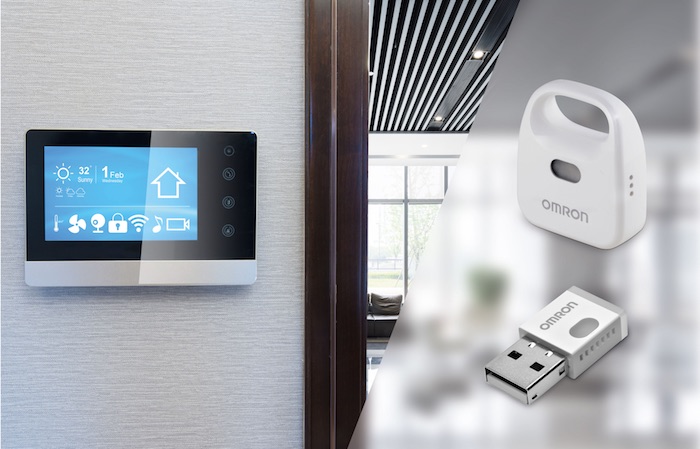
    A USB version of its multi-function Environmental Sensor that quickly allows designers to monitor seven parameters has been announced by Omron Electronic Components Europe .

    Like the previously available Omron 2JCIE-BL01 Sensor, the new 2JCIE-BU01 offers multiple sensors in one unit that has built-in memory and connectivity through beacon communication.

    Omron’s Environmental Sensor is available for the first time as a USB unit measuring just 14.9 x 29.1 x 7.0mm and can monitor temperature, humidity, light, UV, barometric pressure, noise, seismic and air quality (VOC gas). The sensor can accumulate data for approx. 3 months (based on a communication frequency of once every 5 mins) and connect to multiple devices, such as smartphones, via Bluetooth 5.0.

    Despite their compact size, the 2JCIE sensors feature their own embedded memory for data logging to keep track of the surroundings. Potential applications include monitoring and controlling both industrial and office environments to improve the work space. It is also suitable for home and outdoor applications.

    Data from the modules can be downloaded over Bluetooth (BTLE) allowing designers to easily access recorded data. The 2JCIE Environmental Sensors are cloud compatible with no need for additional hardware. Bespoke threshold values can be set to provide alerts that notify the user of any abnormal sensor readings.

    Commenting, Gabriele Fulco, European Product Marketing Manager of Omron Electronic Components Europe said, “Our multi-purpose Environmental Sensors make it very easy for the designer to deliver a wide range of measurement functions from just one small sensor. This will save development time by providing numerous options that can be tailored to the user’s needs. The USB version offers even more convenience to suit every application. Whether it’s a question of simply making sure the office environment is kept at the optimum working temperature or ensuring that say a museum has the correct humidity and lighting to protect the exhibits, these sensors offers easy to interpret data that can then be analysed, stored on the cloud and used to set parameters and make real-time adjustments.”

    Certified for all required regulations/directives in the EU, US and Japan, the 2JCIE range is FCC approved and CE marked. The BTLE link has a range of approximately 10m and the sensor has an operating temperature between -10 and 60 degrees Celsius.

    @OmronEurope  #Environment

    Wednesday, 17 January 2018

    Ultra-Fast USB load cell interface.

    DSCUSB-FQ Fast USB Load Cell Interface from Applied Measurements, promises high speed readings of 4800 samples per second.

    The DSCUSB-FQ is an ultra-fast USB load cell interface that converts a strain gauge transducer signal to a digital USB serial output at an amazing 4800 samples per second!  Thanks to its 13 bit noise free resolution the DSCUSB-FQ promises high stability with 1 part in 8000 resolution.  Making the DSCUSB-FQ fast USB load cell interface the ultimate for high speed, dynamic applications.

    The powerful toolkit software is FREE to download and connects to your DSCUSB-FQ in seconds.  The toolkit can configure, calibrate, log data and review.  It can capture and save up to 30 minutes of data at 4800 Hz which can then be saved to a CSV file for further analysis.  The logging software can provide trend charts of real-time data, FFT frequency analysis and offers a simple oscilloscope to help visual any patterns in the data.  Two point or automatic system calibrations can also be achieved in your chosen engineering units and it also allows you to select the actual engineering units that the module was calibrated in for ease of use.

    As the DSCUSB-FQ fast USB load cell interface plugs directly into the USB port of your computer it makes installation quick and easy into your application.  What’s more, it needs no additional cables as it gets all its power from the USB port.  The unit comes housed in a robust plastic case rated to IP50 making it suitable for all indoor applications.

    @AppMeas #Pauto

    Wednesday, 20 September 2017

    All-round industrial camera.

    A newly developed generation of their successful uEye SE industrial camera family is being launched by IDS. The camera will be available as both a GigE and USB 3.1 Type-C connection – in each case screw-on – as a housing version or as a board stack version, and with a broad range of CMOS sensors with rolling or global shutter. In conjunction with a comprehensive range of accessories (lenses, cables, etc.) this is an industrial camera suitable for a huge number of applications.


    The first 25 models that IDS will launch next month (October 2017) are versions with CMOS sensors from Sony (including Pregius IMX253, IMX304, IMX255, and IMX267 sensors with 8.9 and 12.3 mega pixel resolution), ON Semiconductor and e2v with rolling or global shutter.

    The housing with a C-mount lens connection has a robust design and is equipped with a special dust-proof sensor seal. The cameras have a screw-on 8-pin Hirose connector for trigger and flash – both opto-isolated – and two GPIOs, which allow numerous additional application functions in an industrial setting. All camera models are also supplied as an unhoused board stack version with C-mount front or with no lens holder. An integrated 128 MB memory decouples image acquisition from transmission, making the uEye SE particularly interesting for multi-camera applications.

    These versatile cameras are available with a screw-on Gigabit Ethernet connection or with a – also screw-on – USB 3.1 Type-C connector. The GigE models support single cable operation with Power-over-Ethernet (PoE) up to a length of 100 m. Instead of via PoE, the camera can be supplied with power using a 12-24 V power supply. The GigE uEye SE is available with a choice of GigE Vision firmware or the IDS Software Suite.

    In conjunction with IDS's proprietary driver package, the USB 3.1 Gen 1 version of this camera family also allows USB Power Delivery (PD). This enables an LED light to be operated using the USB cable, with the camera requesting the necessary power for itself and the light from the host PC via the USB Type-C interface as a PD consumer.

    The IDS Software Suite is identical for all lDS cameras, regardless of whether they have a USB 2.0, USB 3.0, USB 3.1, or GigE connection. This enables optimum use of the camera and sensor features.

     #IDS-Imaging #PAuto

    Wednesday, 23 August 2017

    Taking the strain out of USB strain modules!

    The FSU-SSB innovative fast USB strain module has been released by Mantracourt Electronics.

    Aimed at the precision-orientated Test & Measurement sector, the very competitively priced FSU-SSB is designed to thrive when coupled with dynamic, fast-moving applications that require ultra-high speed measurements. The benefits of the device are certain to be invaluable in the areas of impact, drop, vibration, materials and non-rotational torque testing.

    The FSU-SSB simply connects to a PC (via a USB port) and offers a host of features that are sure to make it the go-to product in the field. It’s seriously fast, taking 4800 samples per second, and hugely reliable with a temperature drift of only 5ppm/°C – a fraction of that demonstrated elsewhere in the sector. Accuracy is key with this speedy (and simple to setup) product. A non-linearity reading of 25 ppm sets the FSU-SSB way ahead of the pack – providing unparalleled peace of mind (and value for money) to users.

    “Accuracy and precision are what we do best, here at Mantracourt,” says Kelly Voysey, Sales & Marketing Manager at Mantracourt. “We’re always pushing the envelope, and with the FSU-SSB we’ve redefined what exactitude can mean in this sector.”

    The device is based on the popular USB strain module (the DSCUSB) which combines high stability and superior performance at a lower rate of 100 samples per second. The DSCUSB remains a perfect choice for lower speed applications.
    The FSU-SSB’s operating system builds on the strengths of its predecessors to offer superior functionality and user-friendliness. The Toolkit is free to customers – a gesture that shows the importance Mantracourt places in maintaining life-long relationships.

    The powerful, intuitive, feature rich, Toolkit has many outstanding elements. It gives real-time data-analysis, automatically calibrates and captures up to 30 minutes of data at 4800 samples per second. Innovative Scope, FFT frequency analysis allows users to visualise data and establish patterns. The Toolkit’s intuitive navigation and features, combined with key functionality (such as the ability to highlight data of interest and delete unwanted data), confirm the FSU-SSB’s position as the one to beat.

    “We’ve been leaders in this field for over 40 years. We constantly invest in people, skills, equipment and product development. That cycle is a central part of our DNA. By obsessively paying attention to details and working closely with our clients, we maximise efficiency. That’s why we can produce products like the FSU-SSB at such a great price.”

    The FSU-SSB is just the latest in a long list of innovative products that Mantracourt is justifiably proud of. “The uniquely productive ecosystem we’ve set up, here in the south-west of England,” says Kelly Voysey, “means we’ve taken the strain out of USB strain modules!”


     @mantracourt #PAuto

    Tuesday, 25 July 2017

    HART modem with power!

    A new USB HART Modem that includes a +24Vdc power supply to power HART instruments has been launched by ProComSol. The HM-USB-PWR is the newest member of our modem family and reduces connection complexity and setup time.

    Jeffrey Dobos, President of ProComSol says, “Integrating power and communication simplifies device configuration and test setups on the bench and in the field. This all-in-one package and simple-to-use design saves time and money.”

    The HM-USB-PWR only requires two connections. First, connect it to the USB port on your PC or laptop. The USB connection provides both power and the communication modem to your device configuration application. Then connect the mini-grabber cable to your HART transmitter. You are now ready to configure, adjust, test or diagnose your HART device!

    The HM-USB-ISO HART modem meets industry standards for USB connectivity. The USB interface is compatible with both USB 1.1 and USB 2.0 standards. The HART interface also meets the HART physical layer specification HCF_SPEC-54. The power supply also meets international standards. Together they deliver the flexibility and reliability you expect.

    The HM-USB-PWR includes everything you need including an integrated Loop Resistor and quick connection points for your multimeter. The device can be used in 3 modes - a modem only mode, a power supply only mode or a power plus modem mode. An included 110/220 Vac power adapter can be used to power the HART transmitter and modem when a USB port is not available.

    An easy to install Virtual Serial Port driver allows the HM-USB-PWR HART modem to be used in any Windows based application. The driver is included with every modem and is also available for download via the company website.

    @ProComSol #PAuto 

    Tuesday, 16 May 2017

    USB connectors.

    Cliff Electronics has added dual USB2.0 and USB3.0 24mm Mounting (Rectangular) connectors to its fast growing range of XLR format standard and Feedthrough connectors.

    The new dual USB XLR format connectors are available with two different housings, either a rectangular 24mm version or the Series 5 model which has a 21.9mm diameter circular design. Both feature dual USB2.0 and USB3.0 compliant sockets. Output connection header pins are configured to facilitate either direct soldering to PCBs or connection by header cable. Cliff is happy to provide customers with standard or custom designed header cables to meet individual system requirements.

    The Cliff XLR format connector range allows designers to design panels using a single standard XLR cut out to integrate data, networking, digital, optical audio and video data feeds into professional equipment for home automation and lighting, audio, broadcast and industrial applications.

    John Hall, General Manager of Cliff Electronics, commented, “We are continuing to develop our market leading range of XLR format connectors adding new connectivity, colour options and mounting panels to provide designers with a one-stop shop for system connectivity. Our XLR format connecter range is being employed in many more applications in instrumentation and industrial markets where our ability to provide custom solutions is welcomed. Using the industry standard XLR packaging offers our customers a simple to use, standard connector making panel design easier, improving flexibility and reducing cost.”

    The new dual USB2.0 and USB3.0 XLR format connectors from Cliff join the fast growing range which provides Analogue, Digital and Optical connectivity in formats including Firewire, HDMI A-A and 50 ohm BNC versions, USB2 A-to-B and B-to-A “gender change” sockets high speed USB Type – C, USB3 to USB3 in all gender changing configurations - A-A, A-B and B-A. Also available are all popular data and Ethernet connectors including USB 2.0 and 3.0, LC and SC fibre (Duplex & Simplex), UTP and FTP RJ45s in both Cat6 and Cat5e (shielded and unshielded), Toslink, RCA Phono and HDMI and blanking plates.

    The XLR format connectors are simple to mount into any panel designed to accept XLR connectors including instrumentation, control and rack panels, wall-plates, etc. Cliff now provides a pre-drilled 19” x 1U mounting panel to simplify panel design. For ease of assembly the Cliff XLR format connectors are available with standard or countersunk mounting holes. Bezels are available in 7 colours to identify the function of connectors when fitted to a control panel.

    Typical applications include broadcast, AV installations, systems integration, home theatre, automation, solar power and a growing range of industrial applications including instrumentation, industrial control and data acquisition

    #Cliff #PAuto

    Wednesday, 24 August 2016

    High-precision potentiometer input module.

    Mantracourt has launched an accurate and reliable high-performance potentiometer input module. The new DSCUSB-PT plug and play USB device has been designed to convert resistance-based input into digital output and, together with their DSCUSB Toolkit software, allows for quick and easy measurements.

    Speaking about the new DSCUSB-PT, Jonathan Purdue, Sales Manager at Mantracourt said, “This is a valuable, new addition to our signal converter range. As well as being easy to configure and use, its compact and plug and play design means it is extremely flexible.”

    This new introduction to the company's range of signal converters can be used with resistance based sensors to indicate position, rotation, angle and depth and is particularly suited to applications such as displacement measurement and angular measurement that require high accuracy. The DSCUSB-PT connects directly to a PC and, using the intuitive Toolkit software, data can be extracted from the linear potentiometer input.

    As well as being easy to set up and use, the DSCUSB-PT is extremely accurate featuring 7-point linearization and optional temperature compensation. The output is factory calibrated from between 0 – 100% but this can be scaled by the user or a systems integrator to output engineering units. For added flexibility, Mantracourt’s 24 channel logging software enables up to 24 DSCUSB devices to be monitored and data logged. A useful additional feature enables OEM level configuration and calibration to be saved and restored.

    To complement the DSCUSB-PT, Mantracourt offers its free DSCUSB Toolkit software. This software for Windows enables users to carry out a host of actions via an intuitive and icon-based navigation system. With simple to follow instructions and highlighted interactive elements, users can configure, save and restore settings, calibrate input and output and log data to a CSV file. The DSCUSB Toolkit also features a real-time, scrolling, auto scaling trend chart that holds and displays up to 10,000 points. This allows engineers to monitor input signals in real time and gives them the information needed to adjust data rates and filters, if necessary.

    @mantracourt  #PAuto

    Tuesday, 7 June 2016

    USB data connectors.

    The latest addition to Cliff Electronics rapidly expanding range of XLR-Format Feedthrough Data Connectors is a USB Type - C format socket. This new high speed connector offers system integrators and panel builders a number of useful features.

    The Cliff USB Type - C format socket offers greater flexibility and smaller form factors than previous generations of USB connectors and provides designers with an ultra-slim USB-C connector reducing the number of cables required for system interconnection. The new connector is capable of supporting higher data speeds of up to 10 Gbps, data compatible with USB 3.1. It is rated up to 100W for power supply delivery or charging portable devices. USB Type - C connectivity offers end users the potential to reduce the number of sockets per device and is forecast to be the future connector of choice for many electronic devices currently requiring multiple sockets for power, data and video connections.

    John Hall, General Manager of Cliff Electronics, comments; “We continue to find new applications for our cost effective and market leading range of Feed-Through connectors and are happy to provide standard or custom solutions for our customers. Our new high speed USB Type - C format socket offers high speed performance and future-proofs our customer’s new industrial and professional audio product designs. From our formation in 1964 Cliff has built its success on the flexibility we offer our customers many of whom are major global OEMs in the music and pro-audio markets.”

    Their growing range of feed-through connectors  are packaged in the widely used 24mm diameter XLR connector format and are available in black plastic or with a rugged die cast aluminium fascia finished in nickel or black to enhance the high quality, high performance and prestige image of this new product range.

    Other models in the range provide Digital and Optical Feed-Through connectivity in formats including USB3 to USB3 in all gender changing configurations - A-A, A-B and B-A. Also available are all popular data and Ethernet connectors including USB 2.0 and 3.0, LC and SC fibre (Duplex & Simplex), UTP and FTP RJ45s in both Cat6 and Cat5e (shielded and unshielded), USB “gender” changers, Toslink, RCA Phono and HDMI and blanking plates. Further options will continue to be introduced throughout 2016 and custom design enquiries are welcomed.

    All versions, metal and plastic, share the same features and dimensions and offer a complete range of very cost effective audio, data, and fibre connectors, all of which can both front or rear mounted into industry standard 24mm XLR connector mounting holes. The new FT Series are simple to mount into any panel designed to accept XLR connectors including instrumentation, control and rack panels, wall-plates, etc. For ease of assembly the Cliff FT Series are available with standard or countersunk mounting holes. Bezels are available in 7 colours to identify the function of FT connectors when fitted to a control panel

    The FT Series offers true feed-through connection, allowing standard cabling to be used to connect at both front and rear, eliminating the need to solder or terminate the connections and simplifying and speeding up assembly.

    Cliff’s FT series has already found widespread use in a multitude of system integration applications for custom I/O solutions. Typical applications include broadcast, AV installations, systems integration, home theatre, automation, solar power and a growing range of industrial applications including instrumentation, industrial control and data acquisition.


     #PAuto #CliffElec

    Friday, 18 December 2015

    Technical advances of USB standards.


    Mouser Electronics, has unveiled its newly designed USB Technology site, created to give engineers easy-to-access information on the latest technical advances in USB Standards.

    As part of Mouser’s growing selection of Applications & Technologies sites, the USB Technology site provides a wealth of resource material — including a new section devoted to USB Type-C™ — as well as the newest USB connectors, controllers, and related components available at Mouser.
    The USB Technology site, available on Mouser.com, contains helpful information for engineers who are interested in expanding their knowledge about USB technologies. The Product Selector section includes an Overview section, as well as tabs containing information on and links to products representing four USB standards and specifications: Type-C, Power Delivery, USB 3.1 Gen 1, and USB 3.1 Gen 2.

    USB Type-C is the latest USB-IF connector standard, which offers a new reversible connector to fit nearly every purpose. The new USB standards, used in electronic devices and cables, promise to reduce clutter, provide unprecedented inter-operability, simplify docking, and provide much faster charging.

    USB 3.1 Gen 1 (or SuperSpeed) delivers 5Gbps, up to 10 times the data transfer rate of Hi-Speed USB (480Mbps), and brings improved power efficiency to the market.

    USB 3.1 Gen 2 (or SuperSpeed 10Gbps) defines a more efficient means of data encoding to deliver more than twice the effective data through-put of existing SuperSpeed USB (USB 3.1 Gen 1) over enhanced, backward-compatible USB connectors and cables.

    The site’s Featured Products section focuses on key products available from Mouser to help engineers incorporate USB technologies into products. Some of the Featured Products include the Texas Instruments TUSB321 USB Type-C configuration channel logic and port control; the TE Connectivity USB Type-C connector; and the Fairchild FUSB300C programmable USB Type-C controller.

    The Articles section contains relevant information on USB technologies, including the Three "C's" of USB Type-C. All articles offer an area to post comments and questions to facilitate further discussions on the topic.

    Finally, the Technical Resources section lists videos, application notes, and white papers that discuss device selection and system considerations when designing USB technologies into systems. The section includes discussions on migrating to USB Type-C, incorporating USB in automotive applications, and circuit protection for USB systems.


    @MouserElec #PAuto @MouserElecEU 

    Wednesday, 18 November 2015

    USB Type-C receptacles.


    Mouser Electronics, Inc. is now stocking the USB Type-C receptacle from TE Connectivity (TE), a world leader in connectivity. This new mid-mount connector provides data, power, and audio/video connectivity and transmission in a single solution. The receptacle is fully compliant with USB Type-C specifications and is designed to be small enough for handheld devices yet robust enough for industrial applications.

    TE’s USB Type-C receptacle, available from Mouser Electronics, features a reversible mating interface designed to accept a plug in any direction, enabling easy, reliable mating. The connector supports a variety of protocols and, with the use of adapters, is backwards-compatible to HDMI, VGA, DisplayPort and other types of connections from the single USB Type-C port. The connector supports scalable power charging, delivering up to 100W at 20V, and meets USB 3.1 protocols, giving it high throughput speeds up to 10Gbps plus backward-compatibility with USB 3.1 Gen 1, Gen 2 and USB 2.0.

    TE’s new USB Type-C connector features enhanced electromagnetic interference (EMI) shielding on the receptacle shell to help eliminate unwanted EMI leakage and provide enhanced performance over similar legacy products. It also offers additional connector board retention features compared to the industry standard footprint to provide enhanced reliability and ruggedness. The receptacle is suitable for a variety of applications, including factory automation, power chargers, medical devices, automotive infotainment systems, smartphones and tablets and wearable devices.

    Friday, 6 November 2015

    USB Infra-red temperature sensor.

    The PyroMiniUSB, a new USB infrared temperature sensor from Calex Electronics, makes non-contact temperature measurement in benchtop, laboratory and education applications easier and more accessible than ever before.

    This low-cost miniature sensor measures surface temperature with 1°C accuracy and with an instantaneous 125 ms response time.

    The included intuitive, touch-friendly software provides a temperature display and a scrolling temperature chart. No configuration is necessary when measuring most non-reflective materials, however advanced software options also allow a range of partially reflective materials to be measured.

    Data can be logged to an Excel-compatible text file.

    Integration with third-party software is straightforward. The open Modbus protocol allows direct communication with the PyroMiniUSB sensor via a virtual COM port.

    “If you want to quickly take a surface temperature measurement and see it on a PC, you won’t want an expensive sensor or extra signal conversion equipment,” said Anthony Smith, product manager at Calex. “You just need a small, inexpensive sensor with a USB plug, and simple software to read the temperature. The solution is the PyroMiniUSB.”

    The sensor is built as solidly as an industrial pyrometer, with a sealed stainless steel housing that can be fixed into position with the supplied mounting nut and optional mounting brackets.

    A choice of wide-angle or narrow optics allows large or small targets to be measured at short or long distances.

    As well as general industrial applications, this pyrometer is ideal for schools (for teaching concepts such as heat transfer, emissivity and thermodynamics), universities and test laboratories.

    Friday, 31 July 2015

    Computer in your pocket!


    Mouser Electronics is now shipping the Intel® Compute Stick with Ubuntu Linux, a new generation of computer from Intel Corp. The Compute Stick is a revolutionary new device that enables any screen with an HDMI interface to become a fully functional personal computer. The Compute Stick comes pre-installed with the Ubuntu 14.04 LTS operating system. The Intel Compute Stick is a fully-functional computer in a package similar to a large USB stick.

    The new Intel Compute Stick with Ubuntu Linux, available from Mouser Electronics, is powered by a 64-bit 1.33GHz Intel® Atom™ Z3735F Quad-Core processor with 2Mbytes cache, integrated Intel HD graphics, and multi-channel digital audio. The Compute Stick plugs into any display that has an HDMI 1.4a interface. Networking is achieved with onboard IEEE 802.11 b/g/n WiFi, and peripheral connectivity is available through the Bluetooth 4.0 and USB 2.0 interfaces. Once plugged into a display’s HDMI port, the user powers the Compute Stick with a wall adapter. A status LED indicates the device is powered while both graphics and audio is provided through the HDMI port. The device can be controlled through a wireless keyboard and mouse.

    The Intel Compute Stick with Linux is available from Mouser Electronics running a custom build of Ubuntu 14.04 LTS operating system direct from Canonical, with all the latest updates. The stick has 8GBytes of eMMC Flash for user file storage and 1GByte of RAM. An Intel Compute Stick running Microsoft Windows 8.1 is also available from Mouser Electronics. Flash user storage is expandable for both versions through a microSDXC slot on the side of the device.
    Once configured, the Intel Compute Stick has all the performance and functionality of a full-sized computer and can browse the web, view online video, edit photos and files, and play music.