Showing posts with label Italy. Show all posts

Monday, 30 March 2026

Ai-ready UPS systems validation.

Artificial Intelligence has fundamentally altered power dynamics within data centers. Unlike traditional workloads with slow and predictable power variations, modern Ai creates “pulsed loads”, where processors switch rapidly between idle and full capacity. Power demand can swing from 0% to 100% and back in milliseconds, creating erratic “on-off” cycles that place power infrastructure under severe stress.

Pic: Veritiv
Veritiv has created a fully integrated measurement ecosystem from Yokogawa, anchored by the WT5000 Precision Power Analyzer, DL950 ScopeCorder, GM10 Data Acquisition System, and tied together by the IS8000 software platform.*

Luigi Balma of the Vertiv R&D team explained, “The Yokogawa ecosystem is the best solution for us because it allows us to see so many different variables - voltage, currents, DC and AC - at the same time on a single display, and coherent in time.”

Uninterruptible power supply (UPS) systems now also function as a dynamic power conditioner capable of reacting to these variable load swings in real time. If it cannot manage these pulses effectively, they can be reflected back to the grid or backup generators, threatening overall system stability or even breakdown.

Vertiv provides critical infrastructure technologies, including large power converters. Its Power Center in Bologna (I) needed to validate new Input Power Smoothing algorithms for its Vertiv™ Trinergy™ UPS systems. These intelligently draw energy from the UPS batteries during peak pulses, shielding the upstream generator from the erratic behavior of an Ai load.

The units have a sophisticated topology, featuring two AC three-phase mains and one DC battery input, and one three-phase output. Each required monitoring simultaneously. Teams needed to capture long-duration thermal data and high-speed resolutions to analyse waveform deformation, noise, and Total Harmonic Distortion (THD) during rapid switching events. Active, reactive, and apparent power also had to be characterised to fully understand power quality under stress.

With high channel counts, currents of up to 5000 A demanding strict safety controls, and a need for 24/7 reliability, intermittent anomaly capture, and long-term thermal stability logging, the instrumentation challenge was considerable.

The WT5000 Precision Power Analyzer provides primary power analysis. With a power accuracy class of 0.03% and support for up to 7 input modules, it allows Vertiv engineers to measure AC and DC power simultaneously. The instrument provides harmonic analysis up to the 500th order, essential for evaluating power quality and validating efficiency even under dynamic load conditions.

The DL950 ScopeCorder captures the transient behavior of the “pulsed loads”. Configured with 16 channels, it combines the benefits of a high-speed oscilloscope with a long-term data recorder. It captures the specific shape of voltage and current waveforms during rapid switching events, allowing engineers to identify high-frequency noise and verify the system’s dynamic response time without missing critical details.

Connecting these domains is Yokogawa’s IS8000 software, which synchronises the instruments using the IEEE 1588 Precision Time Protocol (PTP). This platform integrates data from the WT5000, the DL950, and the GM10, which monitors thermal points across the system. This setup creates a single, time-aligned dataset where thermal stress, power efficiency, and waveform distortion can be viewed side-by-side.

As well as directly enabling the validation of their patented Input Power Smoothing technology, the integrated solution has transformed the Bologna laboratory’s workflow. Being able to view thermal, electrical, and waveform data on a single IS8000 interface has significantly reduced testing complexity and debugging time. Using Yokogawa’s precision validation, Vertiv continues to develop next-generation data center technology.


* The full case study may be read here.

@Yokogawa, @Yokogawa_EU, @Yokogawa_Europe @VertivEMEA @irishpwrprocess @NapierPR #Energy #TandM #Data Centres


Friday, 7 November 2025

Thirty years celebration.

Datalogic is celebrating the 30th anniversary of its manufacturing plant in Castiglione Messer Raimondo (I). An event was held in the presence of local institutions, employees, and their families at the end of October 2025. Established in 1995, the site today stands as one of the Group’s key technological hubs, dedicated to the design and production of vision systems and solutions for logistics and industrial automation.

“We are proud to celebrate 30 years of our Castiglione Messer Raimondo manufacturing plant. From here, our products are shipped to serve the world’s largest logistics customers — from postal couriers to airports and e-commerce operators — and to provide laser marking systems and safety scanners for production environments,” said Valentina Volta, CEO of Datalogic. “The expertise, high specialization, and passion of the people working here in Castiglione will continue to be a point of reference for the future. A future that includes new technologically advanced products and significant investments to modernize our equipment.”

Founded in 1995 with the production of the Dataplus 8000 handheld scanner, the Teramo plant is now specialized in the development of 2D imaging platforms and high-performance vision systems for logistics, such as the AV900 and AV7000 linear cameras, used in industrial facilities and baggage sorting systems at airports worldwide, including Milan, Rome, Madrid, Paris, London, Dubai, Singapore, Tokyo, and Sydney. The plant also produces barcode-based solutions for parcel sorting in postal, retail, and e-commerce logistics.

In addition, the Castiglione Messer Raimondo plant manufactures safety area scanners, designed to stop machinery when operators enter hazardous zones, preventing workplace injuries, and laser markers used for product marking in the luxury and automotive sectors.

During the celebration, the company also announced its future development plans for the site, including investments in innovative products for logistics and industrial automation, greater integration of production phases, and a modernization of the facility with the introduction of state-of-the-art technologies.

A symbolic tree planting ceremony took place during the event, representing the company’s deep roots in the local community and its ongoing commitment to a sustainable future. Local authorities and institutional representatives attended a guided tour of the plant, where they were able to see the production lines and technology development areas up close.

The event also opened the company’s doors to employees’ families — a gesture dedicated to those who contribute every day to the life and success of Datalogic.

With over 2,700 employees worldwide and operations in 27 countries, Datalogic continues to invest in research, innovation, and development. The Castiglione Messer Raimondo plant remains a cornerstone of this journey, a place where local heritage meets global innovation.


@DatalogicGroup @mepaxIntPR #PAuto #Communications

Wednesday, 2 July 2025

Carbon Dioxide sensors at Biennale Venezia!

Some of its leading-edge carbon dioxide sensors  have been donated by Vaisala to the team responsible for creating a thought-provoking and inspirational exhibit at this year’s Biennale Architettura in Venice, Italy. One of the key aspirations for the project is to use trees to create an agreeable indoor climate.

Commissioned by the Flanders Architecture Institute and curated by landscape architect Bas Smets, the Belgian Pavilion will this year feature an exhibition titled ‘Building Biospheres’. 

“Climate change and the recent crises that we have faced, are forcing us to rethink the relationship between architecture and nature,” Smets explains. “Historically and traditionally, architecture has isolated itself from the natural world, recreating an indoor climate with heating, ventilation and mechanical tools. As humans we prefer the conditions of a sub-tropical climate, so our project will investigate and demonstrate what happens when sub-tropical plants such as the camphor tree are used to manage the indoor environment.”

With its inception in 1895, La Biennale di Venezia is one of the longest-running cultural festivals in the world, and now features around 30 permanent pavilions established by different countries. In 2025, the goal of the Biennale Architettura will be to eliminate waste, recycle and circulate materials, and regenerate natural systems to demonstrate that the built environment can coexist harmoniously with the natural environment.

In November 2024, a prototype of the ‘Building Biospheres’ exhibit was built at the Faculty of Bioscience Engineering at Ghent University, where Professor Kathy Steppe and her team established a greenhouse facility in which sub-tropical trees are closely monitored with TreeWatch technology. Prior to the beginning of the Biennale Architettura, all of the plants and associated monitoring infrastructure were transported to Venice and re-established within the Belgian Pavilion. Four of the key environmental measurements are light, temperature, humidity and carbon dioxide because these are the factors with greatest influence on indoor human comfort and well-being.

Explaining the potential for utilising plants to manage indoor environments, Prof. Steppe says: “In order to maintain optimal conditions inside buildings, it is usually necessary to implement some form of heating, ventilation and/or air conditioning, but this can be very costly, both financially and from a carbon footprint perspective.” Comparing and contrasting the built and natural environments, she continues, “Plants actively interact with and help regulate their local climate through processes such as photosynthesis and transpiration. This means, for example, that the CO2 produced by humans, other organisms and natural processes can be taken up by plants during photosynthesis, helping to prevent excessive indoor CO2 build-up.”

As a greenhouse gas, CO2 levels in the atmosphere are having an impact on climate change. Indoors, CO2affects the comfort and performance of the people inside a building. Occupied spaces with good air exchange may contain 450-1,000 ppm CO2 , but anything above this can induce drowsiness. Levels above 2,000 ppm CO2 cause headaches, sleepiness, poor concentration, loss of attention, increased heart rate and slight nausea. Exposure to very high levels (from oil/gas burners or gas leaks for example) can even result in fatalities from asphyxiation.

According to the International Energy Agency (IEA), the operations of buildings account for 30% of global final energy consumption and 26% of global energy-related emissions (8% being direct emissions in buildings and 18% indirect emissions from the production of electricity and heat used in buildings). The climate crisis is therefore challenging all sectors, and the building industry in particular, to find ways to lower greenhouse gas emissions. ‘Building Biospheres’ therefore seeks to investigate the opportunities presented by the integration of plants into indoor environmental management, and to engage with the architecture and building design community, to challenge traditional approaches to building design and operation.

The ‘Building Biospheres’ exhibit will serve as a living laboratory, exploring the ways in which plants can be used to complement traditional energy-intensive building management technologies. Vaisala’s CO2 sensors have therefore been deployed at different locations throughout the exhibit: one outdoors, one in the entrance hall of the pavilion and one within the plant canopy in the ‘Building Biospheres’ room, to monitor how effectively the plants help regulate indoor CO2levels.

This year, visitors to the Belgian Pavilion of the Biennale Architettura will be able to view live data from the ‘Building Biospheres’ exhibit. “This is one of the most prestigious architectural events in the world,” Prof. Steppe adds. “So, it represents a fantastic opportunity to inspire building designers from around the globe. The most obvious applications – you could call them the lowest hanging fruit! – are large buildings such as train stations and airports.”

The objectives of the Biennale Architettura 2025 align with Vaisala’s sustainability objectives, including the company’s core purpose, which it describes as: taking every measure for the planet. “We were delighted to be invited to participate in this highly respected event,” comments Vaisala’s Pekka Ravila, Vice President, Industrial Measurements EMEA. “Not just because it highlights the performance of our CO2sensors, but mostly because this represents a very exciting opportunity to help create a paradigm shift in the way that buildings are designed and managed. If we can achieve that, the potential beneficial impacts on climate change will be enormous.”

Summarising, Prof. Steppe says: "If we are to convince building designers to incorporate plants into their design, it is essential that we are able to supply them with data to support our ideas. Vaisala’s carbon dioxide sensors are therefore playing a vital role in helping us to demonstrate how plants are able to help regulate indoor CO2levels naturally, without the need for a heavy carbon footprint, and with the added benefit that the plants look great!”

Real-time data display at Biennale.  (Pic:Dirk De Pauw, Plant AnalytiX)


@VaisalaGroup @GlobalGoalsUN  @la_Biennale @_Enviro_News #Environment #Italy #Belgium

Wednesday, 31 May 2023

Acoustic Imager cuts costs, reduces waste and improves pipeline.

Air Liquide, the multi-national company supplying industrial gases and services to the health and industrial sectors has cut costs, reduced waste and boosted the efficiency of pipelines in Italy through the use of advanced ultrasonic measurement devices from Fluke.

The company has benefited from the ii910 Precision Acoustic Imager, designed by Fluke to make it easier, faster and safer to carry out high-sensitivity detection of gas, corona and partial discharge (PD). Suitable for use by operators with minimal training, the point-and-shoot device can also detect compressed air, gas and vacuum leaks, making it ideal for detecting leaks in gas distribution systems.

“Because our Syracuse refinery operates on a 24-hour basis, avoiding downtime is essential," said Sebastiano Carpinteri, Process Engineer at Air Liquide Priolo. "That means tests for leaks must be carried out as easily as possible and results analysed in the shortest time. Using Fluke’s ii910 Precision Acoustic Imager, measurements over the entire pipeline can now be assessed from a static position by just one person. The intuitive device clearly identifies leakages, enables measurements to be carried out without any kind of infrastructure required and makes it easy to produce up-to-date and accurate reports on the locations of leaks.”

Strong sustainability agenda to drive energy efficiency.
Driven by a strong sustainability agenda, Air Liquide wanted to increase energy efficiency and reduce its carbon footprint by tackling costly leaks of air and nitrogen at its dual mixed refrigerant (DMR) refinery in Syracuse (I). The company chose to carry out measurements every two years on all pipelines around the refinery – 7,000m for compressed air and 9,435m for nitrogen – as well as 5km of interconnecting pipelines. Leak detection and repair (LDAR) checks are also required every 12 months by Italy’s environmental regulator ISPRA.

With a frequency range of 2kHz to 100kHz and 64 digital MEMS microphones, the ii910 makes it possible to locate leaks rapidly, detecting a 0.005 cubic feet per minute (CFM) leak at 100PSI from up to 32.8 feet (a 2.5cm3/sec leak at 7 bar from up to 10m). The acoustic imager also incorporates a 1280 x 800 resolution (1,024,000 pixels) LCD display and offers a battery life of more than six hours in the field. Finally, by eliminating the need for secondary cables or other devices, the ii910 gives operators the ability to swap easily between detecting the leak or PD and fixing them.

Several leaks rapidly identified.
Air Liquide called on the services of Belgium-based Intero – The Sniffers who carried out all the required measurements using the ii910 acoustic imager. Thanks to highly sensitive sensors on the device that work with Fluke’s SoundSight technology, the imager’s ultrasonic signals quickly revealed several leaks on the refinery’s air pipeline and multiple leaks on the nitrogen system. This enabled Air Liquide’s engineers to take immediate action to minimise the leaks and achieve instant efficiency gains.

@FlukeCorp @NapierPR #TandM #PAuto #Italy 

Friday, 17 February 2023

Valve certified for Hydrogen applications.

Bureau Veritas Italia approval has been granted for Emerson's BM6X Series Slam-Shut valve for use in applications with up to 100% hydrogen and pressures up to 100 bar was completed in December 2022. The certification was achieved as a result of the commitment of Emerson and Bureau Veritas Italia to ensure suitable products are available for use in new hydrogen infrastructure. The certification granted to the Emerson BM6X Series Slam-Shut valve confirms the verification of material suitability, based on internal and external seal tests performed at the Emerson production plant in Castel Maggiore, Bologna, Italy.

BM6X Series Axial Flow Slam-Shut Valve
Emerson is working with its customers to develop a hydrogen ecosystem, starting with research and innovation, and scaling up production and transportation. These efforts are an important focus of the European Union’s strategy on hydrogen, adopted in 2020, and of similar efforts in other countries and regions worldwide. Certifying key components, such as the Emerson BM6X Series Slam-Shut valve, is a critical step for these types of projects.

“The Bureau Veritas procedure, relating to the issue of Type Approval for hydrogen-operated actuators and valves, defines the audit process for the issue, maintenance and renewal of the certification for actuators and valves used with hydrogen or hydrogen mixtures,” says Giuseppe Signoretta, hydrogen technical manager, Bureau Veritas.

“This procedure supports the certification of products ready to be used in the hydrogen field, and it provides a suitable tool for the concrete implementation of the European plans for energy independence and reduction of CO2 emissions. The collaboration between Emerson and Bureau Veritas demonstrates a concrete commitment to offer suitable and safe products for natural gas distribution networks,” adds Signoretta.

“To ensure product quality, safety and conformity, Emerson is collaborating with the testing and certification agency Bureau Veritas Italia, and it has developed internal procedures to assess the suitability of products to be used in gas infrastructure applications,” said Oscar Bressan, standardisation and product engineer with Emerson’s pressure management research and development team.

“The Emerson procedures describe the requirements, tests and inspection methods for metallic and non-metallic materials, as well as internal and external sealing necessary to use pressure control products in contact with natural gas and blended hydrogen, or pure hydrogen. After the first certification obtained for the Emerson BM6X Series Slam-Shut valve, Emerson will continue to certify other equipment used in hydrogen infrastructure to ensure sustainability and reliability for this rapidly developing market,” concludes Bressan.

The Emerson BM6X Series Slam-Shut valve has multiple applications throughout gas transmission networks, regulating stations and end use infrastructure. For example, natural gas transmission and distribution companies can blend hydrogen into their distribution systems, reducing emissions when the blended mixture of hydrogen and natural gas is burned in homes for cooking, heating and other uses. Industrial end users can reduce emissions by using a mix of hydrogen and natural gas as fuel for turbines used for power generation.

@EMR_Automation @Emerson_News @EmersonExchange @HHC_Lewis @bureauveritas #PAuto

Thursday, 24 November 2022

MES services in Italy upgraded.

A dedicated local team and MES & Intelligence solutions for Italian pharma companies of all sizes is now been provided in Italy by Körber . The international technology group provides the Werum PAS-X MES Suite which is recognized as the world’s leading Manufacturing Execution System (MES) for the life sciences industry.

Italy ranks as one of the key pharmaceutical production markets in Europe with a turnover of more than 33 billion euros. This production value is amongst the highest within the European Union. Italy has the biggest CDMO (Contract Development Manufacturing Organizations) industry in Europe and its biopharma segment has been growing at a staggering pace for a decade.

Already today, Körber has a strong local installed base of Werum PAS-X MES with many multinational customers. In order to be able to support Italian customers even better in the future, Körber is strengthening its local team.

“Our customers benefit from the establishment of a local, dedicated Körber team consisting of MES Consultants, Solution Architects, Project Managers and Sales & Business Consultants,” says Mirko Magrini, Senior Manager Sales & Business Consulting, Körber Business Area Pharma. “Because with our local team we are present at the locations of our customers and speak their language. Our team will continue to grow to meet the needs of our Italian customers for scalable support and a full local service offering. Our goal is to establish Körber as the leading MES provider for the pharma, biotech and cell & gene therapy industries in Italy.”

Körber has a strong local presence and extensive market knowledge in Italy and is already active in Italy with the Tissue and Technologies Business Areas.

@KoerberPharma @WerumKarriere #PAuto #Pharma #Italy

Wednesday, 6 July 2022

Optical tracking.

High-speed camera for integration into optical tracking system.

Thanks to the FLIR RS8500 superior resolution and measurement accuracy, the Italian system integrator can offer test range customers a solution to identify and track targets with the highest accuracy
Based in Sardinia (I), Nurjana Technologies provides mission-critical engineering services and system integration for the aerospace industries etc. The company has been successful in offering unique electro-optical systems for government test labs and test range applications.

Automatic target identification and tracking
The latest addition to the company’s product portfolio is the NEOS (Nurjana Electro-Optical System), a complete hardware- and software-based system for realtime optical tracking in long-range, high-precision measurement applications. The system was designed to fuse data from multiple sensors, including optical payload, telemetry, radar, and ranging measurement data. The optical payload is customized and composed of a visible-light tracking camera, a radiometric thermal imaging camera, a visible-light measurement camera, and a high-speed camera. Near-realtime data fusion and computer vision are leveraged for detecting and tracking targets in the most demanding scenarios.

“A high-resolution thermal camera was essential for this type of application,” says Davide Piras, System Engineer at Nurjana Technologies. “A thermal camera does not only allow us to see targets in dark or adverse weather conditions, like cloudy weather or rain, but we were also looking for a high-speed, high-resolution thermal imaging solution that enabled us to see smaller objects at very long range.”

Clearest target 
The company was already familiar with Teledyne FLIR thermal imaging cameras and based on the team’s previous experiences on test ranges all over the world, it was a natural decision to involve FLIR in the development of the NEOS product as well. The FLIR RS8500 high-speed MWIR camera proved to be the best solution for the application.

“We looked extensively at different camera types, but the image quality, high-speed features, and many different integration and connection options of the FLIR RS8500 made it the ideal solution to improve target visibility within NEOS,” Piras explains.

Nurjana Technologies demonstrated the NEOS system and FLIR RS8500 at select firing test range facilities and centers of excellence for experimentation in the NATO domain. The demonstrations not only showed the FLIR camera’s impressive clarity and image quality but also its superiority to visual cameras in cloudy conditions.

“Thanks to the FLIR camera, we were able to overcome adverse weather conditions, improve target visibility with a clear identification of the target’s thermal signature, and see the target in almost any weather condition,” says Piras. “We are glad to have the chance to integrate such an extremely powerful camera into our solution.”

Test range applications
Nurjana Technologies also valued the straightforward integration using a GenICam protocol, which makes it easier for integrators and end customers to control the camera system over Linux. The NEOS system with the integrated FLIR camera is customizable and available for a wide range of automatic detection, recognition, identification and tracking applications, including bomb scoring, splash detection, impact point prediction, and accurate missile, projectile and rocket tracking. A downsized version of NEOS is available for civilian applications within the domains of critical infrastructure protection and monitoring.

Since the unit is a radiometric infrared camera and the continuous metric zoom lens provides instantaneous focal length and position information on every frame, the system can also be used to capture target data, including signature and apparent temperature measurements.

@Flir @NurjanaTechnol1 @mepaxIntPR #Camera, #Aerospace

Friday, 27 May 2022

Motion control programming in manufacturing tiles.

As a material for the home, workplace, or retail environment, tiles provide a robust and durable surface that can be both practical and elegant. With earliest examples dating back to the 13th century, they last for decades with no visible loss in pattern brilliance or color fade. As good conductors of heat, they adapt to the room’s warmth and help keep your home feeling cozy. And when compared to other materials such as timber and marble, they are highly sustainable as they are made of natural material.


A core step in the manufacturing process is the application of glazes, engobe (a colored slip), and other crystalline protection. These provide adhesion to the tile body along with the required high abrasion resistance and anti-slip coatings needed for locations like restrooms and kitchens where water is present.

Companies such as E.G. Sistemi s.r.l YES! are focused on system integration for the manufacturing equipment used in today’s highly automated ceramic industry. Situated in the ‘ceramic valley’ in Maranello, northern Italy, they have recently retrofitted the multi-axis airless station with independent translators.

Such equipment is coupled with a conveyor belt that delivers tiles to the airless station where they are processed according to one of a number of recipes. Once the process is complete, the tiles are transported to the next stage by the conveyor belt. Such a dirty and dusty environment demands reliable multi-axis motion controllers and motor drives for the servos. Additionally, a robust and easy-to-use human-machine interface (HMI) is essential.

At the core of the implementation is a Delta DVP50MC series motion controller. Capable of controlling up to 24 axes in one millisecond, this solution supports both single-axis motion instructions, such as velocity, torque, and position, as well as multi-axis instructions, such as electronic cam (E-CAM) and gear. G code can also be used. On the connectivity side, CANopen, RS-232, and RS-485 are available in addition to EtherCAT for the motion control and an Ethernet port. Other signals can be wired to the 16 high-speed inputs, while eight high-speed outputs provide additional control options. The DVP50MC also supports an SSI absolute encoder and two incremental encoders to provide servo position feedback.

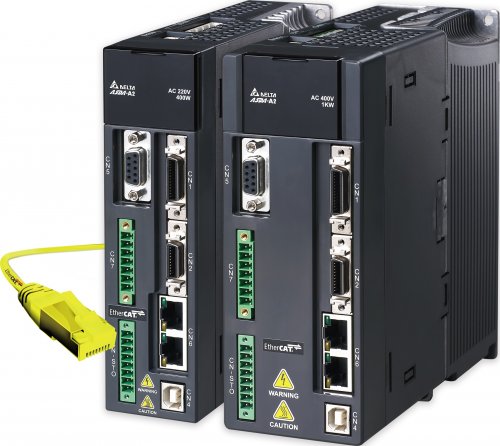
The multi-axis airless station only requires three axes for its three independent translators. To implement this, three ASDA-A2-E series servo drives with STO safety function were coupled with three 180 mm, 3 kW ECMA series servo motors featuring integrated encoders. The servo drives link back to the motion controller via EtherCAT. By combining these two components, the team benefitted from precise control provided by the 1 kHz frequency response and 1 ms settling time. This provided superlative vibration suppression for accurate material application during tile processing. A further benefit of these servo drives for this design was the support for up to 720 electronic cam (E-CAM) points in the ASDA-A2-E. The configuration software ensures that smooth interpolation points can be defined automatically, simplifying programming.

The DVP50MC is also responsible for controlling the conveyor belt. For this task, the team selected an MS300 series compact vector control drive to couple with the chosen motor. This variable frequency drive (VFD) series supports motors from 0.2 kW to 22 kW and is available in both single and three-phase options for everything from 115 V to 460 V systems. Remarkably space-saving at 40% smaller than comparable drives, the MS300 simplifies installation and wiring within the electrical cabinet. The unit is linked to the motion controller via RS-485.

Rounding off the implementation is a 15-inch, DOP-100 series HMI that enables the operator to select the correct recipe for the tiles being manufactured. Part of Delta’s advanced design offering, this display provides a narrower frame that leaves more room for displaying the input controls and system feedback. With an IP65 rating, it is more than ideal for the wet and dirty facilities of tile manufacturing and, thanks to multi-lingual support, ensures simple deployment across the world when required. Thanks to its power isolation, the display is also well protected from accidental surges caused by other equipment on the same electrical supply.

Beyond the hardware’s capabilities, the short learning curve for the software development of the DVP50MC really excited the team. Thanks to the ease of defining E-CAM and GEAR control, they completed around two-thirds of the software implementation within a single day. Furthermore, having all the elements sourced from a single supplier ensured that, should an issue arise, only a single contact was required to resolve it. “Sorting out development problems is also possible remotely,” says Giuliano Castioni, Field Application Engineer. “By leveraging our ASDASoft servo software, we could trace the source of a vibration issue back to the mounting bolts used. As a result, the customer saved much time thanks to our rapid problem resolution.”

With all the components coming from Delta, interoperability is given, ensuring a smooth development path. Such was the success of the initial four prototypes, E.G. Sistemi s.r.l YES! is working on building further machines. The combination of easy-to-program motion controllers and excellent support from Delta’s support team ensure that Maranello retains its status as the place to source outstanding tiles.

@mepaxIntPR #deltaww  #Automation #Manufacturing #Italy

Wednesday, 2 February 2022

Nonwovens manufacturer saves on checking.

An automated system to check materials, improve quality, and reduce customer claims at Texbond Srl has been installed by AMETEK Surface Vision.

Based in Italy, Texbond is a manufacturer of spunlaid thermal-bonded nonwoven products for a wide-range of applications, including personal care, hygiene, medical, furniture and design, farming, building, and motor vehicles.

Initially, the company was relying on human inspection for quality assurance of its products; however, it wanted to move to a robust, easy-to-use, automated system to improve quality, speed, and process optimization.

The medical and hygiene market in particular is extremely demanding and insists on defect-free material due to the nature of its use. Other markets also have high quality standards and common defects. For example, holes and contamination can affect the visual properties of the material.

Texbond needed a robust system that delivered high-resolution inspection in real time, along with a modular approach that uses state-of-the-art technology. Reporting capabilities, expert service support, and availability were also key requirements.

Flexible and customizable, AMETEK Surface Vision’s SmartView® system uses the most advanced inspection technologies and provides precise, real-time detection. Texbond installed two SmartView systems in the production process. One on Line 3 (colored materials) and the other on Line 4 (different weights of white nonwovens).

Each system uses four reflection transmission cameras positioned at the exit of the line and before the winder to act as a “gatekeeper,” detecting all relevant defects and contamination. The use of a white backing bar helped support contamination detection on Line 3, while SmartView’s LED lights ensured high performance when inspecting heavy material.

The systems are integrated with Texbond’s process control, for automatic start and stop of inspection, and store information for database analysis.

Spunlaid thermal-bonded nonwoven products

Enrico Chemello, Quality Manager at Texbond, said: “SmartView has really helped to optimize the quality of our products. Defects are detected and the material’s visual properties can be assessed in real time, allowing immediate intervention and optimization of the process, and the elimination of any process upsets. The result is an optimized production with reduced scrap.

“The SmartView system has met our expectations, proving its solid defect detection capabilities. The system became productive in a short time, providing images and defect information from day one.”

@surfacevision @codacomms #PAuto #Texbond #Italy

Wednesday, 1 December 2021

Fixed gas sensor for marine applications.

NevadaNano has announced a partnership with Recom Industrial in Genoa, (I),  to deliver the Gas Point Safe Zone system, their unique Molecular Property Spectrometer™ (MPS™) fixed gas sensor for naval and shipyard environments.

The Gas Point Safe Zone MPS-driven detection system reduces maintenance costs and increases uptime, protecting workers in virtually any environment where flammable gas mixtures are present. In addition to marine applications, the new standalone Gas Point detectors are ideal for use in the petrochemical, agricultural, chemical, oil and gas, airline, and mining industries.

“Recom Industrial has a proven track record in providing gas detection solutions across a wide range of industries and applications,” said Gary Collins, general manager, EMEA, for NevadaNano. “By integrating our MPS sensor technology, Recom is setting the highest standard in performance, reliability, and accuracy that will help save lives and ensure business operations continue without interruption.”

Using MPS sensors, a single Gas Point detection tool quickly detects and precisely quantifies more than12 different types of gases and mixtures, improving safety conditions. Those who work in a work environment at risk can rely on a single, extremely reliable device to warn promptly of the onset of danger. Unlike traditional models, the MPS sensor requires only a standard factory calibration eliminating the need for periodic field calibration for up to five years. With built-in compensation for temperature, pressure, and humidity, the gas sensor can detect methane and combustible gas with exceptional accuracy even in rapidly changing environmental conditions, minimizing false positives. Based on microelectromechanical system (MEMS) technology, the gas sensor device is very robust and immune to drift, decay or poisoning.

@Recom_Ind @CorridorComms #nevadanano #PAuto 

Thursday, 11 November 2021

Drives for biological purification plant.

Significant energy and cost savings have been made in the biological purification process at an Italian water plant following the introduction of variable frequency drives into the process.

Specialist water technology, design and management company So.T.Eco SpA, managed by Dr. Salvatore Barletta, introduced an oxygenation process into the Robecco sul Naviglio Water Purification Plant, close to Milan (I), after being appointed to upgrade and renovate the existing facility.

The process pumps oxygen evenly into the waste sludge which encourages the activation and growth of bacteria. These in turn consume the organic matter during the water purification process before clean water is released back into a river. However, the amount of oxygen must be varied to suit changing environmental conditions as well as the amount of sludge being processed. This is where VFD technology improves the efficiency of the process and reduces energy and maintenance costs. 

 “In biological purification plants it is important to regulate the supply of oxygen adequately as insufficient oxygenation impairs the result of purification while excessive oxygenation results in considerable energy costs for pumps or other ventilation devices,” said Roberto Giordano, Technical Manager at So.T.Eco SpA. “It can also create excessive wear on the components used which can cause maintenance costs and expensive downtime.”

Introducing Invertek’s Optidrive P2 VFD technology means the pump speed can be accurately controlled depending on the conditions and to ensure an even spread throughout the activated sludge process.

Mr Giordano said: “In order to obtain a good regulation and always keep the oxygen concentration as close as possible to optimal levels, it is necessary to avoid switching the pumps on and off. Instead, a variable-flow device was needed and we opted for the Optidrive P2 from Invertek Drives due to its accurate control functions, ease of set up and use, and, importantly, its durability. By doing this the oxygenation process can be altered precisely depending on the various factors.”

The company worked with Invertek Drives Italia / SP Electric to identify the right drive for the process. It was necessary to have a drive capable of a high torque start-up as well as being easy to set up.

Vincenzo di Giuseppe, Area Manager at Invertek Drives Italia, said: “The Optidrive P2 is perfect for a demanding environment like water purification. It’s a high-performance drive and is more than capable of dealing with a high starting torque. It can handle a 150% overload for 60 seconds as standard which makes it perfect for heavy duty applications.”

Eight 3PH Optidrive P2 VFDs were used in the application. They included two 380V, Size 5, 37kW, 72A; two Size 3, 480V, 5.5Kw, 14A; two Size 2, 380V, 4kW, 9.5A; and two Size 3, 380V, 18A, 7.5kW.

The Optidrive P2 is available in IP20, IP55 and IP66 / NEMA 4X enclosures. A new Size 8 has also been introduced capable of controlling electric motors up to 480A with a power rating up to 250kW / 400HP. The range also adds DNV marine certification, in addition to a built-in EMC filter to meet Category C3 with a factory fit option to upgrade to a high-performance EMC filter that meets Category C2. They also come with high-definition TFT displays as standard. The IP20 and IP55 / NEMA 12 both have an ambient operating temperature up to 50˚C and conform to UL, cUL, EAC and RCM, in addition to DNV.

@Invertek_Drives #Water #Italy

Tuesday, 15 June 2021

Robust connected camera-based quality system for industrial environments.

Bosch VHIT (Vacuum & oil pump products Italy) has announced that it has partnered with Lynx Software Technologies to test a new proof of concept camera-based quality program for use with real-time decision making in industrial settings. The move is part of Bosch VHIT’s digital transformation of its processes and product development.

The program captures data from cameras on manufacturing plant floors and logistics warehouses and harnesses machine learning algorithms to identify quality issues and feed information into the MES system, in order to generate an optimal decision in real time. When securely connected to the cloud, the system benefits from continued access to advanced artificial intelligence algorithms and data analytics packages.

This partnership enables the digital feedback loop that is reliant on capturing quality images and analyzing the data to provide a safe real-time action. The LYNX MOSA.ic for Industrial product enables the program to run multiple functions on a single SoC without compromising performance, security or safety.

“As we continue advancing cutting-edge technology applications for factory automation, we are excited to partner with Lynx to accelerate a new, secure IIoT-based quality system for the market,” said Riccardo Sesini, Digital Transformation Manager, Bosch VHIT. “In increasingly connected manufacturing environments, manufacturers require safe, versatile, and resource-conserving solutions. Lynx has a long history of robust, safety-critical, high-availability systems and was the obvious choice to help us realize this latest program in a safe and scalable way.”

“Partnerships such as this one with Lynx are critical to shaping our future and continuing on our path of innovation to best serve our customers,” Corrado La Forgia, Managing Director, Bosch VHIT.

For new manufacturing quality systems, Lynx’s framework is focused on ensuring security and mitigating any period of equipment downtime that could impact business output. LYNX MOSA.ic for Industrial consolidates mixed criticality workloads running on the same multicore processor - the resources and performance provided by the hardware platform, and the capability of the software components. At the same time, the framework completely isolates critical applications from non-critical workloads, in order to provide high levels of immunity to the former from cyber-attacks. Additionally, this greatly reduces the architectural complexity, cost, and number of points of failure - a critical factor in ensuring business resiliency.

“Bosch VHIT’s goal to accelerate the realization of connectivity solutions for a smarter industrial future aligns with our efforts in the space,” said Pavan Singh, Vice President, Product Management. “Providing robust edge solutions for the connected camera-based quality system will enable real-time responses to be delivered to events while ensuring critical applications run reliably and safely alongside other functions operating on the server/gateway hardware.”

This latest partnership builds upon Lynx’s growing technology partner ecosystem to accelerate the realization of mission critical edge for industrial applications.

@BoschGlobal @LynxSoftware @NeeshamPR #PAuto #IIOT

Thursday, 16 July 2020

Power analyser optimises efficiency.

Società Elettromeccanica Arzignanese S.p.A (SEA), an Italian manufacturer of power transformer and reactors is able to closely match the efficiency performance guarantee that it makes to a customer, with the actual performance of the transformer by using the Yokogawa WT5000 Precision Power Analyzer.
Founded in 1959, SEA supplies high-value assets which are expected to provide a return over decades. Quality, durability, safety and reliable performance are therefore key characteristics that customers are looking for when they specify a new transformer or reactor.

Transformers play a crucial role in the transmission and distribution of electrical energy; they precisely regulate the voltage of the electricity supply as it is transmitted from power stations to homes, offices, factories and high power consumers, such as railways. There is always some power loss when one voltage level is changed to another. In a transformer operating at transmission-network voltages of tens of thousands of volts, the loss of even a fraction of 1% of the converted power can result in losses of many thousands of Watthours of energy every year.

A primary requirement is therefore to make a transformer as efficient as possible to reduce both the financial loss and the emissions of greenhouse gases, and other pollutants, when generating the extra energy required to make up for the power lost in transmission.

The efficiency of a transformer, needs to be carefully verified before shipment to the customer; the terms and conditions of the sale of a transformer typically specify financial penalties running to tens of thousands of Euros if it fails to operate as efficiently as specified by the manufacturer.

The measurement of a transformer’s efficiency, according to the IEC60076-1 industry standard, requires an instrument capable of measuring voltage, current, phase and power (W) over a range of power factors from 1 down to 0.01.

SEA entrusts these critical transformer power measurements to the Yokogawa WT5000, the world’s most accurate precision power analyzer, which offers an AC power measurement accuracy of ±0.03% at 50 / 60 Hz and provides performance guarantees from 1% to 130% of the selected voltage and current ranges. High accuracy measurements at very low power factors particularly requires a power analyzer to possess very low uncertainty for its internal phase shift. This along with all other influences are fully specified for the WT5000, which makes it ideal for the measurement of transformer losses under no-load conditions.

Renato Franco, Testing Manager at SEA, says: “When buying an instrument intended for use over a period of many years, measurement stability is as important as accuracy.” Continuing he says: “Evidence from accredited calibration shows that the instrument not only provides us with the accuracy we need, but also maintains its performance over many years of use – this is a very important reason for us to choose the WT5000.”

SEA’s customers therefore benefit from the highest possible specified operating efficiency, which in turn gives the manufacturer a competitive edge in the market, since claimed efficiency is one of the most important factors affecting the transformer buyer’s choice of product.

Renato Franco of SEA concludes: “For us, it is vital to deliver a product that matches its high design specifications. By using the proven accuracy and stability of the WT5000 to both specify our transformers and to check their individual performance, we are confident that our customers are really getting what they are paying for.”


@Yokogawa_Europe @Yokogawa_EU @ArmitageComm #PAuto

Wednesday, 16 October 2019

Powering the food chain...

On a trip to Rome some years ago we were introduced to the extraordinary food enterprise called Eataly* - a sort of IKEA for food albeit Italian food and drink (is there any better sort!). This made this story more interesting to us.

Have you ever wondered how much work is hidden behind a glass of wine? Or how wheat is sown, harvested and transformed into a pasta dish? FPT Industrial and Eataly announce a three-year partnership to recount the food chain, from farm to table. The two companies have chosen an exceptional stage for this world premiere: Eataly Smeraldo in Milan, where, throughout the month of October, visitors can learn about the ingredients of this special story.

The special Cursor X framework in the Eataly Smeraldo store in Milan

The Milanese store is welcoming visitors in a tailor-made setting representing vine shoots to celebrate the month of wine. Cursor X - the engine concept of the future, a symbol of how FPT Industrial conceives technology, innovation and sustainability - is displayed hanging from Eataly Smeraldo's stage, among the roots of a vine tree. The engine, designed for Planet Earth and for greener agriculture, is Multi-power, because it can be powered by natural gas, electric batteries and hydrogen; Modular, easy to install and quick to maintain; Multi-application, adapted to any vehicle and mission; Mindful, capable of self-learning, predicting and programming its own maintenance. The set-up has been designed to be sustainable as the emissions for its production will be offset by the planting of trees.

From seeds to high-quality food on our tables, FPT Industrial and Eataly divide the story of the virtuous production process in the store into four thematic areas dedicated to typical products of Italian cuisine: wine, pasta, tomatoes and cheese.

With its engines, FPT Industrial helps to plant, harvest and deliver high-quality products to our table, placing sustainability at the heart of its research. Throughout its history, the Brand has been a key player in the changes of agriculture, thanks to its innovative and increasingly environmentally friendly engines.

Today, 40% of the wheat and 80% of the wine grapes in the world are harvested thanks to machines powered by FPT Industrial. “The partnership with Eataly is one that once again makes us proud of our products and our mission, because we can recount and explain the role of our engines along the entire food chain”, says Carlo Moroni, Head of Communication for FPT Industrial. “From farm to table, FPT Industrial is the sustainable and innovative engine of agriculture”.

“The earth is tired. Therefore, technologies that express environmental responsibility are very welcome”, explains Francesco Farinetti, CEO of Eataly. “The agricultural sector production chain is witness to virtuous changes through technologies that express respect for the environment. If we can also do our small part by telling our customers about these new frontiers, then we do it very willingly. For us, the ideal scenario is to innovate while preserving traditions”.

The story of this chain is also broken down into two events at Eataly Smeraldo. The first one will be held on October 18th at 6:30 p.m. with Chiara Maci, the new TV face of Food Network with the series "L'Italia a morsi", presenter of the show "Cuochi e Fiamme" and author of various cookbooks. She will be the key figure of a cooking show that will engage the public in the preparation of original dishes.

I'm hungry already.... Sláinte!

* We understand that their are branches of Eataly in the USA and possibly in other countries.

@FPTIndustrial @EatalyIT #Food #Italy

Wednesday, 2 October 2019

Automation users from Europe, the Middle East & Africa to meet in Milan.

The largest-ever Emerson Global Users Exchange in Europe will be taking place in Milan (I) next year (2020).
The biennial conference is scheduled for the Milano Convention Centre from March 18 to 20, with current and potential users of Emerson automation technologies, products and services attending from across Europe, the Middle East and Africa. The theme for the event is ‘Discover, Design, Deliver’ and delegates will be able to learn how the latest automation technologies can help in digitally transforming operations and improving asset efficiency.

The Emerson Global Users Exchange, Europe, Middle East and Africa is organised to help delegates extract the most from their automation investments and share their learning with each other. Shaped by users, for users, the event in Europe is managed by a board of directors, comprising Emerson users from a range of industries, along with Emerson facilitators and hosts, who formulate conference content and guide the direction of the users’ group at large. In total, more than 4,500 delegates have attended previous Global Users Exchanges in Europe, 90% of whom said they would recommend a colleague to attend the conference.

• Our account of the previous EMEA EMrex (in the Netherlands 2018)
An unprecedented number of presentations have been submitted by users – more than 300 in total, from 30 different countries. This is an increase of 25% over previous Exchange conferences held in Europe, demonstrating the significant level of interest in the 2020 event. Representatives from 15 industries, including food and beverage, oil and gas, chemical, power, pharmaceutical and discrete manufacturing, will deliver presentations on current project solutions and application successes. This includes companies such as ADNOC, BASF, BP, Dow, EDF Energy, Equinor, GE Healthcare, Novartis, SABIC, Shell, Södra Cell, Total and Yara.

“The fifth Global Users Exchange in Europe will be the largest and most innovative to date,” said Roel van Doren, group president of Emerson’s Automation Solutions business in Europe. “It will offer a greater opportunity for delegates to discover new technologies, services and work practices, before returning to their companies armed with the knowledge to deliver improvements that can increase their business performance.”

Roel Van Doren.
Highlights include keynote addresses by Roel van Doren; Richard Mortimer, VP engineering, Global Projects Organisation at BP; and Vidya Ramnath, president of Emerson’s Automation Solutions business in the Middle East and Africa. User presentations from 20 subject tracks will focus on topics including addressing industry losses and meeting business performance targets; dramatically enhancing safety and compliance; reducing capital and engineering costs; increasing profitability through effective energy management; making sustained improvements through process optimisation; justifying a predictive maintenance programme; creating successful system migration and lifecycle management paths; and solving difficult measurement and control challenges.

Participants can choose from 25 certified training courses to extend their range of skills and enhance their personal and career development. Courses include cybersecurity best practices, implementing DeltaV™ Version 14, and energy management strategies for process plants.

Delegates can create a free account on the Emerson Global Users Exchange Europe Middle East and Africa website, enabling them to view details of all the user presentations in advance. The personalised account offers options to ensure participants gain maximum value from the conference, with suggestions for personalised itineraries based on the most relevant presentations from the subject tracks matched to the specific needs and interests of each attendee.

The event will also feature an 8,000 square-metre solutions expo – the largest ever at an Emerson Global Users Exchange in Europe. The expo will include hands-on demonstrations tailored to each delegate’s job specification. A highlight of the expo will be a demonstration of the incredible potential of digital solutions for improving shutdown, turnaround and outage planning and execution. Delegates will be able to enjoy an immersive 360-degree video and virtual reality experience. The expo will also feature over 30 technical partners, including Cisco, Microsoft and Informetric.


#PAuto  #EMEA #EMrex @EMR_Automation @Emerson_News @HHC_Lewis

Thursday, 27 June 2019

New head at connectivity and sensors company in Italy.

TE Connectivity (TE), has appointed Nadia Iannuzzi as vice president and general manager for its Systems subvertical, effective July 1. She will report to Lars Brickenkamp, senior vice president and general manager, in TE’s Industrial business unit.

Nadia Iannuzzi
Iannuzzi takes over for Guanghua Yang, who is leaving the company to pursue other opportunities. Yang will be supporting the transition until he leaves the company at the end of July.

“Nadia Iannuzzi will be responsible for driving further synergies, increasing capabilities and driving growth within our Systems organization, as we mature into a true end-to-end solution provider to our customers,” says Brickenkamp.

Iannuzzi has been with TE for more than 15 years, holding a variety of leadership roles in pricing, customer care, general management and human resources in multiple business units, including Industrial. She was most recently VP for HR Solutions, EMEA (Europe, Middle East and Africa) and Americas. She holds a bachelor's degree in Business and Administration and a master's degree in Business and Marketing from the University of Turin (UNITO) in Italy.

 @TEConnectivity #PAuto #Italy

Wednesday, 19 June 2019

Improving odour treatment plant efficiency.

With environmental legislation in relation to odour management becoming increasingly more stringent, Italy-based Technologia & Ambiente (T&A) has purchased a Falco fixed, continuous photoionisation detector (PID) from Ion Science Italia – leading manufacturer of gas detection instrumentation for environmental and occupational health monitoring applications – as a key component of its newly developed Online System for Monitoring Odours Treatment Efficiency (OSMOTREFF).

T&A was established in 2010 as a division of the Polytechnic of Bari (I). The company offers a wide range of environmental services including waste management, reclamation of polluted sites and treatment of waste water and emissions. Backed by highly qualified staff including industrial chemists and environmental engineers, T&A can offer tailor-made solutions for complex applications in chemistry and environmental engineering applications.

T&A’s OSMOTREFF is a pilot system specially designed to analyse odour treatment facilities. Once connected to odour treatment plant using physical chemical absorption, such as chemical scrubbing and activated carbon filtration, the innovative OSMOTREFF provides on line monitoring of treatment efficiency and can conduct pilot tests on effluent gases to help further improve the process.

The odorous compounds contained in conveyed gaseous flows are difficult to monitor continuously because of their multiplicity, the peculiarity of the specific application and the sampling and analysis methodology.

Ion Science’s Falco PID is installed on T&A’s OSMOTREFF and represents one of the key components of the system. It provides continuous, online measurement of volatile organic compounds (VOCs) in both inlet and outlet conveyed gas streams that have odour problems.

T&A’s Roberto Pisconti comments: “Odorous molecules are typically found in VOCs with a market tendency to be present in the vapour phase. Many VOCs contained in gas streams generate odours and, for a given process, in most cases there is a direct correlation between the concentration of VOCs and amount of odorimetric units in accordance with European Standard EN13725, Air quality – determination of odour concentration by dynamic olfactometry.

“Once this correlation has been determined, a Falco PID can be useful for easy online monitoring of VOCs and indirectly of odorimetric units on outlet conveyed gas streams.

“In Italy, a new legislation with specific odour limit thresholds has also been recently introduced making it ever more important for companies that have treatment in their processes to monitor and improve the treatment efficiency of their systems in line with regulatory requirements.

“Ion Science and its products are well known across our business so we were confident in the Falco’s ability to reliably and accurately measure VOCs in both inlet and outlet gas streams,” he adds.

Most gas streams cause condensation. Although T&A’s OSMOTREFF incorporates a feature that can dilute the gas sample in order to avoid condensation, it can still occur making it essential to have an instrument with condensation resistant design.

A 0-3000 parts per million (ppm) detection range can cover most petrochemical applications. For other applications, 0-1000 ppm may be suitable.

The Falco PID operates in conjunction with T&A’s OSMOTREFF system with a pilot test on conveyed gas streams taking from two hours up to several days, depending on the application requirements.

Roberto Pisconti concludes: “Since Ion Science Italia provided training, we have found the Falco very easy to use and operate, and it has been excellent in terms of accuracy and reliability. The service has also been very good and they were quick to respond when we needed assistance with calibration. ”


 @ionscience #Environment #Health  @elhcomms #Italy

Friday, 2 November 2018

Digital MES platform for Italian site.

Aegis Software tells us that Elettronica GF (EMS) has chosen Aegis’ FactoryLogix® digital MES platform, for their manufacturing facility located in Faenza (I).

As material supply issues in the market threaten the completion of schedules in many factories across the electronics manufacturing industry, Elettronica GF steps boldly forward, supported by Aegis’ FactoryLogix software, to ensure continuous accuracy for material allocation, consumption and spoilage accountability throughout the factory, enabling certainty for completion of planned work-orders, full traceability of materials and process, representing a critical enhancement of their ERP system in supporting fast and accurate material procurement for flexible manufacturing.

Gian Franco Argani, Senior Electronics Designer / owner, Elettronica GF commented, “Seeing the current market trends towards Smart manufacturing as well as for potential material supply issues, we immediately recognized the advantage of bringing in one solution that helps resolve both of these issues, keeping us ahead of competition in terms of meeting our customers’ expectations and requirements, both immediately, and long-term.”

Daniel Walls, European Managing Director, Aegis Software stated, “Being in control of all aspects of Production mandates complete visibility, including execution, materials and test. FactoryLogix provides active, intelligent interfaces, coupled with software intelligence to support immediate decision-making by manufacturing and supply-chain managers, engineers, and business systems.”

Antonio Grassino, President, Seica SpA commented, “Elettronica GF is setting a great example for companies across Italy, and the rest of Europe, demonstrating how the focus on the customer, leads business to success. Being proactive to quickly adopt the best solution, avoids unnecessary compromise.”

With Aegis’ FactoryLogix software as an integral part of their manufacturing and supply-chain technology, with full local support being provided by Seica, Elettronica GF and their customers are positioned to enjoy the rewards of genuine Smart factory values.

@FactoryLogix #Electronics  #MES

Wednesday, 12 September 2018

Enabling digital transformation.

Multisite automation investment to help FIS improve efficiency, quality and compliance of manufacturing operations

R&D at FIS Montecchio
FIS – Fabbrica Italiana Sintetici, a leading active pharmaceutical ingredients manufacturer, has selected Emerson to digitise operations and work processes at three manufacturing sites in Italy. With the €16.1 million (US$20 million) contracts, Emerson will provide automation technology to help create a fully electronic manufacturing environment for increased efficiencies, quality and regulatory compliance.

“It is vital that FIS develops the right relationship to help it expand operations in a measured and prudent manner,” said Franco Moro, general manager of FIS. “Working with Emerson provides FIS with a trusted partner as we digitise work processes and invest in automation to improve production and efficiency.”

As part of its growth strategy, FIS constructed a new $123 million (€100 million) unit at its Termoli site, doubling capacity to produce active pharmaceutical ingredients. Emerson will implement its Syncade™ manufacturing execution system at the Termoli site, as well as the Montecchio facility, providing automated workflows and paperless procedures and record-keeping. Paperless manufacturing improves production efficiency and offers widespread benefits in compliance, product quality, inventory and document control, which are critical in the highly regulated pharmaceutical industry.

The two leading companies have partnered before; Emerson provided its DeltaV™ distributed control system to monitor and control manufacturing at the Termoli site in 2017. As part of this latest agreement, Emerson will expand the automation system to incorporate additional measurement and control instrumentation. By standardising on DeltaV across its Termoli, Montecchio and Lonigo sites, FIS aims to improve efficiency and ensure consistent operations.

“This project reinforces Emerson’s strong relationship with FIS, and, as a trusted advisor, we will continue to support its business objectives on a long-term basis,” said Mike Train, executive president of Emerson Automation Solutions. “Our expertise will help FIS further automate work processes and boost profitability across these three sites as part of a companywide digital transformation strategy.”

The contracts are part of a 10-year strategic framework agreement signed with Emerson for the supply of its DeltaV and Syncade systems, measurement instrumentation and control valves, as well as a 10-year service agreement that covers the control systems at all three sites plus the new MES systems at Termoli and Montecchio.

@EMR_Automation #PAuto #Pharma @Emerson_News #Italy

Wednesday, 21 March 2018

Partnership supporting Industrie 4.0.

Aegis Software has announced their partnership with SEICA Italy, a global supplier of intelligent automatic test equipment and selective soldering systems, consolidating Aegis’ and Seica’s mutual vision to support Italian and EU government-driven environment sustainability and Industry 4.0 digitalization initiatives.

SEICA is a progressive company with a strong digital vision for Industry 4.0, providing a complete range of connected manufacturing equipment solutions that provide unique value into diverse market sectors. The combination of Aegis FactoryLogix digital MES software and Seica equipment is the perfect way to deliver true digital innovation into the market, with a focus on energy management, production efficiency, and sustainability.

“Industry sectors such as telecommunications, automotive and IT, to medical and avionics are urgently looking for digitalized solutions that enable them to reach the next level of manufacturing performance with Industry 4.0, and as such, Seica is the perfect company to act as a representative for Aegis and its expanding customer base in Italy” said Stephan Häfele, Senior Director of Sales and Business Development for Aegis Software.

Aegis attaches great importance to providing its customers with exceptional sales and service support ensuring the reliability and quality of its products. This partnership will ensure that customers with a requirement for true Industry 4.0 and energy management solutions, integrating digitalized engineering, manufacturing, quality and supply chain, particularly where the demands for compliance, control and traceability are essential, will be well catered for.

“The partnership with Aegis allows us to offer the unique solution that the industry needs, the right combination of hardware and software for the next generation of digital factories with environment awareness,” stated Antonio Grassino, President of Seica.

 @FactoryLogix  #PAuto #Seica #Italy #Europe