Showing posts with label Motion Control. Show all posts

Monday, 23 March 2026

Motion control and PLC.

The new Trio Motion-PLC series, availablle from Mclennan, offers a powerful solution as an EtherCAT servo controller for synchronised motion with PLC integrated machine control. As a perfect fit for Mclennan’s motion system design and build service the new Motion-PLC is offered in three model configurations with feature enabled codes (FECs) that competitively address low- to medium-axis count requirements for applications from simple point-to-point positioning systems to complex, tightly synchronised multi-axis stand-alone machines. An integrated slice interface and dedicated expandable digital and analogue I/O slice modules complete the system with programming via IEC61131-3 or TrioBASIC and Trio’s Function Blocks software.

Trio’s Motion-PLC range combines MCS series motion controllers and MS series I/O slice modules. The MCS-30 offers up to 4 motion axes with simple control for point-to-point positioning whilst the MCS 40, along with the higher-performance MCS 50, are 'Flexible Machine Controllers' that will address more complex axis-and machine-synchronised tasks. With the capability for rapid machine development, all MCS series servo controllers feature a slice interface that facilitates seamless integration of Trio’s MS I/O system which supports up to 16 variously configured slice modules of 16 digital inputs or outputs, or blocks of 4 analogue inputs or outputs. Trio’s MS I/O slice modules can also connect to an EtherCAT coupler for flexible integration. The DIN-rail front mounted system features spring clamp connectors with push-button removal that make wiring fast, facilitating quick and flexible machine set-up.

MCS series motion controllers are based on the ARM Cortex A55 processor with a 600MHz clock frequency and 64-bit position register precision for exceptional motion and machine synchronisation, and motion cycle times to 1 ms. The multitasking operating system includes a comprehensive motion library, offering capabilities such as electronic gearbox, axis to axis interpolation, mathematical functions and I/O interaction. Programming is efficiently accomplished using the TrioBASIC motion language or IEC61131 standards. Setup and diagnostics are facilitated through Trio’s Motion Perfect software. The MCS-40 and -50 also supports Uniplay, Modbus TCP, PROFINET IO, and Ethernet/IP protocols. Software tools are available for cam profile generation, robotic kinematic transformations and CAD path conversion, further supporting minimum application development timescales.

This versatile motion control system ensures seamless integration with Trio’s DX series distributed servo drives covering power ranges from 50W to 7.5kW in a choice of three model variants. Complete standalone machine operation can also be realised with Trio’s UNIPLAY HMI 7” and 10” colour touch screen displays.


@TrioTech @mepaxIntPR #McLennon #PAuto 

Tuesday, 20 January 2026

Safety-critical motion control.

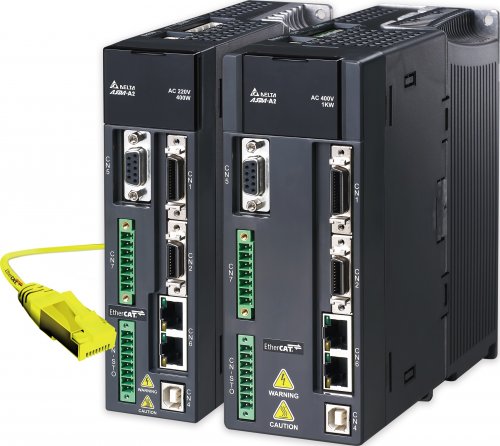
The latest addition to its Delta's ASDA-A3 series of high-end AC Servo Systems, the ASDA-A3-EP model is designed for high-performance applications that require advanced operational safety. Compliant with standards including IEC 61508 (SIL 3) and ISO 13849 (PL e), it features a built-in Safe Torque Off (STO) functionality, as well as an optional extended safety card that offers thirteen advanced safety functions, including SS1, SS2 and SOS.

Commenting on the introduction of the ASDA-A3-EP servo drive, Stephen Hu, Head of Product Management Team EMEA, said: “The servo drive and motor are the primary interface between automation and machinery, which means that safety must be our top priority. Delta’s commitment to it is reflected in the drive’s compliance with the latest safety standards, the STO functionality, and the inclusion of safety functions including SS1, SS2, and SOS. The ASDA-A3-EP is equipped to successfully navigate even the most demanding market major challenges, while remaining safe, simple to integrate and to use.”

Developed for the needs of machine builders, the ASDA-A3-EP servo drive is also well-suited to system integrators and application providers. Its user-oriented design delivers benefits ranging from simplified integration to flexibility and competitive costs, thanks to the rapid device setup and installation time, which enables it to swiftly deliver measurable value to users. The safety card function adds a new dimension to the solution, ensuring that it can meet the requirements for future machinery development and integration with maximum safety for human operators. They also benefit from safety features that drastically shorten the reaction times between the motion end effector and human action.

The servo drive’s design specification and functionality is the result of deep cooperation with high-end machine builders. Their experience and feedback informed the development of the ASDA-A3-EP platform, which enables it to meet the needs of premium machine builders across central Europe, North America, and Asia.

The ASDA-A3-EP features EtherCAT interface - with extended sub-protocols FoE, EoE and FSoE - and the drive is also equipped with a TCP/IP port and support for IoT nodes. Leveraging EtherCAT's high-speed communication, the ASDA-A3-EP transmits Ethernet data and files directly to enable faster communication. The FSoE allows high reliability with robust error detection and validation mechanisms. For added flexibility, the servo drive can integrate third-party motors if necessary, while the safety function can be activated easily using a simple digital wired signal.

It has been developed to be easy to set up, while users also benefit from the considerable attention paid to human interaction with the motion application. Its total cost of ownership is reduced thanks to advanced connectors in the drive, which can be further reduced when combining with Delta’s battery-free motor. The streamlined wiring also reduces machine downtime and helps maintain production rates.


@DeltaEMEA @mepaxIntPR #PAuto #Motion

Monday, 5 January 2026

Controlling complex, multi-axes robots with ease.

In 2008 PLCopen released Part 4 of the Motion Control suite of specifications, dealing with coordinated motion, for example robotics. Basically, with this specification one can control a robot in the PLC or one can see it as an interface to a robotic controller, which will do the calculations and movements. Especially for this last option feedback was received from robotics companies with specific requirements, which resulted in a Corrigendum and is the basis for version 2.0 of this specification.

The PLCopen Motion Control Part 4, version 2.0 - Release for Comments can be downloaded from their website. They look forward to receiving feedback and comments on this document by February 18, 2026 latest.

Also, with the release of the Standard Robot Command Interface, SRCI (within Profinet International), which is based on this document, a merger of both specifications was proposed. The current update of PLCopen Motion Control Part 4 reflects this merger. As such, the original PLCopen document is extended with new function blocks, as well as information on position, trajectories, changes in transition and buffer modes. The updated Part 4 retains the key functionalities from the SRCI but presents them in the well-known PLCopen look & feel. Retaining about 10% of the original size, while preserving 80% of the essential features.

Profinet International (PI) released version 1.3 of the Standard Robot Command Interface (SRCI) in November 2022, supported by many robot vendors. This specification is based on PLCopen Motion Control Part 4 and provides an interface to remote robot controllers. For this, our Part 4 was extended with the knowledge from the community of robot vendors, as many of them were involved.

The SRCI specification adds configuration functionalities and defines an interface to the different robot vendors. The essence of PLCopen is to incorporate these missing functionalities in the PLCopen Motion Control standard while maintaining the same Look & Feel by providing backward compatibility. Also, these functionalities need to be mapped to the defined interface and network. As such it is not restricted to Profinet as network.

The objective of the update of Part 4 is to define a set of extensions to “Part 1 - PLCopen Function Blocks for Motion Control”, focused to the coordinated multi-axes motion in 3D space, to serve most user’s application needs in this area. A key addition in this part is the kinematic model, linking the different axes to a mechanical construct and as such defining the movement of the relevant endpoint.

Implementations can include architectures with integrated solutions or remote connections to an intelligent controller like a dedicated robot-controller, which includes the kinematic model and specifics for the application like welding or moving parts. The goal is to provide a programming interface to the user that hides as much as possible these different implementations, making the development of the application software as independent as possible from the underlying architecture.

The PLCopen Motion Control Function Blocks are specified at such a level that the user quickly recognizes the functionality and that the effect of the activation and of sequencing with other function blocks is clear. Path oriented movements are programmed either with specific robot-oriented programming languages, or “G-code” (for instance cf. DIN 66025) as used in the CNC world. But without a doubt, the movements which can be described in these languages are applicable to a broader area of use. This PLCopen initiative transforms the functionalities known in the CNC and Robotic world to the PLC world. With this, an additional part is added to the range of PLCopen Motion Control specifications. 


@PLCopen #PAuto #PLC #Robotics

Thursday, 20 November 2025

Device for industrial motion and IOT applications.

Festo has added the first edge device to its range of AX Controllers. CEPE is a high-performance industrial PC and control unit designed for industrial motion and IoT applications. It uses the Festo AX operating system (OS), which is based on PLCnext Technology and offers an open ecosystem for modular automation and easy programming.

CEPE is designed to control and automate assembly lines and machines, as well as production processes. Highly configurable, CEPE enables the programming and monitoring of production processes, including motion applications such as pick & place, palletising and servo presses. It can also support machine visualisation and IOT data acquisition and analysis.

Ben Lloyd, Festo’s Product Manager‒Electrical Automation, says: “End users and machine builders are under constant pressure to meet new production demands and shorten development cycles. Automation provides the answer, but it involves integrating multiple functions, such as control and motion, AI, data integration and evaluation, and predictive maintenance into applications simultaneously. The addition of CEPE to the Festo AX platform makes this process easier than ever.”

Festo AX Controls combines many software modules, such as operating system, motion, visualisation, high-level languages and low code development tools through to commissioning software with a scalable hardware platform. The AX suite consists of the Festo AX OS, Festo AX Motion control software, Festo AX Machine Visualisation software and now the CEPE edge controller.

Easy integration.

CEPE combines high processing power with a wide range of interfaces and software functions. It can gather and analyse local data, program its own applications and install third-party applications via various app stores. Thanks to its Linux-based operating system, users are also free to develop their own applications using familiar platforms like C++, C#, Python or the IEC61131 family.

Equipped as standard with an Intel i3 processor and a wide range of communication interfaces such as Profinet, Ethernet/IP and EtherCAT or Festo's own AP network, the CEPE edge controller can be optimally connected to different control architectures. Festo's entire electrical and pneumatic portfolio can be seamlessly integrated using this device, so customers can always use the right technology for their application. OPC UA is included for secure, cross-platform and interoperable data exchange in industrial automation and control systems. Combining industry-proven hardware with open control architecture, the CEPE offers many development options for different software applications.

Wider benefits.
Festo AX OS is based on PLCnext technology from Phoenix Contact. Developed specifically for industrial environments, it enables real-time applications, programming with modern programming languages and seamless cloud connectivity. The containerised runtime environment enables an open and modular software architecture and the integration of modern AI-based software, as well as robust cybersecurity. This creates the basis for accessing, evaluating, archiving and reusing valuable process data.

It amplifies these benefits, enabling users to develop individual solutions and seamlessly integrate existing systems to meet the requirements of various industrial applications. Development cycle efficiency can also be increased through the use of open source software and apps, with no limits to future extensions.

The company already provides a wide selection of apps, including CODESYS, Multi-axis motion, Python, Node-RED and the proprietary Festo AX Industrial Intelligence, a powerful AI predictive maintenance tool. All these software apps and licences will be available via the Festo online catalogue or for purchase via the growing PLCnext Store in future.

“The combination of Festo and PLCnext technology is focused on a common goal: helping our customers to meet the challenges arising from the convergence of IT and OT through open automation solutions,” concludes Ben Lloyd.


@FestoGB @festo_global @Publitek #PAuto #Manufacturing

Friday, 19 September 2025

New CPUs, I/O module and couplers.

The launch of new Motion Controllers CPUs, Input/Output modules, and Couplers for Delta's AX-5 Series has been announced. Designed for machine builders, system integrators, and distributors across sectors such as packaging, assembly, woodworking, and metalworking, these enhancements deliver greater flexibility, performance, and scalability—empowering customers to stay competitive in the fast-evolving IIoT era.

“The direction of Industrial Automation is being shaped by the rise of AI, IIoT and the growing convergence between the industrial and IT world”, said Alessio Villa, Product Manager EMEA Delta. “With our new AX-5 Series Motion Controllers CPU’s, we’re responding directly to market demand for connected, high-performance, and flexible solutions. This release reflects Delta’s ongoing commitment to anticipating market shifts and helping our customers prepare for the future.”

Delta’s Advanced IIoT Motion Controller CPUs of the AX-5 Series are ideal for production line equipment and can simultaneously control servo drives, AC motors, remote I/O modules, and other motion devices. It supports PLCopen motion control instructions and includes Delta’s exclusive motion commands for seamless servo and AC motor integration. A compact, 12 mm ultra-thin I/O modules design minimizes cabinet space, while an independent I/O power supply simplifies wiring for stable operation and easy expansion. The controller also includes IIoT features such as MQTT, FTP and OPC UA—helping customers cut down on hardware and development time.

New Motion Controller CPUs.
The enhanced Motion Controllers set a new benchmark in automation control, offering high-speed performance and built-in hardware interfaces—including dual Ethernet ports, USB, and an SD card slot. With native support for multiple industrial protocols (EtherCAT, CANopen, CAN, PROFINET Controller/Device, Ethernet/IP Scanner/Adapter, and Modbus TCP/RTU), no additional modules or licenses are required—ensuring seamless integration, reduced costs and greater operational efficiency.

New Input/Output Modules.
The new I/O modules significantly expand the AX-5 Series' application range. Ideal for complex environments, they include a high-speed counter, positioning module, and load cell module for precision control and measurement. Maintaining the 12 mm slim design, they offer removable connectors and built-in diagnostics for easy wiring, setup, and maintenance.

New PROFINET Couplers.
With PROFINET now used in 27% of device nodes in industrial automation, the new coupler enhances the interoperability of the AX-5 Series—enabling fast and seamless integration with third-party controllers and full compatibility with AX-5 I/O modules.

The new CPUs, I/O modules, and PROFINET couplers for Delta’s AX-5 Series will be available across EMEA starting September 2025.


@DeltaEMEA @mepaxIntPR #PAuto#HMI.

Tuesday, 19 September 2023

Stepper drive.

Kollmorgen has introduced the P80360 stepper drive, the newest addition to the company’s flagship P8000 stepper platform.

“The newest drive in our P8000 series is a game-changer for engineers looking to achieve the greatest precision and control in a stepper system,” said Ross McMillan, vice president of engineering at Kollmorgen. “We’ll be introducing even more stepper drives with exciting feature sets in the near future, so stay tuned."

Like other drives in the series, the P80360 incorporates innovative stepless control technology to deliver smooth, quiet motion and optimal performance across the full speed range. Additionally, the P80360 stepper drive offers closed-loop position control and is fully programmable, enabling servo-like versatility, precision and repeatability in a stepper drive.

In addition to open-loop stall detection, the P80360 drive offers the ability to track load position via encoder feedback and automatically correct for any overshoot or undershoot errors. Closed-loop position control is useful, for example, in systems where gearing, couplings or heavy loads result in compliance that can cause motor missteps. By correcting for these position errors, the P80360 actively minimizes the risk of scrap or equipment damage. This feature has the added benefit of improving efficiency, so the motor doesn’t consume as much electricity and runs cooler.

The P80360 drive is fully programmable via an intuitive graphical user interface and programming language, available within the Kollmorgen Space software package offered as a free download on the Kollmorgen website. Using these tools, engineers can create simple point-to-point movements as well as linked motion sequences with ease. The versatility and functionality of the P80360 programming software eliminates the need for an external PLC or indexer to perform single-axis motion control, reducing overall system cost.

Kollmorgen Space software also includes a Motor Wizard that enables users with Kollmorgen motors to get their machines up and running faster, requiring only input of the initial profile velocities and acceleration times.

All P8000 series drives are backed by Kollmorgen’s world-class support and expertise, from motor and drive selection and sizing to assistance with setup and troubleshooting. All drives feature CE, RoHS and REACH certifications.

The P80360 stepper drive can be used with all stepper motors with phase current up to 3.0 Arms. It is ideal for labelers, indexing tables, CNC machines, XYZ gantry systems such as 3D printers, packaging, medical lab equipment, pumps and many other applications requiring simple point-to-point movements as well as linked motion sequences.


@AboutKollmorgen @mepaxIntPR #PAuto

Thursday, 22 June 2023

Motion control from from 4 to 64 axes.

Delta has  launched the AX-304EL, AX-316E, and AX-364EL motion controllers to complement the existing AX-308E motion controller. AX-3 series motion controllers offer a CODESYS development environment to enable intelligent industrial automation applications. Compatibility with Delta AS Series IO products and support for major industrial communication protocols including EtherCAT and MODBUS.

They released the AX-308E as the first CODESYS-based motion controller in the AX-3 series, which was an immediate success. To fulfill the need for controllers that could handle more than 8 axes as well as a more cost-efficient model beneath it, the new AX-3 series models are now being introduced. Alongside the AX-8 series, Delta now offers extremely cost-competitive solutions across a broad range of automation scenarios.

Flexible usability, high performance and seamless communication.
The new controllers expand Delta’s motion portfolio and enable single-axis movements as well as synchronous multi-axis motion such as gearing, ECAMs, and interpolation. IO capabilities are integrated into the motion controller but can also be implemented using external Delta AS-series modules for remote input/output setups.

The AX-304EL, AX-316E, and AX-364EL support up to 4, 16 and 64 axes respectively and offer an EtherCAT master, 2 Ethernet ports, serial ports, 16 built-in digital inputs, and 8 digital outputs. The AX-3 series motion controllers are compatible with the common communication protocols OPC UA, Modbus and Ethernet/IP. As the CODESYS AX-3 Series is an evolving and growing product series, the goal is to offer more communication protocols as well as more advanced product.

Faster time-to-market with DIADesigner-AX.
DIADesigner-AX software integrates CODESYS into Delta’s DIAStudio software platform. The environment provides support from the planning stage through execution and commissioning, easing the implementation of both simple and complex motion control, including single- and multi-axis movements, gearing, ECAMs and interpolation. It also helps ensure compliance with international standards such as IEC 61131-3 and PLCopen. Software developers will benefit from integrated tools including an oscilloscope, simulator, and CAM design editor.

@DeltaEMEA @Delta_Americas @mepaxIntPR #deltaww #PAuto

Wednesday, 26 April 2023

Motion control leader moves!

Thomson Industries is moving its Kristianstad (S), operations into a larger space to meet growing demand for its motion control technology. The Kristianstad plant has been a steadily growing supplier of Thomson electric linear actuators and linear motion systems to European customers and is on track for further growth. The new facility is larger, more advanced and will effectively support future business growth.
“Strict adherence to safety, quality, delivery, inventory management and productivity excellence has fuelled our success, so much so that we have outgrown our facilities. It would have been impossible to add new product lines or production capacity in our original location without jeopardizing the fundamentals that got us here,” said Peter Swahn, Site Manager, Thomson Industries.

Thomson's business in Kristianstad has experienced steady growth since its inception in 1985 with 25 employees. The company’s growth has been driven by increasing adoption of its cleaner and smarter electric actuators by industrial users transitioning away from hydraulic cylinders as well as the overarching trends toward automation to improve human lives.

Located about one kilometer northeast of the original site, the brand new, cutting-edge production plant spans over 10,200 m2. This footprint will enable Thomson to consolidate operations that it had previously housed in three separate buildings.

“We can now configure goods receiving, production, packing and shipping in an optimized, streamlined workflow, including warehouse, maintenance, technical lab, and offices all in the same building. We can also integrate better vertically, having room to bring in machinery for operations we have previously outsourced,” said Swahn.

In addition to being able to handle more business, the new facility will offer improved amenities for employees, including electric charger-equipped parking, and expanded areas for dining and personal lockers. The move has begun in April with full production expected to be in the new space by summer of 2023.

@Thomson_Ind @bcm_pr #Pauto #Sweden

Monday, 31 October 2022

Product line card explores motion control.

Mclennan has released a new capability brochure and a product line card that brings prospective and existing customers up to date with its wide range of electronic and mechanical motion components, and its expertise in precision motion and automation system design and build.
With its 40-year history as a supplier of precision motion control product and systems integration, Mclennan has long-established distribution partnerships with globally leading manufacturers as well as its own in-house design and production facilities. Qualified and experienced technical sales and applications support staff offer a professional specification and design service through a partnership approach.

Mclennan’s product lines extend to stepper and servo motors and drives, integrated motors, AC synchronous motors, feedback devices, motion controllers and software as well as gearboxes, actuators, positioning tables and other mechanical components. Its products are widely used and well proven for precision motion and automation and can be supplied as individual components or integrated together as part of sophisticated solutions for complex motion control systems in industrial automation, medical & laboratory equipment, process & instrumentation, scientific research, vacuum science and more.

@mepaxIntPR  #mclennan  #PAuto

Monday, 25 July 2022

Real-time qualified industrial PCs.

Today, more and more industrial customers are using PC (Personal Computer) technology for high end sophisticated real-time control applications. These computers have high CPU processing capabilities in relation to their costs when compared to software and hardware development for dedicated platforms.

Typical applications where such PCs are used are:
  • CNC and Motion Control
  • Robotics and PLC applications
  • Medical applications like surgical robots or computer tomographs
  • Real-time data acquisition

Regular PCs are designed for standard office use while such industrial applications need hardware which is more suitable to their respective environment: Industrial PCs (IPCs)!

These Industrial PCs fulfill various requirements like mechanical robustness, power consumption, connectivity, storage.

However, some control systems require hard real-time latency predictability while the processors of the x86 architecture today have sophisticated power saving mechanisms which may have serious impact on the requested determinism. These CPUs also have a special protection and correction mode known as system management mode (SMM). This mode is not traceable by the operating system and is a source of unpredictability in the system. Also other features that may be controlled in the BIOS may have an influence on the IPC's real-time behavior like Hyper Threading or GPU settings.

Thus, one of the IPC selection criteria will be the real-time capabilities of the respective solution. Especially in the case applications have the need to run the Microsoft Windows operating system in conjunction with a real-time extension or real-time hypervisor software solution, this becomes an important and sometimes challenging selection criteria.

For that purpose, acontis has developed a standard scheme to determine and compare the real-time capabilities of Industrial PCs

An excerpt of different IPCs from various vendors have been pre-validated for real-time use.

Appropriate BIOS settings as well as real-time results are published here on their website.

@PresseBox #acontis #IndustrialPC

Friday, 27 May 2022

Motion control programming in manufacturing tiles.

As a material for the home, workplace, or retail environment, tiles provide a robust and durable surface that can be both practical and elegant. With earliest examples dating back to the 13th century, they last for decades with no visible loss in pattern brilliance or color fade. As good conductors of heat, they adapt to the room’s warmth and help keep your home feeling cozy. And when compared to other materials such as timber and marble, they are highly sustainable as they are made of natural material.


A core step in the manufacturing process is the application of glazes, engobe (a colored slip), and other crystalline protection. These provide adhesion to the tile body along with the required high abrasion resistance and anti-slip coatings needed for locations like restrooms and kitchens where water is present.

Companies such as E.G. Sistemi s.r.l YES! are focused on system integration for the manufacturing equipment used in today’s highly automated ceramic industry. Situated in the ‘ceramic valley’ in Maranello, northern Italy, they have recently retrofitted the multi-axis airless station with independent translators.

Such equipment is coupled with a conveyor belt that delivers tiles to the airless station where they are processed according to one of a number of recipes. Once the process is complete, the tiles are transported to the next stage by the conveyor belt. Such a dirty and dusty environment demands reliable multi-axis motion controllers and motor drives for the servos. Additionally, a robust and easy-to-use human-machine interface (HMI) is essential.

At the core of the implementation is a Delta DVP50MC series motion controller. Capable of controlling up to 24 axes in one millisecond, this solution supports both single-axis motion instructions, such as velocity, torque, and position, as well as multi-axis instructions, such as electronic cam (E-CAM) and gear. G code can also be used. On the connectivity side, CANopen, RS-232, and RS-485 are available in addition to EtherCAT for the motion control and an Ethernet port. Other signals can be wired to the 16 high-speed inputs, while eight high-speed outputs provide additional control options. The DVP50MC also supports an SSI absolute encoder and two incremental encoders to provide servo position feedback.

The multi-axis airless station only requires three axes for its three independent translators. To implement this, three ASDA-A2-E series servo drives with STO safety function were coupled with three 180 mm, 3 kW ECMA series servo motors featuring integrated encoders. The servo drives link back to the motion controller via EtherCAT. By combining these two components, the team benefitted from precise control provided by the 1 kHz frequency response and 1 ms settling time. This provided superlative vibration suppression for accurate material application during tile processing. A further benefit of these servo drives for this design was the support for up to 720 electronic cam (E-CAM) points in the ASDA-A2-E. The configuration software ensures that smooth interpolation points can be defined automatically, simplifying programming.

The DVP50MC is also responsible for controlling the conveyor belt. For this task, the team selected an MS300 series compact vector control drive to couple with the chosen motor. This variable frequency drive (VFD) series supports motors from 0.2 kW to 22 kW and is available in both single and three-phase options for everything from 115 V to 460 V systems. Remarkably space-saving at 40% smaller than comparable drives, the MS300 simplifies installation and wiring within the electrical cabinet. The unit is linked to the motion controller via RS-485.

Rounding off the implementation is a 15-inch, DOP-100 series HMI that enables the operator to select the correct recipe for the tiles being manufactured. Part of Delta’s advanced design offering, this display provides a narrower frame that leaves more room for displaying the input controls and system feedback. With an IP65 rating, it is more than ideal for the wet and dirty facilities of tile manufacturing and, thanks to multi-lingual support, ensures simple deployment across the world when required. Thanks to its power isolation, the display is also well protected from accidental surges caused by other equipment on the same electrical supply.

Beyond the hardware’s capabilities, the short learning curve for the software development of the DVP50MC really excited the team. Thanks to the ease of defining E-CAM and GEAR control, they completed around two-thirds of the software implementation within a single day. Furthermore, having all the elements sourced from a single supplier ensured that, should an issue arise, only a single contact was required to resolve it. “Sorting out development problems is also possible remotely,” says Giuliano Castioni, Field Application Engineer. “By leveraging our ASDASoft servo software, we could trace the source of a vibration issue back to the mounting bolts used. As a result, the customer saved much time thanks to our rapid problem resolution.”

With all the components coming from Delta, interoperability is given, ensuring a smooth development path. Such was the success of the initial four prototypes, E.G. Sistemi s.r.l YES! is working on building further machines. The combination of easy-to-program motion controllers and excellent support from Delta’s support team ensure that Maranello retains its status as the place to source outstanding tiles.

@mepaxIntPR #deltaww  #Automation #Manufacturing #Italy

Monday, 6 December 2021

Shaft selector tool.

A real-time special machining configuration capability has been added by Thomson Industries to its online shaft selector tool. The new functionality enables customers to reduce the time spent in customising round rail shafting for their application needs to mere minutes instead of hours or even days.
The new add-on to the Thomson shaft selector tool allows users to more quickly create and procure a special-machined shafting solution that meets their exact application needs.

“This tool is especially useful to the job shop or machine builders often looking for smaller quantities quickly,” said Markus Brändle, Product Line Manager – Linear Bearings & Guides at Thomson. “They might be redesigning a piece of equipment or entering an early prototype phase. They save time by eliminating the back-and-forth questions that are typically necessary for custom work and could save money by seeing in real time the pricing impact of over-specifying.”

Typically, a customer uses the Thomson shaft selector to specify materials, size or other standard characteristics for their round rails, but if they needed any special machining such as threads, reductions, ring grooves or radial holes, they would have to submit a drawing or configure the shaft in a one-on-one session with a sales engineer.

With the online tool’s new add-on feature, customers can configure their shaft’s special machining themselves, interacting with a 2D drawing that updates in real time to reflect how configuration changes impact the design, pricing and lead time. It also avoids compatibility errors, such as spacing conflicts or a radial hole that is too large for the specified diameter, displaying only those options that fit your specified configurations.

Users access the special machining add-on through the Thomson online shaft selector tool. Once they select the shaft type and material, the special machining link appears alongside the list of recommended part numbers. The configuration tool focuses on the most common customisation options available from Thomson, which can be selected for both ends as well as the middle of the shaft.

“With the tool add-on, customers produce a 2D drawing that features all of the pertinent dimensions and tolerances, which they can print out, share or download,” Markus added. “They also have the option to purchase the configured shaft right from the tool interface.”

For any special machining options not shown in the shaft selector tool, customers can work directly with a Thomson application engineer via phone, email or online chat to quickly configure an ideal solution.

@Thomson_Ind  #PAuto #Manufacturing

Monday, 29 November 2021

SIL tool for intelligent servo drives.

Elmo Motion Control’s Platinum series advanced servo drives feature EtherCAT™ networking for ultra-fast machine synchronised single and multi-axis motion, and industry leading levels of functional safety. These impressive drives are now available with Elmo’s free-to-use Motion Composer2 tool allowing machine designers to easily develop, test and implement user-specific motion and machine control algorithms as drive level SIL (Software in the Loop) commands. 
Elmo Motion’s Platinum series advanced servo drives – available with Servo in the Loop (SIL) from Heason* technology 
Integrated as a module within MathWorks® Simulink® Real Time Workshop, Motion Composer2 features an assortment of servo performance, motion profiling, communications, and robot kinematics-based library blocks that are assembled, cross-compiled and downloaded to the Platinum drive. Enabling rapid time to market with fast performance-optimised algorithm development, individual library blocks are easily modified with comprehensive evaluation and system level simulation aided by ELMO’s EASII Application Studio.

The integration with the Real Time Workshop allows access to measurement devices such as inertial sensors, gyros and IMUs as well as a host of machine control I/O devices, hardware components, and sub-systems from a wide range of manufacturers. Users can develop their preferred communication protocols over serial links in real-time and kinematic transformations are easily designed and implemented.

This series covers four intelligent drive designs with single-axis as well as 4-axis servo capability. Through the range, typical continuous power levels to 2 kW and qualitative power levels to 5.0 kW are available (up to 22 kW coming soon). All Platinum series drives feature industry leading processing capability channelled through EtherCAT with cycling down to 100 microseconds. These impressive cycling rates provide the basis for unparalleled motion synchronisation and the potential for Software in the Loop processing provides a platform for extremely demanding high speed and high throughput motion-centric automation applications across industry, research, and defence. As well as their SIL capability, Platinum series drives also offer comprehensive functional Safety and FSoE certification. For straightforward application development, ELMO’s EASII Application Studio software also manages EtherCAT configuration, motion configuration, drive tuning, parameter recording, monitoring, and much more.

*With several years’ experience with Elmo Motion and supported by its own in-house design and build capability, the British distribution partner Heason supplies and supports Elmo’s full range of servo drives and controls as separate motion components or as part of custom-designed motion systems complete with positioning and drive transmission mechanics.

@heasonmotion @ElmoMotionContr #Pauto #Transportation

Tuesday, 13 October 2020

Motion control portfolio.

The new PACMotion™ servo motion control portfolio from Emerson offers an integrated automation solution for high-performance industrial applications. The portfolio includes a new motion controller that connects directly into the PACSystems™ RX3i programmable logic controller backplane for high-speed, high-precision performance with synchronised motion for up to 40 coordinated axes, enabling end users to scale up their motion systems without sacrificing performance.

High-performance integrated motion control line designed to improve efficiency and throughput in range of packaging, printing, and food and beverage applications


“This new portfolio continues Emerson’s commitment and investment to expand its offerings to serve a broad range of industries,” said Derek Thomas, vice president of marketing and strategy for Emerson’s machine automation solutions business. “Our comprehensive control and motion portfolio simplifies design, development and commissioning with a single platform and toolset for discrete and hybrid manufacturers, and when combined with Emerson’s industrial edge technology, enables customers to create intelligent machines with advanced IIoT capabilities for even greater productivity and efficiency.”


The complete PACMotion portfolio includes motion controller, servo motors, servo drives and motion configuration software for applications in packaging, printing, material handling, semiconductors, food and beverage, and general manufacturing. The new PACMotion PMM345 motion controller operates exclusively with PACSystems RX3i controllers, simplifying the architecture for seamless integration, while enabling higher speeds and greater precision.

Emerson’s patented technology enables precise, jerk-free positioning, preventing material slippage and production losses and improving machine efficiency. On-the-fly electronic reconfiguration allows users to implement rapid changeovers without stopping production to deliver shorter production runs and increased machine utilisation.

@Emerson_News @EMR_Automation @HHC_Lewis #PAuto #Food


Wednesday, 27 May 2020

Motion in waste recycling!

Waste recycling industries are increasingly look towards technology to improve efficiency and productivity. Many are turning to motion control as part of automation systems that improve throughput and optimise processing quality. With the already ubiquitous use of sophisticated automated systems in large-scale industrial waste processing plants where significant improvements continue to be made possible, manufacturers of special purpose equipment are turning to problem solving for smaller food waste, general waste recycling and materials recovery requirements that are found, for instance, in industrial kitchens, restaurant groups, food outlet chains, supermarkets and logistics companies.
These application areas, just like their large scale counterparts, are characterised by the need to efficiently process waste material with minimal costs and maximum efficiency. By transferring the processing and materials recovery of bulk waste to outside contractors, in the form of foodstuffs, packaging materials and waste material from manufacturing processes etc., their costs are potentially much higher than in-house ‘vertically integrated’ waste processing using specialised equipment that now increasingly serves these industries.

For food waste processing, smaller scale macerators remove liquid through centrifugal action with grey water directed to normal drainage systems. Dried solid waste can then be processed in further operations. More sophisticated food waste processing equipment can include compactors to compress food waste with the ability to not only remove water but also separate oils and yield the waste as a dry fibre suitable for biomass – these machines can provide significant ROI, not just in reclaimed costs for the re-use of the material and reduced outside contracting costs but also transport, labour and storage costs - as well as saving the environmental kudos.

Heason Technology can supply high-torque servo motor driven rotary actuators with for this type of equipment where torque control and rapid profile-controlled acceleration can deliver the precisely controlled high forces that improve process results and throughput times. Where machine size and its footprint are important considerations the higher power and torque ratios of these geared servo motors will realise a more compact machine design. Furthermore, the possibility of intelligent controls can bring additional benefits in machine operation, scalability and processing flexibility.
Compacting waste such as cardboard and packaging materials reduces volume and assists with disposal or material recovery processing – and is also made more efficient and productive with motion control. By compressing materials in machines fitted with competitively priced electric actuators driven by geared motors, high performance and high efficiency processing is possible for machines of all sizes. As opposed to machinery using hydraulic actuators, the processing remains clean and ultimately more controllable with the added benefit of quieter operation. The machines that fulfil these tasks include various sized equipment that can compact product into bin bags or wheelie bins, or for larger operations can include bailing for ease or transportation for other processes.

The company works closely with its customers across many industrial and research areas where its motion control components and sub-systems play important enabling functions for manufacturing machinery, test equipment and where other demanding high precision positioning tasks are vital. With a large product range encompassing mechanical and electrical/electronic components as well as motion control and industrial automation software from global distribution partners, Heason’s system integration expertise brings these component parts together with its own in-house design and build capability to deliver complete motion controlled sub-systems. Such systems include single and multi-axis motion controls, servo or stepper motors and complementary drive technology with both standard and Heason designed customised positioning mechanics. Application areas include but are not restricted to aerospace & defence, printing & packaging, medical & laboratory automation, research & development, motorsports and industrial automation.

#PAuto #mepax @heasonmotion  

Thursday, 24 January 2019

Motion control out of this world!

For a small number of motion control applications, project success is only confirmed long after delivery so that no compromise whatsoever can be tolerated with design integrity, manufacturing quality and reliability. This is especially true for many projects undertaken by Phytron GmbH, the extreme environment motor, drive and motion systems designer and manufacturer, represented in the Britain by Mclennan.

InSight Mars (Pic: NASA/JPL-Caltech)
Insight Mission
For example, Phytron’s development, design and supply of deep space-prepared stepper motors and gear units for NASA’s InSight Mars lander began in 2013, working with the Max Plank Institute for Solar System Research (MPS) on the levelling system for the SEIS (Seismic Experiment for Interior Structure) seismometer. With several European and American partners collaborating on the technological development of the SEIS project, the ultraprecise seismometer is capable of capturing sub-nanometre level ground motion from marsquakes, meteorite impacts, local events like dust storms or landslides, and even the tiny tidal deformation of Mars induced by its moon Phobos. Delivery to MPS took place well before Insight’s launch in May 2018 and in November last year the successful landing of the spacecraft was followed by confirmation that the seismometer was operational early in January 2019.

No strangers to such extended project success timescales, and with well-developed and highly proven manufacturing and test procedures that ensure the reliability required for such extreme environment applications, Phytron have supplied over 250 motors for space applications and many more for other equally demanding motion control tasks.


A cut-through view of the SEIS seismometer
(Pic: NASA/JPL-Caltech)
For the SEIS instrument, Phytron supplied three 19 mm diameter stepper motors complete with in-house designed planetary gear units with a 48:1 reduction ratio. The triangular levelling system uses the three motor gear units to precisely align the instrument via precision spur gears driving separate threaded spindles. The stepper motor, with its nominal current of 0.3 Amps and full step resolution at 200 steps/rev, and the integrated gear unit is relatively simple and traditional design. However, the manufacturing process and attention to detail in construction included separate engineering and qualification models each with intensive performance testing for electrical, dynamic, mechanical, and thermal specifications before final flight models were supplied for the actual mission. All processes and the necessarily stringent quality testing was completely documented and most components were manufactured in-house.

Space prepared motion components from Phytron are typically designed for use in ultra-high vacuum with intensive radiation hardening and for temperature extremes of 573 ⁰K for the motor winding down to 4 ⁰K ambient (300 ⁰C to – 270 ⁰C). Gear units include special lubrication and construction in materials including high quality stainless steel and titanium. Of course, cleanliness during and after manufacture is paramount for such components. Outgassing and vacuum conditioning includes particle removal assisted by UV light, aided by alpha wipes and ionised gaseous nitrogen before and during assembly in Phytron’s clean room. Testing and quality assurance is carried out in-house using Phytron’s extensive test facilities or with the customer, and can include environment duplication where possible. Packaging includes double bagging with the first bag purged with dry nitrogen before heat sealing with a desiccant pack and a humidity indicator placed in the second bag.

Many of these manufacturing procedures are also used for other extreme environment motion control applications found in cryogenics, particle accelerator research, nuclear engineering, medical equipment and other equally demanding industries. Phytron’s certifications include DIN EN ISO 9001 and DIN EN 9100 “Aircert”. The full product range covers standard and specialist grade stepper motors and complete actuator assemblies with compatible stepper motor drives, gear units and sophisticated multi-axis motion controllers with optional LABVIEW® programming.

Mclennan has worked closely with Phytron for several years as a customer as well as a full distribution and support partner since 2017, and can boast several years’ experience specifying and integrating the German specialist’s standard and extreme grade motion components. They have over 40 years’ experience working with long term, complicated technological projects such as this so the partnership with Phytron is ideal.

Through distribution partnerships with other leading motion component manufacturers and with its own comprehensive design and build service available, Mclennan provides stepper and servo motor based automation solutions from single components through to complete mechatronic assemblies.

Other cutting edge instruments deployed on the InSight lander that contribute to measuring Mars’ “vital signs” include precision temperature and tracking equipment.

#McLennan @phytronmotors @NASAInSight

Thursday, 29 November 2018

Miniature microstepping drive.

Applied Motion Products’ STR2-nano microstepping motor drive, available from Mclennan, delivers advanced features for open loop motion control in an extremely compact package measuring just 34 x 35 x 16 mm (length x width x height). With selectable current control from 0.3 to 2.2 Amps/Phase and with a 24 VDC supply voltage, the STR2-nano is aimed at OEM machine and automated positioning applications where space is at a premium but performance cannot be compromised.

The STR2-nano has 16 selectable microstepping emulation/resolution settings from 200 to 20,000 steps/rev. Step + direction or CW/CCW pulse control is available and advanced digital current control technology features include automatic idle reduction for improved efficiency and lower heating as well as electronic damping through smoothing and step filters for enhanced anti-resonance and quiet performance. A 30-pin header connector and multiple dip-switches enable easy set-up and installation with no need for software. Built-in safety includes under-and over-voltage protection.

The tiny drive has an operating temperature range of 0 – 40 °C and may be heat-sink mounted or fan-force cooled for use higher current and more demanding start-stop performance. A wide selection of compatible permanent magnet microstepping motors from NEMA size 11 to 23 are available with full support from Mclennan.

The STR2-nano is a cost-effective drive solution for linear or rotary positioning for use in medical/laboratory equipment, small mechatronic and automated systems, power tools, battery portable instruments and many other industrial and research-based motion control applications where space saving and/or high performance is required.

#McLennan #PAuto @ampmotion

Wednesday, 20 September 2017

Motion controller ideal for robots.

Aerotech’s HEX RC is a 6-axis motion controller ideal for controlling robotic systems like hexapods. The HEX RC is 4U rack-mountable and compatible with the Automation 3200 (A3200) motion platform.
  • - 4U high, rack-mount, six-axis controller for brush, brushless, and stepper motors
  • - Ideal for controlling six-axis robotic systems like hexapods
  • - Real-time A3200 distributed control architecture allows synchronized motion on up to 32 axes
  • - FireWire® or ASCII command interface via TCP/IP
  • - Program in native RS-274 G-code, AeroBasic command set, C, C++/CLI, .NET, MATLAB®, or LabVIEW® for the ultimate in programming flexibility
A high-performance processor provides the intense computing power needed to run up to 32 axes, perform complex, synchronized motion trajectories, manipulate I/O, and collect data at high speeds.

Powerful Control Architecture
The HEX RC features 6-axes of drives capable of controlling any combination of brush, brushless, or stepper motors. It digitally performs both current loop and servo loop closures to ensure the highest level of positioning accuracy and performance. The HEX RC connects and controls up to 26 additional axes of servo, stepper, or piezo-driven stages using the A3200 distributed control architecture.

Interface and Design Options
The HEX RC is designed with an ASCII command interface over TCP/IP for control in applications such as beamlines. Alternatively, it can act as a master controller to control other A3200 external drives via the FireWire® interface.

The HEX RC accepts amplified-sine or digital encoders. Optional integrated encoder multipliers, up to X4096, ensure high-resolution positioning.

An optional 6-axis jog pendant permits easy, manual control of the positioning system. In safety critical applications, an emergency stop option with redundant safety relays can be added.

Flexible Programming Environment
Aerotech’s A3200 focuses on ease of use for the programmer, shortens development time compared with other tools, and provides the flexibility to use the tools or controller most familiar to programmers. A complete Integrated Development Environment and a comprehensive .NET motion library provide classes for motion, I/O, status, and diagnostic information. You can program in Visual Studio and use the .NET library, or use the Motion Composer (IDE) to develop code with AeroBasic™ commands or G code. A LabVIEW® VI library is available for NI users, while a complete C library is available for those using Visual Basic, C++, or C.

@aerotechmotion #PAuto 

Wednesday, 23 August 2017

Dedicated to motion control and positioning in Germany!

On March 2, 2016 Aerotech celebrated the groundbreaking for our new Aerotech Germany office in Fürth, (D). Construction and relocation to the new building has been completed and the opening ceremony was held on May 18th, 2017.
Aerotech have expanded with a dedicated building in Germany.
According to Norbert Ludwig, the Managing Director of Aerotech Germany, "We had approximately 40 participants from outside [Aerotech] plus 20 Aerotech Representatives at the opening ceremony. Participants at the opening ceremony included customers and suppliers, architects, and craftspeople. Our special guest was the Major of the city of Fürth.”

After a general welcome, Norbert Ludwig gave a presentation on Aerotech GmbH describing the new, greatly expanded support capabilities in Germany, followed by some greetings and welcome words from the President of Aerotech, Mark Botos. After lunch the Major of Fürth spoke and there was also a presentation of an invited speaker, a Physics professor from a German university, talking about laser structuring of materials using Aerotech components.

The opening ceremony was very well received and the company looks forward to the additional sales, service, and support that our new office will allow them to expand the numbers of their customers in Germany, as well as throughout Europe. The German building now joins a dedicated Britsh building, as well as a network of offices and representatives, in support of other European customers.

 @aerotechmotion #PAuto 

Monday, 3 July 2017

Research for new tesla coil sesigns.

Thomson Industries has donated a high-precision ball screw assembly to The Geek Group National Science Institute in Grand Rapids, Michigan, to help develop revolutionary designs of Tesla Coils (TC). An ambitious R&D program has been initiated there to discover new uses for the TC with help from a new automated process for winding coils.

Thomson was selected because of their top-notch application engineering support and breadth of product offerings, which enabled delivery of an optimal complete ball screw assembly. That Thomson ball screw assembly will help The Geek Group’s high-energy engineering team convert from typical manual winding to a much faster, more accurate automated process for winding thousands of coils required to conduct their experiments.

A Thomson customer support engineer guided The Geek Group engineering team in selecting the exact configuration to best match their needs. The product selected was a quick-install ball screw assembly that avoids any precision problems that may result from assembling components on site. The final configuration consisted of a Thomson FSI Style ball nut along with an eight-foot-long ball screw just under an inch in diameter.

"We set our IRC team on the task of finding the best linear motion technology in the industry,” said Chris Boden, CEO of The Geek Group. “The team, composed of a couple hundred experts from many science and technology disciplines, analysed about a dozen different products and concluded that only the Thomson drive could do exactly what we needed and exactly how we wanted to do it”.

The TC production program has already begun, and The Geek Group has plans for experimenting with larger coils in the future.

@Thomson_Ind @thegeekgroup