Showing posts with label Ixthus. Show all posts

Wednesday, 3 August 2022

Harsh-environment linear position measurement.

The ILT series linear position sensors from Ixthus Instrumentation are a cost-effective choice for precision linear measurement tasks in harsh duty areas such as construction and agricultural machinery, and heavy-duty industrial plant. The durable and robust IP67/69K rated sensor has an independent linearity specification of +/- 0.25% (FSO at 20° C) and is supplied in a choice of eleven stroke lengths from 25 mm to 600 mm.

The ILTs non-contacting inductive sensor technology measurement principle offers long-life and maximum reliability with MTBF rated at 360,000 hrs. A 35 mm diameter anodised aluminium housing provides maximum protection for the sensor electronics with vibration and shock ratings specifications of 10 g and 40 g respectively (IEC-68-2-6 and IEC-68-2-29).

The mechanical and electrical options built into ILT series make selection and installation straightforward. Standard mounting options for the rod-style sensor includes optional steel or plastic 8 mm diameter rod ends, alternatively M8 female threads at both ends may be specified. A choice of four standard electrical output/input options include 0.5…4.5 VDC from a 24 VDC input as well as 0.5…4.5 V ratiometric from a nominal +5 VDC.

Other options are 2- and 3-wire options for 4…20mA output from a 24 VDC input. The extended operational temperature range for the 2-metre screened cable interfaced option, available across the ILT series, is -40 to +100°C with the ratiometric version offering an extended upper limit to 125°C. Alternatively an M12 connector version is available with temperature range limited to -40°C to +85°C and an overall environmental sealing rating derated to IP67.

@IxthusInst @Variohm @mepaxIntPR #PAuto 

Tuesday, 5 April 2022

Signal conditioners and switches for vibration.

Metrix has recently announced its new 5580 series smart vibration signal conditioners and switches. The new units provide a 4-20 mA output proportional to the measured variable from accelerometers, velocity or position sensors for preventative maintenance and safety tasks on industrial fans, compressors, generators, pumps, and other large shaft-equipped machines where probe systems are essential. 

Also available as the SW5580 series, optional solid state or relay outputs realise field configurable setpoint and alarm monitoring. Both units are available as single or dual channel devices, also with field configurability for output scaling in peak or RMS units, high, low and band pass, and frequency filters.

Both units are available with full support in Great Britain from Metrix’s distribution partner Ixthus Instrumentation.

These DIN-rail mounted signal conditioners offer a competitive alternative to rack mount monitors. The 4-20 mA output allows convenient connectivity with PLCs, DCS or other 4-20 mA input monitors over extremely long-distance instrumentation set-ups. Also included, an integral signal amplifier boosts the raw sensor output for direct signal monitoring up to 300 metres. Single channel units may be modified in the field with a firmware release code which may be purchased where users require a second sensor monitoring channel as part of a system expansion etc. Metrix can supply these signal conditioners and switches fully configured for the sensor type required. For instance with a proportional output set to acceleration, calibrated in g-forces or proximity set to microns. Sensor input signal levels cover 100 to 500 mV/ips, 10 to 100 mV/g, and 100-200 mV/mm.

These compact units measure approximately 117 x 45 x 93 mm (h x w x d). Sensor excitation is included for piezo-velocity sensor input types at 24 VDC, 4 mA. Wiring is made easy with terminal strip connectors and integrated BNC connectors for output to waveform analysers. The SW5580 solid state switch version has a 100 mA, SPST, 120 VAC or 24 VDC output whilst the relay version offers SPDT resistive loads of 5A, 240/120 VAC and 5A, 24 VDC. A sensor malfunction warning is included with LED status indication on the unit’s facia. The 5580 series has full compliance EMC certification and is furthermore available with hazardous area certification to CSA & NRTL/C Class I (A, B, C & D) T4, Div. 2. ATEX/IECEx/UKCA. Comprehensive datasheets for the series are available for download from the Ixthus website.

Metrix designs and produces a wide range of range of seismic and proximity measurement sensors and instruments for industrial vibration monitoring as individual components as well as field portable and fully installed systems. Ixthus Instrumentation represents Metrix across this full range with comprehensive technical and sales support. Also, through similar distribution partnerships with many other leading suppliers of non-contact sensing technologies, Ixthus provides solutions for force, torque and vibration measurement applications across industry, research, military, aerospace, marine, oil and gas, mining, hoist and crane, automotive and more.

@IxthusInst @MetrixVibration #PAuto #Manufacturing


Friday, 25 February 2022

Ultrasonic sensors.

Migatron Corp has recently announced a two new sensor models aimed at proximity detection and displacement measurement tasks for production line applications such as high-speed counting, liquid level, and many other areas of process control. The low-cost LCU-40APW is a self-contained sensor with an operational range from 100 mm to 1 metre with a analogue output and pulse width output included – allowing use for either fixed, factory calibrated 250mV per inch measurement (analogue) or with time-of-flight measurement to determine distance (pulse width). 

The new RPS-409A-IS3 is an intrinsically safe ultrasonic position sensor for measurement ranges from 100 mm to 5.5 metres in four range options where its 0 … 10 V DC output is a fixed analogue volts-per-inch value based on the maximum range of the unit. This sensor is certified for use in hazardous gas or dust environments classified as Class I, II, or III when used with approved intrinsic safety barriers.

Ultrasonic sensors from ISO9001:2015 registered Migatron measure distance/displacement by comparing outgoing and reflected high frequency signals against time and suit both proximity and range measurement, mainly regardless of the material, colour, transparency, or surface of the medium being measured or tracked. Across Migatron’s comprehensive range its sensors are characterised by fully sealed housings and encapsulated solid state electronics using a variety of materials – altogether offering extreme resilience to environments, providing truly long-life non-contacting measurement and essentially maintenance free operation. These sensors also offer a superior resistance to shock and vibration, infrared radiation, ambient noise, and EMI radiation. Various models cover positional accuracies in the range of 0.5 to 2 mm with Migatron’s specialist high precision RPS-412A series capable of a 5-micron accuracy and sub-micron resolution when used with suitable 14-bit resolution analogue-to-digital conversion electronics.

The fully sealed and highly durable LCU-40APW has a 42 mm diameter PVC housing and a glass filled epoxy resin sensing face. Powered from 11.8 … 30 V DC with reverse polarity protection, a choice terminal block or M8/M12 connector electrical interfacing is complemented with a selection of mating cable assemblies.

The intrinsically safe RPS-409A-IS3 sensor is housed in a 30 mm, fully sealed, PVC barrel style enclosure with a PVC sensing face. It is powered by 16 – 30 V DC with reverse polarity protection and its 0 … 10 V DC calibrated analogue output is short circuit protected. The sensor features an M12 female connector with IP67 cable assembly accessories available to order. Built-in temperature compensation ensures accurate readings throughout the -40 to +60° C operating temperature range.

Like the majority of Migatron’s ultrasonic sensors, these new models are designed to take advantage of PLC and PAC analogue input modules where the system resolution is dependent on the module’s specification and the zero and span values may be user-programmed. 

 Ixthus Instrumentation Ltd are the exclusive Britain and Ireland distribution partner for Migatron Corp.

@IxthusInst #Migatron #PAuto 


Tuesday, 25 January 2022

Torque-range measurement down to 0.5 Nm.

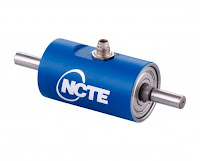
NCTE has expanded its 2300 torque sensor series with the introduction of a new variant for lower torque-range measurement tasks down to 0.5 Nm. The series now covers a torque range from 100 Nm down to 0.5 Nm. With measurement bandwidth up to 1,000 Hz, speeds to 10,000 rpm and accuracy to 0.5%, these non-contacting, long life sensors are perfect for torque, as well as speed, shear, and angle measurement in precision mechanics, test beds for smaller electric motors and engines, machine tool performance control, controlled screw fastening and capping operations, robotic manipulators and more.

Their torque sensors use the physical principle known as the inverse magnetostrictive effect in a patented process where magnetically encoded components in the sensor are modified by a surrounding magnetic field. Each sensor includes two magnetic fields in opposing directions which takes care of unwanted interference such as that from EMC. This real-time process, where torque measurement may be static, or dynamic detects miniscule magnetic changes for highly precise data acquisition. Factory calibrated and certified sensor outputs are 0…10V DC, 4…20mA, CANbus and USB with supply voltage requirement of 5 to 28 VDC. The USB option includes PC analysis software.

The 2300 series is available in nominal diameters of 8, 9 and 15 mm with seven measurement range variants between zero to 1 Nm and zero to 100 Nm. Full technical specifications are available from Ixthus Instrumentation. The plug and play sensors do not require external signal conditioning and as the sensor becomes a part of the shaft component, integration is easy. This non-contacting sensor technology has excellent resilience to shock and vibration and a choice of protection class allows use in harsh conditions – even in oil or under water – through a temperature range from -30 °C to +85 °C.

NCTE’s extensive range of standard torque sensors are available for measurement up to 10 KN with customised variants available on requests. The sensors are widely used for applications including but not restricted to agricultural and commercial vehicle take-off shafts, engine and turbine test beds, e-bikes, robotics and handling machinery, performance motorsports, and automotive engineering.

All are available with full support from NCTE’s distribution partner in Britain, Ixthus Instrumentation Limited,

@IxthusInst @mepaxIntPR @NCTE_AG #Pauto 

Monday, 12 July 2021

Digital strain gauge signal conditioning modules.

Ixthus Instrumentation has expanded its range of force and load cell instrumentation accessories with two high performance digital strain gauge signal conditioning modules from its USA distribution partner Strainsert Inc. 

Aimed at measurement tasks where accuracy, resolution, and stability are essential, the new products include a single channel option with USB connectivity and a model for single or multichannel strain gauge signal conditioning with optional RS-232, RS-485 or CAN outputs and a choice of ASCII, Modbus or CAN protocols. Both new products are supported with comprehensive software tools allowing straightforward interfacing, configuration and calibration including a Windows DLL for building custom applications.

The DSC digital strain gauge module, supplied as a single channel PCB format package or combined in customised enclosures for multiple sensor measurement tasks, provides up to 500 readings per second. With a user programmable signal filter, the module is suitable for 4-wire bridge measurement with a nominal 5 V excitation voltage, and bridge resistance from 320 to 5000 Ohms (350 Ohms typical) with a typical sensitivity 2.5 mV/V. Standard single and multichannel modules are available for RS232 and RS485 output with ASCII or Modbus protocols, or CAN output using the CAN 2.0B protocol Single modules require an external 12 V DC power source at 450 mW typical for a 350 Ohm bridge.

The USB interfaced version, (DSCUSB) is powered from its USB port and a simple ‘plug and measure’ feature allows direct connection to a PC, appearing as a virtual COM port. Where multiple USB ports are available, multi-channel use is possible. At 200 samples per second at 18 bits noise free resolution, the module outputs an ASCII protocol. In combination with the software toolkit, the module can cater for correction of non-linear sensors. The compact ABS plastic enclosure (71 x 51 x 20 mm) has an IP50 rating and is also available with a DIN-rail mounting kit.

Both DSC and DSCUSB digital strain gauge modules share common specifications for temperature stability, linearity and resolution. Detailed specification sheets are available from Ixthus Instrumentation who can assist UK and Ireland customers with application engineering and customised system integration for multi-channel measurement tasks.

@IxthusInst @mepaxIntPR #strainsert #PAuto 

Friday, 25 June 2021

Expanded linear position sensors.

Ixthus Instrumentation has expanded its range of linear position sensors with the new heavy-duty, inductive technology equipped ILT series for measurement stroke length from 25 mm to 600 mm. An exceptionally durable and compact 35 mm diameter anodised aluminium casing offers IP67 / IP69K environment rating whilst integrated sensor electronics allows a wide choice of industry standard voltage and current outputs without the need for signal conditioning. 

These non-contacting and therefore long-life sensors feature absolute position output on power-up for calibration-free measurement with an effectively infinite resolution and linearity error of +/- 0.25%. The ILT series is particularly suitable for harsh environments in industrial and agricultural machinery or for special vehicle construction.

The technology offers many advantages other non-contact sensors including superior accuracy, robustness and a generally more compact stroke to overall length. Furthermore, the interfacing electronics offers high EMC protection and adaptability for a wide range of electrical I/O options to flexibly suit customer requirements.

The sensor boasts impressive environmental specifications. The operating temperature range is specified up to -40° C to +125° C. Full specifications are available in an Ixthus datasheet – available on request or download here, and full technical and application support is of course available from Ixthus.

The ILT series is offered in measurement stroke lengths of 25 mm and 50 mm, then 50 mm stroke increments up to 300 mm with 100 mm increments to 600 mm. The sensor is available with steel or plastic 8 mm diameter rod ends or M8 female threads at both ends. The minimum distance between rod ends for the longest (600 mm) stroke option is 810 mm whilst the 25 mm stroke version has a 185 mm dimension. The standard electrical interfacing option is 2 m screened cable. OEM customers can specify custom stroke length, and alternative mountings or electrical interfacing on application to Ixthus.

@IxthusInst @mepaxIntPR #PAuto #Agriculture

Tuesday, 25 May 2021

Triangulation sensor.

Riftek RF609 series laser triangulation probes are specifically designed for precision geometric measurement and inspection of small inner diameter holes, typically from 9 mm to 48 mm. Now available through Ixthus Instrumentation, a newly released version adds a Wi-Fi interface to the device to facilitate wireless measurement of borehole diameter/ Developed for use as part of a CNC machine’s automatic tool changing system, these ultra-compact measurement probes measure the distance to the hole surface as the probe is rotated and moved axially into the hole; synchronously measuring the polar surface coordinates which are interpreted through PC software to build a 3D geometric model pattern with micron level accuracy.

The new RF609 Wi-Fi is a rechargeable battery-powered device supplied as a complete system with mains charger, cables, PC software and a detailed operation manual. The device is available in two measurement versions allowing a range of inner diameter measurements to be made: 9 to 19 mm or 16 to 48 mm diameter with maximum bore length of 139 and 143 mm respectively. Both probes feature the 48 mm diameter main controller, battery and Wi-Fi housing with an extended shaft that houses the laser triangulation sensor scanning head. A 16 mm diameter shaft facilitates straightforward collet mounting on the CNC.

An uncomplicated set-up procedure includes software download and initial wired USB connection to interface the probe followed by a simple probe calibration routine that sets the probe rotation speed, calibration diameter and tolerance parameters.

The RF609 series is also available as a self-powered device with a built-in slip ring assembly for power input and data signal output. The ultra-compact probe head has been well-proven in special custom-made equipment developed by Riftek for specific component measurement – sometimes used in conjunction with linear and rotary translation positioners to allow, for instance, scanning pipes, bushes, stepped and tapered holes and tubes etc. The principle has also been applied to special debris inspection equipment for small diameter holes where traditional vision systems can be troublesome.

The new RF609 Wi-Fi series is part of Riftek’s comprehensive range of 2D laser scanners, laser triangulation sensors, speed and length sensors, railway and other measurement instrumentation systems. Ixthus Instrumentation works closely with Riftek and many other leading instrumentation component manufacturers to supply sensors, transducers and complete systems for the measurement of displacement, force, torque and vibration.

@IxthusInst @Riftek_Russia @mepaxIntPR #Wireless #Geometric

Friday, 23 April 2021

Wireless load sensors and load cell telemetry.

Two new high-performance load sensor products from Strainsert Inc., based on license-free, 2.4GHz telemetry with a working range up to 800 metres, will facilitate straightforward and cost-effective installation for single- or multi-sensor use over long distances, problematic installations and otherwise challenging load measurement tasks. Especially compelling as an alternative for system set-ups where long and noise-prone cable runs in traditional wired systems prove complex and expensive, the new wireless load sensors and load cell telemetry systems are available exclusively in Britain from Ixthus Instrumentation.

The new products include wireless load pins with integrated wireless transmitters, configured as standard or custom designed clevis pins or shackle bolts for single or multiple sensor systems. Complementary to these wireless-integrated sensors, the newly available T24 series wireless load cell telemetry system comprises modular transmitters, base stations and accessories with the adaptability for conversion of existing wired Strainsert sensors with strain, current or voltage output - or for the development of completely new wireless system designs. With IP67 rated enclosures and built for the harshest conditions for weighing and load monitoring tasks in aerospace, industrial, construction, mobile machinery and more, the range is supported with comprehensive software tools for straightforward configuration and monitoring.

Strainsert’s T24 wireless transmitter modules are available in two module sizes with a choice of batteries – a compact AA cell version or for longer battery life a larger sized D cell module. The electrical and range performance specifications for both modules are similar. The 4-wire bridge measurement and 4.5 to 5.25 VDC excitation characteristics suit Strainsert sensor requirements. The modular system offers a choice of four USB powered base stations that are used for interfacing with PCs or PLCs through a choice of USB, RS232 or RS485 ports for configuration and control. They work in concert with the T24 transmitter modules, facilitating the data capture through the T24 software toolkit which is included with the wireless systems. Further system accessories include Modbus Gateway and ASCII serial interfaces, analogue and relay output modules and wireless range extenders for up to 1600 metres. Also included are wireless handheld receivers and LED display modules.

The wireless load pin has all the specification characteristics and interfacing possibilities offered by the T24 telemetry systems with the potential advantage found in its integrated load sensor component and transmitter design that can further aid installation planning and commissioning.

@IxthusInst @mepaxIntPR #strainsert #PAuto 

Tuesday, 23 March 2021

Scanning steel band in tyres.

Riftek* is continuing to develop bespoke measurement solutions for high-throughput manufacturing processes centred around its well proven range of 2D laser triangulation sensors. 

The latest custom-engineered project is a fully automated Industrial Ethernet based system that measures internal geometric parameters of the cylindrical steel bands that form an integral part of automotive tyres. The production conveyor-mounted machine combines a two-axis motion system that positions and rotates a specially adapted Riftek RF627 series 2D laser triangulation sensor to create a radial 3D scanning sequence inside the steel belt. With an inner-diameter range between 110 to 410 mm and axial height of 70 to 305 mm, the RF627 in combination with the probe software measures diameter, roundness, chamber width and angle to an average accuracy of +/- 50 microns with the values returned to a PLC via an integrated PROFINET interface.
The mechanical hardware, including the mounting frame and main housing with interfacing connectors for 24V DC power and fieldbus, forms part of the Riftek supplied system. As well as the probe software, an RS422-to-PROFINET IO module interfaces the 2D laser sensor to the PLC. For this set-up, the customer preferred to use a Siemens S7-1200 PLC although other manufacturer’s PLCs of choice could be used. GSD files and a comprehensive installation manual are also part of the supply. The probe software and the IO module combine to provide a data packet allowing the graphical display of the component being measured and a file output for use in further analysis software. The system supplied is fully adaptable for vertical or horizontal orientation to suit the customer’s project demands.

The final system is part of Riftek’s RF096 series custom build range that also includes other versions of the RF627 and other laser sensors that are specifically adapted as sub-systems for multiple measurement of customer’s component parts, typically as part of high-throughput manufacturing processes. Other examples of the RF096 sensor measurement series include fully machine integrated systems for welding lines and automated assembly measuring length, diameter, proximity etc., as well as component profile and thickness measurement, debris monitoring and more. Other systems can include manual operation with footswitches, hand controls or keypad/mouse activation to provide measured results recorded and displayed on a GUI as actual dimensions or as pre-set go or no-go values.

*Ixthus Instrumentation Ltd provides a comprehensive sales and technical support service in Britain across Riftek’s comprehensive range of optoelectronic 2D and 3D laser measurement devices and systems from single components to complete systems such as the RF609 series.

@mepaxIntPR @IxthusInst #Riftek #Robotics #Pauto #Automotive 

Monday, 22 February 2021

Ethernet fieldbus controller acquires info.

Burster's new generation 9251 series fieldbus controller (available through Ixthus Instrumentation in Britain), supports PROFINET, EtherCAT and ETherNet/IP - and in combination with the well proven 9250 series universal instrumentation amplifiers make light work of sensor data acquisition for the Industry 4.0 age. 

Featuring automatic channel detection/addressing for up to eight 9250 instrumentation amplifiers and with flexible configuration using Burster’s DigiVision PC software via an integral USB interface, the 9251 has ample ability to simultaneously acquire and transfer large amounts of disparate sensor measurement data through the Ethernet fieldbus to PLCs, DAQ systems and other control systems.

Burster’s 9251 Ethernet fieldbus controller and 9250 instrumentation amplifier systems enable the flexibility to mix the customer’s preferred strain gauge, potentiometer, voltage or TTL sensor technologies. With rapid sensor set-up using Burster’s TEDS push-button auto-sensing facility, this extends to a manufacturer-independent choice that allows the integration of sensor data for complete machines and systems where high precision and real-time measurement of torque, force, vibration, pressure, etc., is required for extensive condition monitoring and preventative maintenance purposes – a pre-requisite of Industry 4.0.

The 9251 Ethernet controller also offers an optional analogue input with a ±10 V range that may be used as an additional measurement channel - allowing up to nine sensors per Ethernet fieldbus interface. This same option includes a PLC I/O channel (DIN61131) that may be used for tare, tare reset, or limit reset etc.

Their 9250 series instrumentation amplifier is based on 24-bit A to D conversion for highly accurate measurement with the sensor power provided by the amplifier module and no additional voltage source required. The amplifier may also be used independently of the fieldbus controller – its USB port and Burster’s DigiVision PC software may be used to configure autonomous measurement systems where a choice of sensor output and a range of other parameters can be called and set. As with many of its sensor products Burster can optionally supply these instrumentation amplifiers with DAkkS-certified calibration certificates.

The durable and compact 9251 and 9250 housings, finished in a polyamide material with metal support elements, feature DIN- rails mounting for convenient installation with the possibility to mount the amplifiers close to the sensor if required.

@IxthusInst @burstermeasure @mepaxIntPR #PAuto #Fieldbus

Wednesday, 27 January 2021

Anti-bribery standard achieved.

Ixthus Instrumentation has recently completed the comprehensive due diligence process for TRACEcertification* and gained full approval from the world leading anti-bribery standard setting organization. Initiated through its distribution partnership with Kaman Precision Products,  TRACEcertification demonstrates Ixthus’ commitment to commercial transparency through its dealings with suppliers and customers alike.

As part of the certification process, Ixthus received TRACE’s comprehensive anti-bribery compliance training and a verified due diligence report is available from the TRACE Intermediary Directory.

Kaman Precision Products Inc., is a USA based designer and manufacturer of precision, inductive Eddy current position measurement systems that are widely applied in military and aerospace industries, and in many other challenging application areas. With ISO 9001-200 certification and Satellite Industry Association (SiA) membership, Kaman is also a leading sensor specialist for cryogenics, high-vacuum, radiation tolerance and other severe environment position measurement tasks. Ixthus Instrumentation has a long association with Kaman providing a complete UK-based, engineer-to-engineer consultancy and service across Kaman’s comprehensive product range.

Ixthus works closely with Kaman and, over several years, has developed a high level of application expertise for its non-contact displacement sensor technologies - providing comprehensive sales and support at component level or for complete instrumentation systems. Ixthus’ knowledgeable technical staff are on hand to assist with measurement solutions - from the first enquiry, to supply and to after-sales support. 

* Trace International is a global anti-bribery association.

@IxthusInst @KamanSensors @TRACE_Inc @mepaxIntPR #Pauto #Integrity

Tuesday, 12 January 2021

Temperature monitoring, protection and sensing specialist acquired.

Variohm Holdings, part of the discoverIE Group plc, has advanced its strategic plans to expand both product portfolio and manufacturing competency with the acquisition of the German/Hungarian temperature control component manufacturer Limitor Solutions GmbH. With its main 2.700 m2 manufacturing site based in Pecs - Hungary and headquarters and warehousing facilities in Urbach near Stuttgart (D), Limitor Solutions has a fifty year history as a leading manufacturer of temperature based component technologies for thermal protection, regulation, switching and sensing as well as temperature timers, fuses and controllers.

Udo Angermaier, managing director of Limitor Solutions GmbH looks forward to the acquisition’s opportunities. “We are most excited to join Variohm Holdings, to work with the other members and enjoy the benefits of our combined forces and the capability for significant growth.” 

With a customer list that spans global electronics manufacturers such as AEG, Siemens, Kärcher and Philips, Limitor Solution’s temperature monitors, temperature limiters, thermal switches, controllers, temperature fuses and timers find wide use in electric motors and associated drives, inverters and generators, transformers, domestic and DIY appliances, as well as automotive, medical, scientific and industrial control equipment. The Company also manufactures other electrical and electronic components such as cable harnesses and power cables, printed circuit boards, pumps and other components for customers and its many commercial partners.

Limitor Solutions’ core technologies and comprehensive manufacturing capabilities extend to an extensive design and automated production capability throughout its product range. Manufacturing is supported with component assembly equipment, automated welding and soldering machinery, plastic moulding and encapsulating machinery, marking and printing equipment. Fully supported by 100 employees with highly trained, qualified and experienced sales, production and quality control teams, the Company has certification for ISO 9001:2015 quality management as well as ISO 14001:2015 environmental management approval.

Over the past few months and during these most difficult times the Variohm Holdings has purchased Phoenix America - the leading USA based magnetic encoder and magnetic sensor solutions specialist - as well as the present acquisition of Limitor Solutions. 

These new additions join the other Variohm Holdings’ members including 

  • Variohm EuroSensor (sensor and transducer supplier and manufacturer), 
  • Herga Technology (switching and sensing solutions), 
  • Ixthus Instrumentation (specialist measurement systems), 
  • Heason Technology (motion control components and systems) and 
  • Positek Limited (specialised linear and rotary voltage displacement sensor technologies).

Variohm Holdings’ managing director, Graham Pattison, acknowledges discoverIE’s support and vision for the substantial potential in manufacturing capability and sales growth this latest acquisition brings. “This latest purchase demonstrates discoverIE’s belief in Variohm Holdings, providing even more synergy and paving the way for an increasingly compelling offer to our valued customers”.

@Variohm #PAuto #Components 

Monday, 26 October 2020

High reliability fast beam-steering mirror control systems.

Kaman Precision Products' recently launched high-reliability version of its fast beam-steering mirror measurement system is now available with full support from Ixthus Instrumentation. The upgraded KD-5100+ enables high-precision position feedback for control systems used in mirror steering and scanning tasks for laser communications on satellites and ground stations, airborne and shipborne directed energy systems and image stabilisation systems.

Typical inductive sensor configurations used with the KD-5100+ include Kaman’s 15N or 20N series offering non contacting measurement ranges of +/- 0.9 mm and +/- 1.9 mm respectively. Arranged in precisely matched pairs on the X and Y mirror axes with each pair acting as a balanced bridge circuit on either side of the mirror, these sensors detect the differential distance as the mirror rotates about its pivot, providing an output voltage from the KD5100+ which is proportional to the mirror’s angular displacement. The resulting resolution and precision for each axis is in the sub-micro radian range - providing the means for exceptional accuracy.

The KD5100+ measurement system features an operating temperature range of -20°C to +60°C (sensors are -52°C to +105°C) with excellent thermal and long term stability in a small and easily installed package size. The highly durable measurement system is designed for long trouble-free operational life for maximum high-reliability usage.

The upgraded KD5011+ features an identical Mil-PRF-38534 Class H proprietary hybrid microcircuit as the KD5100 ‘standard’ version with the addition of high-rel diodes and capacitors plus an upgraded aerospace specification for circuit layout, ground connections and sensor connectors. The KD5100 is already providing nanometre level precision for control systems used, for example, in laser focussing for micro-column architecture in semiconductor wafer manufacture as well as precision long-range telescope positioning and many other applications were differential inductive measurement is contributing to an advance in precision measurement technology.

Throughout ISO 9001-200 certified Kaman’s comprehensive range of sensors and measurement systems, customisation is available for application areas as diverse as cryogenics, high-vacuum, radiation tolerance or other severe environment position measurement tasks across all types of industry and research settings. A lower cost industrial specification version for fast beam steering mirror position control, utilising inductive eddy current sensors, is also available as the Kaman DIT-5200. Ixthus Instrumentation provide complete service from the first enquiry to delivery and after sales support for Kaman’s specialised range of products.

• Bolstering its commitment for aerospace related applications across its wide range of inductive sensors and measurement systems, Kaman recently took affiliate membership with the Satellite Industry Association (SIA) – the USA based organisation that provides support and representation for operators, service providers and equipment suppliers for the commercial satellite industry.

@IxthusInst @KamanSensors @mepaxIntPR #PAuto #Transportation

Friday, 18 September 2020

Force sensor and load cell in aerospace.

Strainsert’s load cells, load pins, and other force sensing components and systems find use in a wide variety of measurement tasks across a wide range of industries. All applications require uncompromising levels of quality and reliability but none more so than the aerospace sector. Strainsert has a comprehensive standard product offering but characteristically for the aerospace industry, its custom design service comes to the fore – led by a proven multi-stage approach that is supported for British customers by its exclusive distribution partner, Ixthus Instrumentation.

Strainsert’s standard and custom force measurement products include a patented transducer design made possible by an innovative internal gauging process. Through its extensive in-house design and production capability, this process facilitates the manufacture of load bearing components as complete piece parts and structures where strain gauges and all circuitry are actually bonded and hermetically sealed inside small bore holes within the component. Supplied with NIST traceable force calibration, typical specifications range from -40 to +150 degrees Celsius and pressures to 100 bar with MTBF ratings of billions of cycles. With the strain gauges bonded to the neutral axis of the particular load bearing component, they are insensitive to extraneous loading and so are typically more accurately reliable and consistent when compared to competitive components with externally mounted sensor electronics.

Strainsert’s internal gauging process has proven rugged and durable, survivable and highly reliable in extremely harsh environments. This technology has helped to keep Strainsert at the forefront of the aerospace industry with cutting-edge applications such as the Mars Exploration Rover Mission for NASA and the Space Shuttle launching pad.

For custom force sensors, applications can range from research and testing of materials that are evaluated for use in aerospace to complete manufactured component parts that will eventually be used to monitor and control forces during installation, assembly, or operation on ground test equipment or actual aircraft.

For large aerospace projects, many international companies and institutions are typically involved and Strainsert’s force and load sensing products are often utilised to ensure operational safety when interfacing these multiple supplier’s sub-assemblies. In many instances, these same load cells are designed to be permanently integrated in the system to both bear the load and measure the force for the life of the product.

Strainsert’s load cells also find use for force determination and evaluation of aircraft hardware in loading simulation trials to determine and verify the expected fatigue spectrum encountered during the actual life of the hardware and even the aircraft over many millions of loading cycles.

The aerospace industry is a great proving ground for the integrity of Strainsert’s load cells, load pins, and other force sensing components. Applications include but are not restricted to monitoring force on aircraft landing gear, wings, flaps, slats and ailerons as well as engine/wing mountings and interfaces. Other aerospace related measurement tasks include ejection seat and parachute force monitoring, satellite antenna forces, rocket separation bolts and many other interesting applications.

Ixthus works closely with Strainsert and other global sensor technology leaders for force, torque and vibration measurement, providing a complete sales and support service at component level or for complete instrumentation systems. Ixthus’ knowledgeable technical staff are on hand to assist with measurement solutions - from the first enquiry, to supply and to after-sales support.

@IxthusInst #PAuto

Monday, 15 June 2020

Preventative maintenance.

Sensors and systems to monitor plant and equipment.

Catastrophic failure on large rotating and structural machinery is arguably most commonly caused by mechanical component malfunction linked to unbalance, misalignment, and excessive wear causing fatigue as well as incorrect lubrication, seal failures, and sometimes improper use outside of the design specification of the machine. Where vibration and/or seismic monitoring with accelerometers is implemented as part of an optimised preventative maintenance schedule, early indications of these conditions can be detected and problems eliminated before serious failure occurs with the considerable benefit of reversing all of the negative outcomes of poor maintenance mentioned previously.

With its longstanding expertise in Metrix condition monitoring solutions, Ixthus Instrumentation can provide preventative maintenance assistance based on the manufacturers Digital Proximity System (DPS) and its other proximity and seismic sensor product lines. The Metrix DPS is a field-configurable PC-based measurement system for position, radial vibration and speed that comprises a digital proximity transducer, interfacing cable and a choice of signal conditioners that eliminate the need for multiple drivers and transmitters. Designed for harsh and hazardous environment use in areas such as oil refineries and gas plants, the ATEX certified and API 670 compliant eddy-current proximity measurement system works with both Metrix and other manufacturer’s sensor products as a digitally configurable proximity monitoring system.

Metrix’s seismic vibration instrumentation includes accelerometers, velocity sensors, transmitters and signal conditioners that combine for the measurement of structural vibration on components such as bearing housings, piping and machinery housings as well as machine support structures. Such systems are particularly suitable for machinery with rolling-element bearings which generally transmit both shaft-and bearing-related vibration to the outside of the machine where it can be detected by seismic measurements. The seismic instrumentation and DPS vibration systems combine to fully protect plant and equipment in preventative maintenance scenarios.

@IxthusInst #PAuto #Metrix #Mepax

Wednesday, 5 February 2020

Force gauge with a lift!

The Centrax 2020 provides manufacturers and operators of elevators, safety guards and other powered door equipped machinery with a compact, portable and effective solution for door closing force and impact energy measurement. It is now available with full support from Ixthus Instrumentation. Manufactured by Centrax and developed with major lift manufacturers, the self-contained 2020 is an indispensable instrument for machinery protection tasks and is specifically designed to measure the forces and closing impact energy exerted by power operated doors.
Powered door closing force and impact energy gauge
The micro-powered 2020 has two main functions: As an applied force gauge with a range between 100 and 1000 N, measurements against a built-in spring resistance in the nose of the instrument are presented on a 4 digit display. If an initial impact with an energy value greater than 1.5 J is detected, the device automatically switches to its energy mode with a recording range up to 14 J. The maximum impact energy value is held in the display for approximately ten seconds before returning to the force mode. Separate blue LEDs on the instrument signal the measurement mode.

The Centrax 2020 is a compact hand-held instrument with an overall length of 340 mm and a diameter of 30 mm. The 12 V battery powered device has an automatic power-up mode, activated when the measurement nose is lightly touched, and power down if inactive for more than 10 minutes. A protective case is supplied that effectively closes the light source to maintain power-off when stored. Battery life is rated at around 1500 operations or two years – a service and re-calibration procedure includes battery replacement.

#BAS @mepaxIntPR @IxthusInst 

Monday, 21 October 2019

Keeping an eye on the rudder!

TruSail is a performance sailing specialist and the name of a modular wireless sensing telemetry system that provides a unique scientific and measurable tool for racing sailboats. Used for expert training by elite sailors and coaches, typically competing at national, international and Olympic level, the system includes real-time measurement and advanced analysis of the most significant dynamic forces that influence sailboat performance. Armed with this data, which may be analysed instantly whilst on the water, sailors can react and improve their performance technique affording a solid team advantage compared to traditional and delayed classroom debriefing methods.

As part of the measurement components used on the TruSail system, Ixthus Instrumentation is supplying Euro-CMRK series angle sensors for the TruSail’s rudder and boom position feedback as well as application expertise that helped the sailing specialists meet its stringent marine environment and performance specifications.

TruSail’s technical director Glynn Lloyd explains the requirements in detail. “Our products need to be light because any additional weight on the boat will potentially slow it down or change the "feeling" of the boat to the sailor. TruSail systems have to work in all weather conditions and because the sailors perform to the limits - with meticulously fine margins between winning and losing - every fraction of a percent in performance really matters. At such extreme limits, high speed capsizing can be frequent so our systems need extreme durability and waterproofing. The Euro-CMRT angle sensors specified by the engineers at Ixthus Instrumentation have proven ideal for these conditions and their miniature design helps keep the TruSail’s size and weight to a minimum.”

At only 10 mm in diameter and 15 mm housing length, and with an M8 threaded mounting and a 3.175 mm flatted shaft, the Euro-CMRT programmable angle sensor now used by TruSail features Hall Effect non-contacting technology in an extremely lightweight IP68 sealed design. Manufactured by Variohm EuroSensor – Ixthus’ sister company in the Variohm Group – this new product is the latest version of a comprehensive range of Hall Effect angle sensors that excel for proven durability, long life, high duty-cycle and exceptional reliability. As the smallest angle sensor in Variohm’s range, it is perfectly suited to precision angle measurement tasks where light-weight and restricted installation space are important design considerations.

For the rudder sensor, the Euro-CMRT is mounted inside the TruSail housing which also includes telemetry electronics. Measuring the rudder angle through the tiller link mechanism (see image with inset below), the sensor’s angle is transmitted to a large display at the front of the boat that sailors are able to monitor as well as to a tablet on the coaches’ boat which runs the main telemetry and performance analysis application software. A similar TruSail system with a further CMRT sensor provides the team with the sailboat’s boom angle position and up to four boats may be linked at the same time with information shared between sailors and coaches. As the sailors are directly able to adapt their sailing style using the monitors, and coaches can support them on the water during the actual training session, sailing performance, boat set-up and learning are all optimised.

The Euro-CMRT is part of a new family of Hall Effect long-life angle sensors that include the 18 mm PCD flange mounting Euro-CMRS and the puck-and-magnet design of the Euro-CMRK. The new products are based on preceding Hall Effect sensors that enjoy a high reputation in measurement applications that include industrial automation, motorsports, mobile construction machinery and agricultural vehicles. Improved production and assembly techniques have led to smaller footprint products with added flexibility that allows straightforward mechanical and electrical adaptation to exactly match the customer’s requirements.

Across the new Euro-CMRx range a choice of single or dual redundant output, with CW or CCW direction, includes ratiometric or PWM signal levels from an industry standard 5 VDC input. Programmable angles from 30⁰ up to 360⁰ in 1⁰ increments are specifiable with independent linearity to within +/- 0.5% of each signal range. The CMRx family offers a vibration rating that meets IEC 600068-2-6 and a temperature range from -40° C to +125° C, with short term operation to 150° C. Working life is rated in excess of 50 million movements for the housed sensors and the completely contactless puck and magnet version has a virtually unlimited life. Encapsulated sensor electronics combined with high grade anodised aluminium housing and stainless steel shaft materials further ensure reliability and performance for the most demanding environments.

#Marine #Transport @IxthusInst @mepaxIntPR 

Friday, 13 September 2019

Contactless tube ID measurement.

Developed for an Italian automation specialist and available as part of Riftek’s* expanding range of laser scanning pipe and tube inner diameter measurement system solutions, a new variant of the RF096 series laser probes speeds precision measurement inspection for tubular components. With direct interfacing to PROFINET equipped fieldbus controllers, the system combines a rotating triangulation laser and a motorised linear translation stage that together step & scan profiled or smooth inner diameters between 35 to 55 mm for a measurement resolution of 3 microns and linearity of ±15 microns over a bore depth range of 100 mm.

The RF096 is an example of Riftek’s capability to design and supply its optoelectronic 2D and 3D laser measurement devices as cost effective automated measurement sub-systems for high-throughput production. In particular this new variant of the RF096 laser probe series includes a Class 2 (IEC60825-1) red semiconductor laser with a 660 nm wavelength. Installation is straightforward with external connectors for Ethernet and 2x PROFIBUS interfacing as well as 24 VDC power. Its sturdy base with a protective aluminium cover is fixed to the production machine – typically for sawing, cutting or precision machining – and the component is axially presented to the traversing laser probe. The overall dimensions of the un-extended unit are within an envelope of 500 x 182 x 90 mm (LxHxW). With automated control via PROFINET, which is fully supported by a comprehensive manual and appropriate GSD files, the linear translation stage accuracy is ±0.05 mm and the typical measurement scan time is 5 seconds. Ixthus Instrumentation works directly with Riftek and these typical specifications and measurement characteristics can be adapted to the customer’s application on request.

Other examples of the RF096 rotational sensor measurement series include customised adaptations with machine integration for manual operation where footswitch or keypad/mouse activation provides measured results recorded within the software that are displayed on a GUI as actual dimensions or as pre-set go or no-go values. Riftek’s measurement principle can be adapted to essentially any inner diameter dimensions and reasonable measured length.


* As Riftek’s exclusive distribution partner for Ireland & Britain, Ixthus Instrumentation provide complete sales and support for the RF096 series.


 #PAuto #Riftek @IxthusInst

Tuesday, 25 June 2019

Vibration alarm switch for machine monitoring.

The Metrix ST5484E-SW series configurable seismic vibration switch has been launched recently. It is now available with full support  in Britain from its distribution partner Ixthus Instrumentation. The compact 24 V DC loop-powered electronic switch will setpoint two programmable and independent alarms through solid state contacts with time-adjustable delays, as well as monitor continuous vibration through a control system.

The new configurable vibration switch is based on the well proven ST5484ST vibration transmitter which is used across a wide range of seismic vibration measurement applications on rotating and reciprocating machinery. Aimed at demanding machine monitoring tasks where built-in alarm protection is additionally required, the ST5484E-SW integrates a piezoelectric accelerometer, signal integrator and amplifier, RMS or peak detector, a 4-20 mA signal conditioner and a digital microcontroller into a single package. Two indepen¬dently configurable alarm setpoints with time delays and corresponding discrete outputs allow implementation of ALERT (pre-shutdown) and DANGER (shutdown) levels by a machine control system. Additionally the units’ 4-20 mA proportional velocity output enables interfacing with PLCs, DCSs, strip chart recorders, or other process monitoring systems where real-time vibration levels can be monitored.

Model variants include an 8-pin sealed connectorised version as a 10 m submersible/water resistant model. The connector version is also available with an optional non-incendive rating (Class1/Div2) that may be used with barriers for special installations. An alternative version with flying leads, wired directly to conduit fittings, is available for hazardous area installations and includes Metrix’s 8200 explosion-proof elbow. The corrosion and water resistant switch is housed in 316 stainless steel with a nominal diameter and length around 38 x 62 mm for the connector version, and overall length of 136 mm for the explosion-proof model.

A wide choice of scale-range options and mounting studs provide application and installation flexibility. The setpoints are set at the factory at one half (1/2) and two thirds (2/3) of the full scale range, but may be adjusted through Metrix software with the delay time programmable up to 300 seconds. Users can choose twelve standard full-scale peak or true RMS range models from 25.4 mm/s to 76.2 mm/sec. Stud interfacing covers all common metric and imperial dimensions through NPT, UNF, UNC and M8/M10. Hazardous area certification includes CSA, INMETRO, and ATEX/IECx and KOSHA -conforming to explosion proof and non-incendive option variants. The ST5484E-SW is also available with a wide choice of low- and high-pass filters or can be customised to exactly suit the user filter requirements.

@IxthusInst  #PAuto @MetrixVibration

Friday, 29 March 2019

Proximity sensor shaft calibration.

Metrix’s newly announced 9060-SCTS shaft calibration system pairs with the industrial condition monitoring system manufacturer’s Digital Proximity System (DPS) and associated Metrix hardware to enable custom shaft calibration in the field even when shaft material is not known. Available with full support in Britain from Ixthus Instrumentation, the 9060-SCTS (Shaft Calibrator Touch Select) is used to adjust the gap in pre-set micron level increments for calibrating proximity probe systems and thanks to the powerful DPS software, allows the user to change the configuration.

The Metrix DPS combines the performance of a fully API 670 compliant eddy-current proximity measurement system with the flexibility of digital configurability. The field-configurable measurement system for position, radial vibration and speed is well proven where critical plant equipment such as motors, compressors, pumps and other rotating machines or piston based machines need to be closely monitored for optimal reliability. Typical systems for use with the DPS comprise a digital proximity transducer, interfacing cable and a choice of signal conditioner - available as a driver for a machinery protection system or as a transmitter with a 4-20 mA signal to a PLC/DCS or SCADA system.

Together with the latest free-of-charge software version of the Metrix DPS, the 9060-SCTS is used to determine the actual proximity probe system output in mV/mil or mV/μm of a machine shaft or piston rod. Comprising a self-aligning cradle and a precision ‘micrometer head’ that positions the inserted proximity sensor under test in fixed 200 micron or 0.010” increments, the system measures output at these fixed increments and is capable of ‘straight-line’ re-calibration where material properties are not known. In this way the complete DPS system is capable of supporting a multitude of older probe systems, cable lengths, and target materials with just a single device.

The 9060-SCTS is compatible with 5 to 22 mm probe tip diameters and with a special adapter plate works with reverse mount probes. For ease of use, the displacement is adjusted by twisting a gap adjustment ring and feeling for set ‘clicks’ that correspond to the required probe calibration increments. After each increment is completed the DPS software, which has probe characteristics and part number recognition built-in, is manually commanded to record the output value. An adjusting strap allows the mounting adapter to fit on shafts from 25 mm up to 300 mm diameter. The shaft calibrator is manufactured in composite plastic material that does not affect probe sensitivity.

@IxthusInst  #TandM #Metrix