Showing posts with label Renewable Energy. Show all posts

Thursday, 1 October 2026

Moisture in waste-heat-to-power conversion.

Sensors provide the humidity and dew point measurements needed to protect critical components, simplify control and build customer trust.

A novel technology that converts waste heat into electrical power at higher efficiency and at lower temperatures than many competing waste-heat recovery approaches has been developed by JTEC Energy. Its system uses hydrogen as the working fluid, pairing a heat-driven compression technology with electrochemical stacks that convert hydrogen pressure into electrical potential. Vaisala sensors provide the humidity and dew point measurements needed to protect critical components, simplify control and build customer trust.

Tight moisture control is essential to this process. The electrochemical stack needs humidified hydrogen to keep its membranes functioning optimally, while the metal hydride reactors used in the waste-heat conversion subsystem must be protected from excessive moisture exposure. To manage that balance, JTEC developed a closed-loop gas management system that removes and recirculates more than 99.99 percent of the moisture introduced into the system.

For this system to operate reliably, JTEC requires highly accurate moisture measurement across conditions ranging from high humidity at the electrochemical stack to the very low dew point levels required before hydrogen can be safely returned to the reactors. These critical measurements also need to be performed with industrial-ready sensors that can operate in hydrogen, support dynamic pressure and flow conditions, integrate with control systems and meet hazardous area requirements.


Protecting a critical system in a demanding Hydrogen environment.
JTEC’s waste-heat-to-power conversion system brings together two subsystems with different moisture requirements: an electrochemical stack that requires moisture to operate efficiently and metal hydride reactors that must be protected from excess moisture.

In this system, waste heat is delivered to one of the metal hydride reactors in the waste-heat conversion subsystem. Metal hydrides act much like a sponge for hydrogen. When cooled, they absorb hydrogen. When heated, they release hydrogen at a pressure linked to temperature. JTEC’s system uses that ability to generate hydrogen pressure as part of the process for converting waste heat into electrical power.

From the metal hydride reactors, the high-pressure hydrogen is then sent to the stack module, where expansion across JTEC’s novel electrochemical stacks produces electrical power. After this expansion, the low-pressure hydrogen leaves the stack and can be absorbed back into a separate metal hydride reactor in the waste-heat conversion module, where it can later be heated, pressurized and used to generate power again. Through this process, JTEC has developed a waste-heat-to-power conversion technology that circulates a single charge of hydrogen in a fully closed loop: No hydrogen is consumed by the system, and waste heat is the only “fuel” JTEC needs to operate.

During passage through the stacks, the hydrogen gas is humidified to keep the membranes in the stacks operating at peak performance. However, excess water exposure can damage metal hydrides by contributing to the development of oxide layers that limit hydrogen absorption and reduce reactor performance. As a result, JTEC must maintain enough moisture to support stack performance, then dry the hydrogen stream before it reaches the reactors.

“At its core, humidity measurement is so important to JTEC because we have two parts of our system that work really well, but for them to work well together, we have to ensure that we can control humidity passing back and forth between them really tightly,” said Julian Bell, Vice President of Engineering at JTEC Energy.

Before standardising on Vaisala, JTEC used conventional relative humidity and dew point sensors in lab and R&D work. These sensors were not always robust enough for the application, especially when exposed to condensation or saturation events.

In R&D applications, a saturated humidity probe could force engineers to stop an experiment, dry down equipment, clean the system and begin again. In one case, an engineer spent three days trying to complete a six-hour experiment because the sensor saturated partway through the test and the system had to be reset.

The risks posed by inaccurate or unreliable moisture measurements are even greater in a production system, where the waste-heat conversion subsystem can represent more than a third of total system cost and is continuously in operation while the system is running. Moisture overexposures can degrade reactor system performance and require offline maintenance for recovery, adding unacceptable downtime to power production infrastructure.

“The honest truth is that we had not found a good sensor option before we came to Vaisala,” Bell said.

Standardising on Vaisala for humidity and dew point measurement.
JTEC first piloted a Vaisala dew point sensor in an internal R&D project in 2023. As the company worked toward its first production system and field pilot, Vaisala became the preferred option based on low dew point performance, calibration stability, availability, integration flexibility and technical support.

In JTEC's production system architecture, Vaisala sensors support three critical moisture measurement points.

• The first is a high-humidity measurement after the initial stage of the dehumidification system. At that point, hydrogen has left the electrochemical stack and much of its moisture has already been removed. JTEC uses a Vaisala HMP7 relative humidity and temperature probe to confirm system performance and help avoid condensation in the line.

• The second is a low dew point measurement after the later stages of moisture management. At this stage, hydrogen must be dried back to specification before returning to the metal hydride reactors. JTEC is using a Vaisala DMP370 Ex-rated sensor in this location. Beyond the stability and accuracy of the DMP370, working with Vaisala to explore a transition to sensors rated for hazardous environment operation has helped JTEC prepare for future customer requirements in demanding end-use environments.

•The third measurement point is in JTEC's maintenance manifold, which adjusts gas pressures in different parts of the system during startup, shutdown and maintenance operations. A Vaisala DMT143 dew point transmitter is used to confirm that moisture is not moved from the wet side of the system into dry sections that supply hydrogen to critical components.

Implementation was straightforward. The sensors were installed as part of the larger system assembly and integrated with JTEC's control system. For a dynamic batch process where pressure, temperature and flow can vary significantly through a cycle, measurement performance, data accessibility and technical support were especially important.

“Vaisala’s auto-calibration is a key feature that improves confidence in the number coming back to us, which has been a huge benefit,” Bell said. “At the same time, we have been able to integrate pressure compensation routines into our dew point measurements with support from Vaisala engineers, and that expertise really shines through.”

Vaisala support extends beyond product selection. The company provides access to Vaisala’s doctoral-level scientists who are global experts in humidity metrology. Their continued guidance helps the team evaluate moisture measurement in hydrogen at varying pressures and low dew point levels.

This was especially important because moisture measurement in hydrogen at pressures substantially different from atmospheric conditions is not fully understood across the scientific community or industry. Vaisala's technical expertise helped JTEC make informed decisions about how to approach pressure compensation and measurement confidence in those conditions.

“Vaisala helped educate us about what is known, what we can confidently say and where confidence drops off," Bell said. “It is because Vaisala has experts like that and is willing to make them accessible to customers that we were able to make intelligent decisions about how to perform these measurements."

Measurement confidence for field deployment As JTEC prepares its first production system for deployment in a field pilot, Vaisala measurement technology gives the company confidence that it can monitor moisture closely enough to protect critical reactor components. For example, JTEC must tightly control moisture content in the hydrogen gas as it returns to the reactors, making measurement accuracy, repeatability and robustness central to field readiness.

“I would have to have the highest level of certainty in my moisture measurements in order to feel comfortable running a reactor system of this scale in a field pilot, and Vaisala provides this certainty,” Bell said. “The investment in the reactor system is too great to justify running it if you are not 100 percent confident that you know what kind of moisture content you are putting back into the reactors.”

The Vaisala sensors help JTEC:

  • Protect metal hydride reactors from damaging moisture exposure.
  • Confidently measure very low dew points accurately.
  • Simplify control through stable, reliable measurement.
  • Support future hazardous-area installations through Ex-rated measurement.
  • Use consistent sensor technology across R&D and production environments.

Vaisala DMT143 transmitters are now standard dew point sensors in JTEC's R&D operations, and the DMT143, HMP7 and DMP370 are standard components in the company's production system architecture.

For low-dew-point measurements, the Vaisala DMP370 offers a control advantage by delivering stable readings without the calibration interruptions that must be managed in some other measurement architectures.

“When we are deciding when to switch from one dehumidification column to another, knowing there is never a time period where we do not have direct eyes on the moisture content of the exiting gas makes it even easier for us,” Bell said.

Vaisala's technical partnership has also influenced how JTEC evaluates sensor vendors. Bell said moisture measurement is one of only a few areas where JTEC specifically names the sensor provider when discussing the system with customers, distributors and technical partners.

“Vaisala provides one of the three most important sensors in our entire system, with the moisture sensor being the most important sensor for the longevity of our system,” Bell said. “This is the one place where we could not be happier and are not looking for new sensors.”

Enabling the next stage of Waste-Heat-to-Power Conversion.
As JTEC moves from the lab to the field, moisture measurement will be central to demonstrating the performance of its closed-loop gas management approach. Vaisala sensors provide the real-time visibility needed to validate performance by quantifying both the high humidity levels entering the moisture management process and the low dew point levels at the outlet.

That visibility helps JTEC protect reactor health, simplify control and build confidence that the system can support field operation. Looking ahead, JTEC expects to continue using Vaisala sensors as its production systems scale and as additional monitoring requirements emerge.

By standardising on Vaisala, JTEC has established a moisture measurement foundation that supports field deployment, system reliability and future growth. In an application where moisture can determine reactor health, control reliability and customer confidence, accurate measurement is a core enabler of bringing a new waste-heat-to-power conversion technology into the field.


@VaisalaGroup @_Enviro_News #DataCentre #PAuto #Energy

Monday, 16 December 2024

Europe's first commercial-scale floating offshore windfarm.

Project to support the decarbonization of the British energy system by supplying 1.5 TWh renewable power annually to the grid.

Aker Solutions has awarded ABB a front-end engineering and design (FEED) contract for the 560 MW Green Volt floating offshore wind project, led by Vårgrønn and Flotation Energy. Green Volt, located 80km off the coast of Peterhead in northeast Scotland, aims to become the first commercial-scale floating wind farm in Europe and will contribute to the decarbonizsation of the country's energy system.

When fully operational in 2029, the project is expected to supply 1.5 TWh of renewable power to the grid annually - enough to supply approximately 555,000 homes a year - contributing to both the British Government’s commitment to reach net zero by 2050 and Scotland’s target for net zero by 2045.

As part of FEED Phase 1, ABB will work alongside Aker Solutions on the complete electrical study for the facility, including system design and high voltage equipment. ABB will lead the electrical infrastructure development, including integrated automation and telecommunications systems for the offshore platform and onshore substation. ABB will also manage the integration of renewable energy into the grid, deploying advanced power and energy management systems to optimize operations.

“Our partnership with Vårgrønn, Flotation Energy and ABB underscores our dedication to contribute to Europe’s vision for accelerating the deployment of offshore wind,” said Henrik Inadomi, Executive Vice President for New Energies at Aker Solutions. “This collaboration will also make a significant contribution to our shared commitment to building profitable value chains for the European offshore wind industry.”

ABB is actively involved in seven offshore wind projects across Britain, which collectively represent 9 GW of capacity. These include Dogger Bank, currently the world’s largest offshore wind farm. By leveraging its advanced automation, electrification and digital solutions, ABB helps offshore wind projects minimise operational costs, optimise energy production and ensure the safe, reliable integration of renewable power into the grid.

“We are proud to partner with Aker Solutions on the Green Volt project and deploy our technologies to help accelerate progress towards the UK’s 60 GW offshore wind capacity target,” said Per Erik Holsten, President of ABB Energy Industries. “Wind power currently accounts for almost 30 percent of the UK’s total electricity generation, with a record daily amount of 21.8 GW generated last year, and projects like Green Volt are important to sustaining this momentum.”

Developed under Crown Estate Scotland’s Innovation and Targeted Oil and Gas (INTOG) leasing round, the project will also bolster the Scottish and overall UK supply chains for floating offshore wind technology.


@ABBgroupnews @ABB_Energy @ABBMeasurement @abb_automation @admiralpr #PAuto #Energy

Tuesday, 4 June 2024

Helping sustainable EVs in public transport.

Smart energy company GridBeyond is to support Stagecoach, the largest bus operator in the Britain, to optimise the energy consumption of its EV fleet and integrate renewables energy in their business strategy.

The new partnership will allow Stagecoach to participate in the Capacity Market from October 2024, while looking at several other opportunities to support the grid and its energy transition goals.

The Capacity Market aims to ensure there is reliable electricity supply to meet peaks in demand, safeguarding against the possibility of blackouts if renewables sources such as those dependent on weather, are not generating enough. By participating in the Capacity Market, Stagecoach will support the grid when there is a high risk that a system stress event could occur whilst reducing the total cost of ownership from its fleet transition to EV through revenues earned by participation.

EV fleets are expanding at a fast pace in several of the world’s largest markets. This is being driven by governments and operators who are promoting electric vehicles as a key technology to curb oil use, fight climate change and air pollution.

As bus companies increase their EV operational fleets there are new opportunities to use this load not only as consumers but also as contributors to the power grid and its decarbonisation through the integration of renewables.

GridBeyond Head of EV Solutions Michael Kent said: “There are many opportunities for EV fleet operators to support the grid and become a key player in supporting the energy transition. We look forward to working together with Stagecoach and to start the Capacity Market programme. The long term contract it is a recognition of GridBeyond expertise and capabilities.”

Stagecoach Asset Management & Infrastructure Director Tony Cockcroft said: “We are pleased to be partnering with GridBeyond as we press ahead with our ambitious fleet decarbonisation plan. Using GridBeyond’s expertise in energy markets will enable us to get the most value out of our significant investment into our electric fleet.”


@GridBeyond_ @StagecoachSE #EV #Transport #PAuto

Monday, 4 March 2024

Fast-growing renewable energy industry factor for new enterprise.

Industrial Ethernet hardware and software for mission-critical data communications networks operating in harsh environments.

From its new base in Copenhagen (DK), Westermo is to provide vital local support for companies in the key energy, rail, water and wastewater, and maritime sectors that are looking to implement robust and reliable industrial network solutions.

Kenneth Olsen (top) and 
Örjan Axelsson
 
Kenneth Olsen, a vastly experienced international sales and business development specialist, becomes the company’s inaugural key account manager for business in Denmark. Örjan Axelsson has been named as managing director (MD) of Westermo Denmark, and will perform the new role in tandem with his existing position as MD of Westermo in Sweden and Finland.

Westermo previously supported its Danish customers through an authorised distributor. However, the company was keen to establish its own premises, enabling it to strengthen its position in the country and enhance the level of support it provides to its customers.

“Establishing close proximity to our customers has always been an important aspect of the Westermo expansion strategy, and that will continue to be the case moving forward,” said Axelsson. “By strengthening our presence in Denmark, we will not only be able to offer companies our full, broad range of industrial data communications solutions, but also comprehensive support at a local level. This will lead to enhanced customer satisfaction, and will help us to forge stronger, trusted relationships.”

A major factor behind Westermo’s move into Denmark is the country’s fast-growing renewable energy industry, in which government support for infrastructure development has incentivised investment in wind and solar power. In addition, the Danish national grid is undergoing significant expansion, with a large number of grid projects set to be launched over the next decade, while Denmark is also set to see major growth in sectors such as rail signalling and telecommunications, water and wastewater treatment, and shipping.

“Such a major level of growth creates an increasing need for highly reliable, secure and resilient data communications networks to support these key industries,” said Axelsson. “Westermo is a global company with an extensive portfolio of proven solutions. For the past 20 years, Incom has provided outstanding support for Westermo products in Denmark, but the company is now scaling back its operations. With the addition of local support through our new office in Copenhagen, this makes us the ideal partner to solve Denmark’s toughest networking challenges, helping to ensure seamless connectivity and continuous operation in some of the country’s most vital industrial applications.”


@WestermoUK @westermo @HHC_Lewis #PAuto #Power

Friday, 26 May 2023

"Sensors, the senses of digitalisation!"

With “Smart in sensing” the WIKA Group underlines its corporate strategy for the coming years. This takes in the megatrends of digitalisation, decarbonisation and demographic change, which pose major challenges for many industry sectors, but at the same time offer promising growth potential such as the networking of systems and processes, the expansion of renewable energies, sustainable mobility solutions and a secure supply of food and medicine.

On this path, as the claim expresses, WIKA supports its customers with high-precision and smart sensing technology. 

“Sensors are the senses of digitalisation,” says CEO, Alexander Wiegand. “Smart in sensing” not only reflects the technological expertise, but also the innovative strength of a world market leader for measurement technology: WIKA perceives the global market needs of tomorrow “with all senses” and develops pioneering products, solutions and services that contribute to the success of its customers.

It was presented to the public for the first time at the Hannover Messe.


WIKA products are marketed in Ireland through Instrument Technology.

@WIKANews  #PAuto #Smart

Monday, 8 May 2023

One of Europe’s largest renewable hydrogen projects.

Large-scale integration of production of offshore wind renewable hydrogen into the energy system in the SoutH2Port project. 

A new hydrogen production plant, operated by Lhyfe and Skyborn, is to be located in the municipality of Söderhamn (S), and connected to Skyborn’s 1 GW offshore wind farm in nearby Storgrundet. When fully operational, it is expected to produce about 240 tons of hydrogen per day, with an installed capacity of 600 MW, making it one of the largest suppliers of renewable hydrogen in Europe. ABB is collaborating with them to jointly realize and optimize this, one of Europe’s most ambitious renewable hydrogen projects ever, SoutH2Port.

“This collaboration is a key part of our strategy in both the hydrogen and offshore wind markets,” said Brandon Spencer, President of ABB Energy Industries. “Creating a seamless supply chain, through partnerships such as these, is essential to accelerate the energy transition. Hydrogen plays a crucial role in helping achieve the world’s climate goals when it comes to decarbonizing the industrial and transportation sectors.”

As part of the Memorandum of Understanding signed between the companies, ABB will apply critical expertise to optimize the integration of the hydrogen and electricity production across the entire ecosystem including automation, electrical and digital technologies and drive the development of scalable, commercial energy transition projects in and around the region. The aim is to explore opportunities to tie-in Power-to-X conversion technologies turning renewably sourced electricity into carbon-neutral energy carriers, such as hydrogen, and storing the energy for later use.

"We are delighted to have such a global technology leader as ABB, who shares our conviction in the Power-to-X potential of the SoutH2Port project, join our collaboration with Lhyfe. I look forward to taking this project to the next level with the help of ABB and their unrivalled expertise within this field,” said Achim Berge Olsen, Chairman of Skyborn Renewables Sweden.

“By combining our expertise and solutions, we can cost-effectively and safely expand the value creation attached to the scale up of renewable hydrogen production,” said Taia Kronborg, co-founder and Chief Business Officer at Lhyfe. “Skyborn’s track record in offshore wind power, Lhyfe’s expertise in renewable hydrogen production coupled with ABB’s technological expertise creates new opportunities for enabling Power-to-X solutions linked with renewable hydrogen production at scale.”

The new plant will support the decarbonization of the Swedish energy system, either directly with hydrogen supply or by further downstream production of refined fuels such as methanol, sustainable aviation fuel or ammonia – contributing to the government’s plans to become the world’s first fossil-free welfare country by 2045. SoutH2port will also further contribute to boosting the attractiveness and competitiveness of the region and local society through the creation of new jobs and business opportunities.

@ABBgroupnews @ABBMeasurement @abb_automation @Lhyfe_hydrogen  #PAuto #Marine #Oil_Gas

Friday, 3 February 2023

Renewable power technology and software portfolio.

Helping producers navigate the emerging sustainable energy economy.

Combining its comprehensive power expertise and renewable energy capabilities into the Ovation™ Green portfolio, Emerson is helping power generation companies meet the needs of customers navigating the transition to green energy generation and storage. By uniting the recently acquired Mita-Teknik software and technology with its own industry-leading Ovation automation platform, deep renewable energy knowledge base, cybersecurity solutions and remote management capabilities, Emerson has created a new extension of its power-based control architecture. The resulting portfolio focuses on the emerging clean energy market to provide simplified renewables automation to help power producers build and scale sustainable operations.

Renewable electricity capacity has seen record growth in recent years. However, transitioning to cleaner energy systems or scaling up existing ones is a complex undertaking for power producers. Wind turbines, solar arrays, lithium-ion batteries, hydrogen electrolysers and hydroelectric power all use a wide variety of automation software and technologies. As renewable portfolios grow, the number of applied technologies will multiply, increasing learning curves and adding complexity to operations as solutions from different vendors require additional integration. While some existing systems can provide layers of connectivity between very specific assets, the Ovation Green portfolio will deliver a single set of purpose-built software and solutions that supports different technologies in one standardised, intuitive system.

“Countries around the globe are focused on transitioning to a clean energy economy in the coming decades, and while green energy is a simple concept everyone understands, the road to implementation is not always clear,” said Bob Yeager, president of Emerson’s power and water solutions. “With the Ovation Green portfolio, our software, support and solutions are unified in one system from a single trusted provider to help power producers more quickly, easily and reliably manage their renewable electricity operations.”

Full access to real-time and historical operations information empowers owners and operators with greater visibility and control of all renewable assets across the enterprise. Through an integrated portfolio of data-driven asset control and management solutions, Ovation Green technologies provide secure, standardised access to data, independent of equipment manufacturer or system type, across a single or multiple sites.

By gathering, collating and contextualising vast amounts of data created by renewable generation and storage assets, the Ovation Green portfolio provides a clear view of renewable operations in a seamless space. The portfolio will empower actionable intelligence from a unified platform to drive faster, more informed decisions to increase availability and production while reducing operations and maintenance costs.


• Emerson’s Ovation Green portfolio will be featured at the Intersolar and Energy Storage North America Conference, February 14-16, in Long Beach (CSA USA)

@EMR_Automation @Emerson_News @EmersonExchange @MitaTeknik @HHC_Lewis #Sustainability #Power #PAuto

Thursday, 8 December 2022

Smart grid not just a buzz phrase.

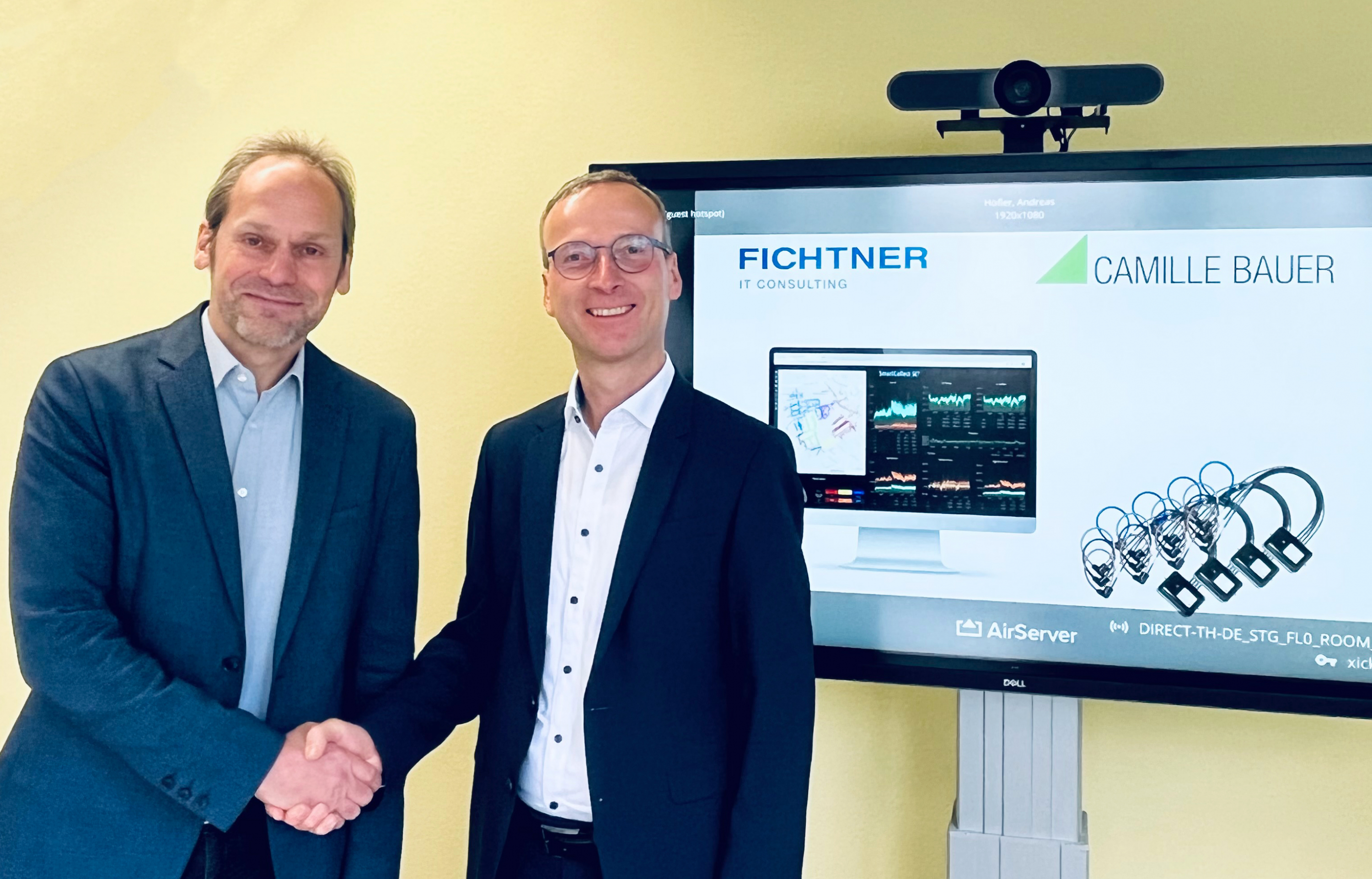
Camille Bauer Metrawatt and Fichtner IT Consulting offer a solution.

Two managing directors make a cooperation agreement, Andreas Höfler, CEO of Fichtner IT Consulting GmbH (left) and Sascha Engel, CEO of Camille Bauer Metrawatt AG).

The term “smart grid” has been bandied about for years. Frequently mentioned in connection with smart meters, it has been used so many times as a buzzword without any real content to back it up, that it has become almost worn out before a global and meaningful implementation could be realized.

Today, however, things appear quite different. Talk of a smart grid within the narrow context of actual "digital grid management” has now become far more meaningful. Renewable energy forms (e.g. PV systems, battery storage, wind turbines, etc.), the vast number of other energy consuming technologies (e.g. hydrogen generation, large-scale DC applications, heat pumps, etc.) as well as the often advanced age of existing assets play a major role. Not only that, distribution system operators, as well as consumers, have to cope with skyrocketing energy prices and an energy shortage. As a result, measures to improve energy efficiency with an optimal CO2 balance are becoming increasingly important. Thus, the focus on active grid management and supply-secure grid operation is intensifying. A future-oriented grid management system for the low-voltage range distribution grid, to complement the possibly existing medium-voltage grid management systems appears to be essential.

All this has prompted the two established companies, Camille Bauer Metrawatt AG and Fichtner IT Consulting, to join forces. High-quality and fundamental measurement data are combined with intelligent digital grid management to fit each application.

Safeguarding grid stability and hence security of supply.
The concept developed by the two established companies Camille Bauer Metrawatt and Fichtner IT Consulting defines a secure approach based on well-founded and market-tested core components. It is based on the fundamental definition of a smart grid as described, for example, by the Swiss Federal Energy Office.

Systemic design structure of measurement
technology and digital intelligence.
In short: it means to operate the existing grid digitally, and thus astutely avoid costly extensions which require a lot of expensive material (e.g. copper). In other words, a smart grid!

The path to digital grid management in four steps Since the cooperation involves the use and combination of proven and innovative technologies, it is advisable to proceed step by step. Both companies have a fundamentally scalable approach to:

    a) avoid overstretching the customer's budget
    b) generate productive benefits at an early stage
    c) ensure further expansion in line with current needs.

Consequently, the two companies propose a project implementation sequence in four steps:

  1. Secure measurement at the low-voltage level to capture the reality in real-time through grid transparency.
  2. Generation of a complete digital image of the grid by deriving the grid status and topology from existing sources.
  3. Presentation of an interactive visualization of the measured values at the measuring points and the resulting grid status in the grid diagram (grid cockpit).
  4. Finalization of a topological end result with the provision of analyses, forecasts and automatic procedures about further developments in the grid status. And this available specifically for each department.

The benefit: significantly lower costs for hardware and control room software, no additional copper in the ground and ultimately a greatly reduced workload, which can even be totally eliminated wherever feasible.

Two hundred and twenty two years of combined expertise.
Camille Bauer Metrawatt AG is a Swiss medium-sized company for the development and production of industrial measurement equipment. As such, Camille Bauer offers customers application-oriented solutions for the high-voltage monitoring and position sensoring markets. This includes a deep understanding of the needs of the electrical energy generation, distribution of energy as well as the industrial consumers. With its Swiss regard for highest quality and its strong capacity for innovation Camille Bauer Metrawatt AG delivers measurable added value to its customers.

A scalable metrological compass with high-resolution zero-blind technology

Fichtner IT Consulting GmbH is the IT competence centre of the world-wide Fichtner Group. They specialize in advising on and implementing high-performance IT solutions for technical networks, facilities and infrastructures. Fichtner combines industry expertise and process know-how with up-to-date technological competence to deliver innovative and cost-effective solutions for the success and satisfaction of their customers. The acquisition, structuring and linking as well as targeted preparation and presentation of information, including spatial referencing, are key to efficient and effective business processes. The concepts and solutions of Fichtner IT Consulting ensure that companies are optimally positioned for digitization.

What the two companies have in common is not only their complementary areas of technological expertise, but also their long track record of success. In 2022, Fichtner will celebrate its 100th anniversary, and Camille Bauer can look back on 122 years of activity. And both managing directors, Andreas Höfler of Fichtner IT Consulting and Sascha Engel of Camille Bauer Metrawatt, see this as a major advantage in an industry that focuses on security of supply. Long-term resilience and years of experience are not incompatible with innovative capability!

• Camille Bauer Metrawatt products are marketed in Ireland through Irish Power & Process (IPP).

@FIT_Fichtner @mepaxIntPR #Camille_Bauer_Metrawatt #PAuto #Energy

Tuesday, 19 July 2022

Towards 100% Renewable Electricity by 2030.

Emerson has joined RE100, a global initiative bringing together businesses committed to 100% renewable electricity. This alignment with other sustainability pioneers in the effort led by Climate Group, in partnership with CDP, is the latest step in Emerson’s plan to source 100% renewable electricity by 2030.*

Mike Train
“Emerson's renewable energy strategy will play an important role in our goal to reach net zero operations by 2030,” said Mike Train, Emerson’s chief sustainability officer. “Our engagement with RE100 enhances Emerson’s ability to drive further investment in renewable electricity and support the overall decarbonisation of the grid in the key markets we operate in, such as the US, Mexico, Europe, China and India.”

To achieve the 2030 target, Emerson will leverage a broad range of renewable energy sources, including solar, wind, geothermal and hydropower. Due to recent efforts in the renewables procurement space, Emerson anticipates sourcing 25% of its global electricity usage from renewable sources in 2022. The company has also installed on-site renewable electricity generation systems at several facilities worldwide and will expand implementation of these systems going forward.

As part of the company’s net zero operations objective, Emerson is targeting 100% renewable electricity coverage from contracted electricity sources and on-site generation assets. Electricity usage drives approximately 75% of Emerson’s Scope 1 and 2 emissions.

“We are delighted to welcome Emerson to RE100,” said Sam Kimmins, director of energy at Climate Group. “By committing to 100% renewable electricity by 2030, Emerson joins over 300 of the world’s leading businesses committed to driving market change. This sends a powerful message that renewable electricity makes good business sense, and we encourage others to follow.”

Emerson established its Energy Sourcing Committee in 2021 to increase the company’s use of renewable electricity, collaborating globally to evaluate and implement renewable energy purchases. Emerson also works with third-party energy specialists active in energy markets to identify emerging opportunities.


*Emerson's latest Environmental, Social and Governance Report.

@Emerson_News @EmersonExchange @EMR_Automation @theRE100 @HHC_Lewis #PAuto #Energy

Wednesday, 25 May 2022

Hydrogen down under!

Advanced automation technology for Toyota Australia’s hydrogen production and refuelling plant.

Emerson and Toyota Australia have collaborated to transform part of Toyota Australia’s operations into a commercial-grade hydrogen production, storage and refuelling plant. The project, supported by the Australian Renewable Energy Agency (ARENA), adopts Emerson’s automation expertise to provide the control system that helps Toyota Australia demonstrate the technical and economic feasibility of manufacturing hydrogen fuels, including the use of renewable solar energy.

As low- and zero-emissions vehicles capture an ever-greater share of the market, countries around the globe need to expand access to renewable fuels like hydrogen. Sustainable hydrogen projects are challenging because they need to integrate many data sources into one balance-of-plant system, a process that’s critical for a facility’s success. For the Toyota Australia Hydrogen Centre, Emerson’s advanced DeltaV™ distributed control system gathers data from the plant’s complex equipment, making it easier to monitor production and storage of hydrogen gas, and document and validate the sustainability of operations.

“By incorporating a digital automation foundation to eliminate data silos, Toyota Australia can not only significantly reduce costs, but also gain greater visibility into system performance, making it easier to maintain and report sustainability performance and increase productivity,” said Mark Bulanda, executive president of Emerson’s Automation Solutions business. “The data foundation Toyota has built will make it faster and easier for like-minded companies to replicate success as hydrogen refuelling networks continue to expand across the continent and the globe.”

Emerson’s DeltaV systems control operations for optimal production efficiencies and help ensure safe operations. Edge control technology from Emerson’s PACSystems™ will further reduce the cost and complexity of integrating third-party systems. Rosemount™ flame detectors will help keep personnel and operations safe. The Toyota Australia team took advantage of pre-existing configuration libraries to reduce set-up time. In addition, Emerson’s technologies create a platform to add future remote operations and data analytics more easily and cost-effectively.

@Emerson_News @EMR_Automation @Toyota_Aus @ARENA_aus @Reuters @EMR_Automation @HHC_Lewis #PAuto #Renewable

Tuesday, 3 August 2021

Smart thermal view of your premises!

Octopus Energy is on a mission to make renewable energy affordable for all. In fact, they’re so serious about helping their customers cut costs, they loan out the FLIR ONE Pro completely free of charge.

Using this thermal camera app, anyone with a compatible smartphone (iOS or Android) can look at their house in a thermal view and quickly spot where heat is either escaping or entering. Chimneys, attics, wall vents, windows, and badly sealed doorways are common culprits for letting cold infiltrate a house but can be extremely difficult to detect. Other common problems a FLIR ONE can reveal include where insulation in the walls or ceilings may not have been installed properly, or single-pane windows that are causing a major energy (and consequently money!) drain.

Octopus Energy has 200 FLIR ONE Pros that they lend to their customers for seven days. In that time, homeowners can find out for themselves where the problem spots in their homes are, and either apply a DIY fix or call in a professional if more work needs to be done.

Greg Jackson, chief executive of Octopus Energy, said in an article by This is MONEY: “While other energy providers might pray for a cold winter, we are committed to keeping customer costs down. We are proud to launch this initiative and show that Octopus isn't afraid to do things differently.”

The thermal camera lending program was a huge hit with customers, who shared pictures of the energy leaks in their homes (or pictures of their dog, equally as important) via Instagram and Twitter. Customers were excited to see the program return this past October with extra COVID-19 precautions in place to keep everyone safe.

@flir @OctopusEnergy @mepaxIntPR #Energy #Pauto 

Tuesday, 12 December 2017

Commitment to 100% renewable energy!

Schneider Electric has committed to sourcing 100 per cent renewable electricity and is throwing light on the doubling of its energy productivity.
The company strongly believes it cannot go renewable without ensuring optimisation of its energy system first. Today’s commitments are yet another step-in Schneider Electric’s journey to becoming carbon neutral by 2030. Aligned with these commitments, Schneider Electric decided to join two global, collaborative initiatives, led by The Climate Group and bringing together influential businesses committed to accelerating climate action:
  • RE100: to use 100 per cent renewable electricity by 2030 with an intermediary objective of 80 per cent by 2020
  • EP100: to double energy productivity by 2030, against a 2005 baseline, setting an ambitious target to doubling the economic output from every unit of energy consumed
Schneider Electric is striving to answer the world’s new energy challenge by boosting energy efficiency everywhere: in homes, buildings and cities, industry, the grid, and throughout remote community. In a world more decarbonised, more digitised, more decentralised, energy use needs to be more productive. In order to deliver on its new promises and its sustained energy efficiency efforts, Schneider Electric will leverage its own technical solutions (EcoStruxure Power, EcoStruxure Grid). Using these solutions, the Group has been able to reduce its energy consumption by 10 per cent every three years for the past 10 years. More specifically, Schneider Electric has reduced consumption by six between 2008 and 2017 at its headquarters in France, The Hive.

These commitments are expeacted to cover more than 1,000 electricity consuming sites around the globe, including 200 factories. Schneider Electric will leverage a broad range of renewable energy sources, including but not limited to solar, wind, geothermal and biomass.

Schneider Electric will drive its transition to 100 per cent renewable electricity through three levers, with an interim goal of achieving 80 per cent renewable electricity use by 2020 to 100 per cent in 2030:
  • On-site projects at Schneider Electric facilities around the world: with renewable energy initiatives, already in place at some Schneider Electric locations, such as a solar rooftop at its sites in Vadodara (India), Bangpoo (Thailand), or geothermal energy and a solar rooftop at its flagship office “The Hive”, France, among multiple others. Schneider Electric will install on-site renewable energy projects to help achieve its 2030 target. While on-site projects are expected to deliver a portion of Schneider Electric’s renewable electricity needs only, they will add to the company’s renewable energy capabilities, and act as a showcase for other organisations contemplating such options, together with energy efficiency enabling technologies;
  • Offsite long-term procurement through Power Purchase Agreements (PPAs): a PPA is a long-term (12-20 year) contract between a renewable energy developer and a dedicated, creditworthy buyer. PPAs enable developers to secure financing for new wind, solar or other renewable electricity projects and allow buyers to enjoy predictable pricing from clean energy sources;
  • Energy Attribute Certificates (EACs) and green tariffs: an EAC is a free market instrument which verifies that one megawatt hour of renewable electricity was generated and added to the grid from a green power source. Schneider Electric will use EACs as a flexible and fast way to acquire and track renewable electricity
Emmanuel Lagarrigue, Chief Strategy Officer and Executive Vice President at Schneider Electric said: “We are in a new world of energy that is becoming more electric, more decarbonised, more decentralised, and more digital. Our mission at Schneider Electric is to supply the technologies that permit, drive and catalyse the transition to a new world of energy. The commitments we have made today in joining RE100 and EP100 to source 100 per cent renewable electricity and reflect on the doubling of our energy productivity are a demonstration of how consumers and business can be empowered to ensure the affordability, resilience, sustainability, and security of the energy that they consume.”

Helen Clarkson, Chief Executive Officer at The Climate Group said: “Already a leader in the energy space, joining RE100 and EP100 represents a smart business decision for Schneider Electric. These commitments will help the company to deliver on its wider climate ambition to become carbon neutral by 2030. Doubling energy productivity will help it to use energy as economically as possible while making the transition to renewables, which are themselves cost-competitive in many markets. I welcome the powerful signal Schneider Electric is sending to peers, investors and governments, to accelerate the transition to a zero-emissions economy.”

At COP21 in Paris in 2015, Schneider Electric announced 10 Commitments for Sustainability. The commitments were aligned with the Planet & Society Barometer, Schneider Electric’s sustainability scorecard to measure its ambitious commitment to sustainable development on a quarterly basis and contribute to the UN Sustainable Development Goals. These commitments support the company’s objectives to make its plants and sites carbon neutral by 2030, in a coherent industry ecosystem encompassing both suppliers and clients.

@SchneiderElec #Pauto #Environment @tomalexmcmahon

Monday, 10 October 2016

Solution to boost use of renewables.

A modular and scalable “plug and play” microgrid solution to address the globally growing demand for flexible technology in the developing market for distributed power generation has been announced by ABB. The cost-efficient, containerised solution is relevant for mature and emerging countries and will help maximize the use of renewable energy sources while reducing dependence on fossil fuels used by generator sets.

ABB’s innovative technology with the PowerStore Battery and the dedicated Microgrid Plus control system as well as cloud-based remote service can not only provide power access to remote areas, but also secure cost-efficient uninterrupted power supply to communities and industries during both planned and unplanned power outages from the main grid supply.

All the equipment required to run the microgrid – ABB’s power converter and dedicated control system, Microgrid Plus, as well as battery storage – has been integrated into a container for faster, easier and safer deployment. The customer can choose to configure the microgrid to integrate energy from solar, wind, main grid or diesel generator supply, based on the application and local conditions.

ABB’s modular microgrid is compact and has four pre-designed variants in the range of 50 kW to 4,600 kW, to meet varying customer needs. The standard integrated functionalities include grid-connected and off-grid operation with seamless transition. It is a containerized solution designed for easy transpor­tation, fast installation and commissioning onsite. Operations and maintenance is enabled via a cloud-based remote service system, another example of ABB’s clear positioning as a pioneering technology leader driving the energy and fourth industrial revolutions.

“Our modular, standardized and scalable microgrid solution will provide cost efficient access to reliable power for rural and urban applications, as a plug-and-play solution“, said Claudio Facchin, President of ABB’s Power Grids division. “It exemplifies ABB’s continued commitment to innovation and reducing environmental impact by enhancing the integration of renewable energy sources and reducing dependence on fossil-fuels, all key elements of ABB’s Next Level strategy.”

@ABBgroupnews #PAuto #Power

Wednesday, 12 January 2011

Appointment brings focus to energy and controls markets

Carlo Gavazzi is extending its management team in Britain to help it meet the demands of the fast-growing renewable energy and building management markets.  Amir Sami is joining the company as business development manager responsible for energy and controls.

Amir Sami
Alan Hickman, managing director of Carlo Gavazzi  commented, “The energy and controls markets are evolving rapidly on a global scale.  The appointment of Amir will enable us to continue developing and supporting our UK customers in this strategically important market.  I am positive that Amir brings the drive and determination to the team that will invigorate our business in this market.”
 

Amir will take responsibility for sales management and strategy for Carlo Gavazzi’s energy and controls product ranges and will work closely with the dedicated UK-wide distribution network to support customers on control, renewable energy and building management solutions.  Amir has extensive experience in PLCs, drives and human-machine interfaces, and, as an Associate member of the Chartered Management Institute, has business administration qualifications bringing significant insight of operations, marketing, and strategic management to the role.

Commenting on his new position, he said: “I am confident that there is great potential for growth with Carlo Gavazzi’s control and energy solutions and I’m looking forward hugely to meeting our loyal customers and forging even stronger relationships.”

Amir gained a B.Eng. in Electronics Engineering in 2004 and began his career with Carphone Warehouse in the Express Engineering Division. This led to a team leadership role for express repair retail stores, before progressing to sales and sales management with specialist electrical distributors in the automation industry. Prior to joining Carlo Gavazzi, Amir worked extensively on international projects for rail and lift applications.

Tuesday, 23 November 2010

New business manager

Siemens appoints new business manager for renewable energy

Kevin Moloney
Siemens Limited has appointed Mr. Kevin Moloney as business manager for renewable energy for Siemens’ Energy Sector. Kevin’s appointment reflects the growing market for renewable energy products and solutions in Ireland. Kevin holds an MBA in International Business from the Centre des Etudes et Recherche et Applications Management (CERAM Sophia Antipolis {F}) and is a graduate of the Waterford Institute of Technology. He holds numerous industry qualifications across engineering and projects.

Kevin has spent over 15 years working in utilities industries, leading the development of new services, products and markets in energy and telecoms. Prior to joining Siemens, Kevin worked with PA Consulting Group as principal consultant with responsibility for developing their Irish energy and utilities portfolio for four years.

Siemens is a global electronics and engineering company providing products, systems, services and solutions for the industry, energy and healthcare sectors. Siemens Energy Sector is the world’s leading supplier of solutions for the generation, transmission and distribution of power. The company employs around 1,000 highly skilled people in Ireland and has offices in Dublin and Cork.