Showing posts with label Datacentre. Show all posts

Monday, 6 March 2023

Mitigating harmonics.

The Ecosine Active Sync is a modular product, from Schaffner, that has been on the market for around five years and actively mitigates the harmonics sent back to an electrical network, reducing or suppressing disturbances by taking the harmonic current generated by non-linear loads and converting it. In Europe, the current level for effective harmonic mitigation is 50Hz and the AHF solution is ideal for applications where harmonics levels are continually changing, such as when producing high quality products like semiconductor wafers.

Ecosine delivers a solution for three- or four-wire system, mitigating harmonics between the phases and neutral wire. It needs to be programmed to fine-tune it to a specific application but, up until now, the traditional way of doing this has been by connecting a computer or laptop with a special cable plus associated software. At the same time, direct machine-face interaction was only possible through a 2-inch (5cm) monochrome display that required the user to press physical buttons to switch through the various parameters and enter values.

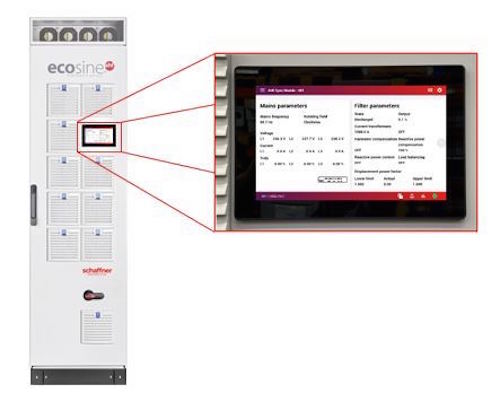
As an alternative to the monochrome Display module and the AHF Viewer PC software, Schaffner step up the user experience with the new HMI unit that uses a large 7 inch (18cm) capacitive colour touch-screen. Using simple screen swipe functions familiar to any smartphone user, this modern user interface makes it more straightforward to access and view all the necessary parameters – while reading and entering values where required. The new HMI makes it possible to change and monitor all filter parameters and measured values of the three-phase network. It can plot up to six traces in an oscilloscope style view, and ensures all measurements are saved automatically to the built-in memory (for subsequent downloading to a USB drive if needed).

With the Ecosine Active Sync used widely in such challenging and demanding sectors as the automotive and robotics industries – as well as in large data centers and semiconductor manufacturing – simplifying the AHF’s operation and modernising how users interact with it were key factors behind Schaffner developing the new HMI.

Says Luc Mosca, Product Manager at Schaffner: “This new HMI is a substantial advance on the previous user interface and enables us to upgrade the user experience to a level where interaction with the Ecosine is a much easier process. With just a simple check, the operator can see instantly whether everything is working okay or if there are any alerts, with errors or warnings displayed clearly on the large colour screen.”

Luc adds: “We have worked closely with customers, consulting with users about what they require from a true human-machine interface and we have come up with a solution that meets their needs. We have already received some highly positive feedback on the new HMI and we expect this to continue as more Ecosine come on-stream. When you place an order for a new Ecosine Active Sync you now have the option of having one featuring this advanced interface and we expect most new buyers will choose to work with this more user-friendly HMI. Of course, they can continue to interact with the AHF via hardwired computer or laptop and dedicated software if they prefer.”

Development of the Ecosine Active Sync Cabinet is based on the extensive knowledge and experience the Schaffner Group has garnered over decades of creating solutions for power quality applications. The most common application for the Ecosine Active sync is in heating ventilation and air-conditioning (HVAC) installations and uninterruptible power supplies (UPS). They are also used across logistics, parcel sorting and luggage handling at airports as well as wind turbines, the steel industry, paper mills, tunnel ventilation and more.

Whether used as a stand-alone unit or combined with others to meet the customer’s requirements, is the Ecosine Active Sync is designed to meet the most demanding harmonic mitigation challenges, whatever the non-linear load involved. In the era of Industry 4.0 and smart energy management, the optional sync module monitors the filter’s usage and allows redundancy to deliver a truly smart power quality solution.

@NapierPR #Schaffner #HMI #Electrical

Wednesday, 18 April 2018

Power System Manager enables monitoring.

The Power by Linear™ LTC2972, a 2-channel power system manager, featuring current, power and energy monitoring of the intermediate bus input to point-of-load (POL) converters has been launched by Analog Devices. Monitoring circuit board power and energy use is a prerequisite for managing, optimizing and reducing their consumption in order to lower server rack and data center cooling and utility costs. The LTC2972 relieves the host of burdensome polling and computation by conveniently providing the input energy, reported in joules, and the elapsed time through a PMBus interface.

When combined with its digital measurements of POL output voltages, currents, and power, the LTC2972 enables long-term monitoring of a power system’s conversion efficiency. The LTC2972 adds comprehensive software-based monitoring and control to the power systems of FPGA, ASIC, and DSP boards, accelerating time to market, enhancing system reliability, and optimizing board energy consumption.

Supply output voltages are trimmed, margined, and monitored using a best-in-class 16-bit analog-to-digital converter (ADC) with 0.25% total unadjusted error (TUE), improving board yields and long-term performance. Supply output currents are measured using a sense resistor, inductor DCR, or the IMON output of a power supply. Supply sequencing, supervision, and EEPROM fault-logging are built in. Faults trigger EEPROM black box recording, simplifying failure analysis while providing insight into future system improvements. Programmable power good, or general-purpose input/output (GPIO), pins are available with each channel. The LTC2972 connects with other power system managers to coordinate sequencing and fault management of more than two rails. PMBus-compatible commands are used for flexible programming and data readback of the power system. Configuration is accomplished through the LTpowerPlay® development environment, which supports all Power by Linear power system management (PSM) devices. Once programmed, no software coding is needed for autonomous operation.

Specified over the 0oC to 70oC commercial and −40oC to 105oC industrial temperature ranges, the LTC2972 is offered in a 44-pin 6mm x 7mm QFN package.

@ADI_News #PAuto

Wednesday, 4 October 2017

Supporting datacentres!

To support the smooth running of data centres, Fluke has developed a web microsite specifically targeting those running and maintaining the infrastructure. The site provides a range of downloadable information for Data Centre Facility Managers, Contractor Services Managers, electrical engineers and UPS, HVAC, mechanical and electrical technicians. Easy contact is made possible with an expert from Fluke who will be able to advise on the best Fluke tool to solve a problem.

Best-in-class tools from Fluke can be relied on to keep data centres running smoothly. Fluke tools can help prevent UPS, HVAC, IT equipment, and generator failure. Downtime can be minimised with planned use of Fluke thermal imagers, battery testers, clamp meters, digital multimeters, and power quality analysers. Whether a member of an in-house maintenance team or a contractor performing maintenance, Fluke has solutions to increase the efficiency of their day-to-day tasks.

The microsite offers downloadable content, including:

  • ‘Data Center Solutions’ – showing a plan of a data centre and suggesting checks that should be made and suitable Fluke tools for carrying out those tasks;
  • ‘Six essential tests to keep your UPS system running’ – describing the regular testing of individual battery cells as well as the UPS system as a whole;
  • ‘Monitoring temperature, humidity and airflow in data centres’ – a US-based application article describing the use of a thermal imager and an airflow meter to monitor the true ambient conditions;
  • ‘Detecting electrical unbalance and overloads’ – describing the use of a thermal imager, power quality and other electrical test tools to monitor and resolve issues.

A wide variety of Fluke test tools including those offering Fluke Connect®, the award-winning software solution that keeps users connected remotely, are covered by the documentation.

@FlukeCorp  #PAuto #TandM

Friday, 7 July 2017

Open Rack technology.

Over three per cent of global electricity output is currently expended on data centers – one of the fastest-growing consumers of power today. This development is being countered by the recently founded Open19 Foundation with a new concept: standardised, modular IT infrastructures ensure higher efficiency, reduced costs, and greater flexibility in the data center. Rittal is now a member of the foundation to push the innovative approach forward together with other representatives.

Rittal has joined the Open19 Foundation. Driven by the Microsoft subsidiary LinkedIn and global vendors, such as HPE and GE Digital, it was launched in May 2017 with the aim of making data centers more cost-effective, more efficient and more flexible. The open source design is based on a standardized architecture for computer and storage components in a standard 19-inch rack, in which the components from different manufacturers are compatible with each other.

Jason Rylands
“Because of the rising energy costs, we use all possibilities for more energy efficiency in favour of our customers. Underlining this, we have joined the Open19 Foundation in which we help shaping innovative rack design”, says Jason Rylands, Global Director, Data Center and Open Compute Solutions at Rittal.

“The Open19 Foundation is a fast-growing community of companies across a wide range of data center and edge ecosystems. We are very pleased that Rittal, as a key actor and global player in the market, is now a member of the Open19 Foundation”, said Yuval Bachar, who chairs the Open19 Foundation.

Standardized design at less cost
As the newest member of the Open19 community, Rittal offers an inexpensive and quickly applicable solution in the form of an Open19 rack based on the standard 19-inch rack. In addition, the system vendor will support the Open19 ecosystem through being a member and promote innovations both for existing data centers and for changing customer requirements.

“As a member of the Open19 Foundation, Rittal is now even better positioned to meet the needs of the data center market. These include the growing number of hyperscalers, colocation providers, as well as telecommunication convergence and edge computing”, Rylands added.

Standardization for a shorter time-to-market
One advantage of the innovative Open19 architecture is the use of direct current to supply the servers. The electricity is distributed via a special cable harness connected to the power shelves.

The DC power supply ensures energy efficiency. The standardized, modular configuration cuts the time-to-market while the scalability enhances the flexibility in the data center.


@Rittal @open19in #PAuto

Tuesday, 27 June 2017

Partnership delivers modular data centre solutions.

Rittal and HPE offer solutions for IoT and Edge
From left: Andreas Keiger (Rittal), Mark Lepore, Brian Whelan, David Winn (HPE), Markus Fischbach (Rittal), Mike Fallos (HPE), Ray Snider, Thomas Schreiner and Dirk Miller (Rittal). 
Foto: Rittal GmbH & Co. KG
Rittal is to partner with Hewlett Packard Enterprise (HPE) to jointly deliver modular data center solutions for the global market. Rittal will bring to the joint market approach their broad portfolio of modular and scalable datacenter solutions from a micro data center to largely scalable container solutions. This will be complemented by HPE Pointnext-services.

“Hewlett Packard Enterprise is a valuable partner for Rittal, bringing us a broader reach to help customers quickly with high end complete datacenter solutions according to their needs”, said Andreas Keiger, Executive Vice President Sales, Rittal.

The partnership will offer complete IT solutions and competencies, bringing customers worldwide the support, equipment and consultancy that is needed to take advantage of the latest IoT and IT Edge requirements.


Commenting on this partnership Brian Whelan, WW Director Data Center Facilities, HPE, said: "Rittal´s modular "lego-style" system for IT Infrastructures fits perfectly with our own offerings and capabilities, helping to provide customers a simplified and seamless experience."

This partnership will focus on markets requiring "plug and play" Hybrid Cloud and Edge solutions. Customer benefits are core data center performance at the edge, agility, proven technology, fast and easy deployment, and cost and energy efficiency.

@rittal #PAuto @HP

Friday, 23 June 2017

Heading for Data Centres event!

The utilities department of Hanley Controls Clonmel have signed up to exhibit at Data Centres Ireland Exhibition & Conference in November at the RDS in Dublin. They intend to showcase the following: Nobel Fire Suppression , IGD Gas Detection and Water Leak & Humidity Detection Systems.

DataCentres Ireland is in it’s Sixth year this year and combines both a dedicated exhibition and an adjacent multi-streamed conference, giving attendees access to the latest in information, best practice, products, services and solutions. The Conference is an opportunity to hear the latest in ideas, best practice and case studies presented by leading industry experts and part in facilitated discussions.

@hanleycontrols #PAuto @datacentresire

Tuesday, 30 May 2017

Innovative solutions for datacentres.

Datacloud Europe (MC: 6 -8 June 2017) is one of the leading events for modern datacenters in Europe.  Rittal, involved as a sponsor, is participating in the accompanying exhibition and is will be providing presentations on state-of-the-art technologies related to “Modular to Hyperscale Datacenter Cooling and Energy Efficiency”. Solutions being presented include the Lefdal Mine Datacentre project, a highly efficient datacenter that uses regenerative energies.

Energy efficiency, scalability and safety are among the central requirements for modern datacenters. Rittal will be presenting a variety of solutions, such as the Lefdal Mine Datacentre (LMD), at the Datacloud Europe congress in Monaco.

Very high energy efficiency: The Lefdal Mine Datacenter
The datacenter, which runs solely on renewable energies, is located over an area of 120,000 square meters on Norway’s west coast. With the LMD, Rittal offers a unique location – it is one of Europe’s most efficient, cleanest and most secure datacenters. Customers can create their own private cloud from different platforms (SAP Hana as a Service, and HPC as a Service), which they operate themselves or can have run as managed services. Benefits include the scalability of the system, its high energy efficiency, as well as the variety of operating models, from colocation to private cloud and through to DCaaS (Datacenter as a Service).

Quick and easy: Edge datacenters
Visitors to the Rittal stand (39) can also find out about turnkey edge datacenters. The solutions, with their standardised, preconfigured IT infrastructure, can also be used with high availability rooms and so ensure the protection needed against heat, dust and dirt in industrial manufacturing environments. This way, companies can quickly and easily create new IT environments for digital processes in order to adapt their IT to the new challenges.

@Rittal #PAuto 

Tuesday, 3 May 2016

Datacentre tool box!

A new Datacentre Tool Box from Microlease has been introduced to equip data centre engineering teams and their subcontractors with the varied instrumentation support that they need to complete installation, upgrades and routine maintenance projects in a single package. It provides a customisable rental package of instruments and equipment for electrical power test, thermal imaging, cabling and optical transmission test – all to the latest standards. The tool box can be delivered to any site world-wide, ready-calibrated and fully tested for immediate use.

The new tool box is aimed at modern data centres that need to provide their customers with high availability to exacting performance standards. Here, high-quality testing is critical across a broad range of technologies.

Rental packages like the Datacentre Tool Box offer engineers access to a broad array of instrumentation, with advanced functionality, high performance and delivering absolute accuracy. The Microlease tool box provides customers with all the different items of equipment needed. It presents ample scope to mix and match an extensive range of options direct from stock. The rental approach offers maximum flexibility in that items can be returned when no longer required or swapped for other models if different test parameters have to be addressed.

The Microlease Datacentre Tool Box encompasses the following elements:

  • * Electrical energy loggers including the Fluke 1735; instruments to measure electrical power disturbance over time, for example the Dranetz HDPQ Power XPlorer; and high-end, realtime power quality analysers like the Newtons4th PPA5500 series.
  • * Infrared imaging systems such as Fluke Thermovision and Keysight TrueIR cameras help to identify cooling issues or systems and cabling at risk of overheating. These instruments can, for example, diagnose out-of-balance three-phase systems that draw excessive current on the zero line.
  • * Cable testing for both copper and fibre installation and renewal is enabled through devices like the Fluke DSX-5000 or the Viavi Certifier 40G.
  • * A choice of easy-to-use return loss testers or more sophisticated optical time-domain reflectometers for single-mode or multimode fibre. Fluke Certifibers or the Viavi SmartOTDR fall in the first category, whilst the Viavi MTS-2000, Exfo MAX-720 and Fluke OptiFiber cater for the higher-end requirements. All instruments can be supplied with fibre inspection probes to make sure connectors are clean.
  • * The Fluke MultiFiber Pro offers an easy to use loss-test set for systems using multifibre push-on (MPO) connectors, diagnosing bad connections, sharp bends and the like.
  • * Available instrumentation for the growing range of transmission protocols used in data centres - from legacy SDH to 1-100 Gbps Ethernet through all rates of fibre channel - includes Exfo FTB-880 and FTB-8830, Viavi MTS-5822 and new CSAM - 100Gig Ethernet testers. There are also testers for high speed (100Gig) interfaces for CFP-1, CFP-2, CFP-4 and QSFP, so that all different interfaces are supported.
  • * Custom tool box functions can be augmented to facilitate additional functions such as electrical safety and earth resistance test, cable location, and vibration testing to avoid mechanical damage.

By using rental to source test equipment for every project, the correct and most efficient instrument can be used without making compromises. Datacentre Tool Box users additionally benefit from Microlease’s global logistics and service operations.

@microlease #TandM #PAuto

Monday, 1 February 2016

Comprehensive data centre testing.

Cressall is partnering up with its French sister company, Rentaload, to provide the British market with an effective means of load testing data centres. The collaboration comes as a response to the growing popularity of cloud computing and consequently, the need for reliable data storage.

Rentaload provides a range of load banks for a variety of industries - from oil and gas to the health sector. The company specialises in renting innovative rack-mounted load banks for the specialised testing of data centres. Cressall is now the UK contact for businesses seeking to rent load banks from Rentaload.

Traditionally, data centre load testing focussed purely on the data halls and back-up generators. Testing was often carried out on individual systems, even before the final infrastructure - such as heating, ventilation and air conditioning (HVAC) or server racks - were in place. This testing method sometimes meant problems arose because elements of the data centres hadn't been tested together.

To address this issue, Rentaload supplies load banks that emulate servers, rack-mounted to provide an accurate perception of working functionality under normal operating conditions. This means they mimic the actual load on the HVAC system, automatic transfer switches and the electrical system. This allows the client to test the whole system under normal operating conditions.

Single phase rack-mounted load banks are available at 7kW and 11kW loads and free standing 21kW single/three phase mini-tower units.

"It's imperative for companies to test data centres at their full working capacity before servers are switched on," explained Mark Templeman, sales engineer at Cressall and representative for Rentaload. "You don't have to look back too far to see the consequences of downtime in data centres. It is what gave birth to tier certification. "Data centres are awarded different tiers of certification depending on their reliability and levels of redundancy in place. These certifications are awarded by an unbiased advisory organization, Uptime Institute and are categorised from one to four. Tier four recognises the highest level of reliability for a data centre. Using Rentaload's rack-mounted load banks to accurately test working loads on electrical, back-up and HVAC systems is an effective way of proving reliance and achieving tier certifications."

Friday, 15 May 2015

Chilled-water close control unit for datacentres!

Magister CW by CIAT is a vertical chilled-water close control unit specially designed to meet the requirements of data centres, computer rooms, switchboard rooms, electrical equipment rooms and other rooms with high thermal loads. Magister CW is 25% more energy efficient than previous versions and uses 20% less power than other models on the market, which amounts to savings of up to €5000 each year! Magister CW is available in five models with capacities ranging from 10 to 130 kW.

Such energy performance is made possible by Magister CW's highly optimised fan motor assemblies, which consist of centrifugal plug fans (for enhanced air handling efficiency) associated with EC motors (for optimum energy efficiency).

The unit uses CIAT's microRC2 controller to self-adjust its operation on both the water and the air circuits. The automatic controller adjusts the fan speed according to the thermal loads of the room and uses a 0-10V signal to control the valve and finely adjust the unit's operation to required levels. An optional enthalpic free cooling module can be added which allows fresh outdoor air to be drawn into computer rooms when their internal temperature and humidity levels reach a certain threshold.

Data centre applications require the very highest levels of reliability. The entire Magister CW range is built with 25 mm double-skin construction and features M0 fire insulation (Euroclasse A1). Optional redundancy functions can be installed to interconnect up to 10 units so that, in the event that one unit fails, the others will automatically take over. Thanks to the RS485 Modbus board, the smallest malfunctions (fan motor assembly, humidifier, abnormal variations in input power, etc.) are detected in real time and relayed as alarms to the supervision system.

It is designed to facilitate maintenance. All its compartments are accessed via hinged doors on the front panel, the fan and motor are directly coupled, and the filtration system is fitted on a mount for easier handling.

Furthermore, Magister CW is 20% smaller than previous models. In order to achieve the highest efficiency with chillers and operate longer in free cooling mode, the water and air temperature ranges in data centre applications are increasingly higher. The Magister CW fan is therefore more powerful and delivers higher air flows. As a result, it delivers more power for the same footprint.

This unit is part of CIAT's CIATRONIC System data centres offer. It combines chilled water production, free cooling and air diffusion. The speed variation of the EC motors, associated with the flexibility offered by water, provides a perfect solution for the changing requirements in data centres. CIAT's solutions constantly adapt to the needs of Tier 4 data centres, be they changes in their classification, changes in their thermal loads over time or needs for modularity.

Their CIATRONIC System includes its AQUACIAT POWER chillers, Opera dry coolers, the Cristopia thermal energy storage system, ITEX plate heat exchangers to isolate the secondary network, the solution for direct free cooling with the Airtech air handling unit, and Magister precision close control units.

Monday, 24 November 2014

Building your data centre on a firm foundation


An efficient IT infrastructure is now at the core of every modern business but underneath the tiers of applications and operating systems, a robust and reliable platform is essential.

Rittal's TS IT provides optimum stability and maximum space utilisation due to the welded frame construction. A depth of 1200mm allows for any additional space that may be required for the next generation of servers. Innovately designed verticals provide a static load rating of 1500kg to incorporate any increase in server weight.

Featuring Rittal's latest door design, the new TS IT has an even greater air flow with an 85% open area to provide cool air to the housed servers. An intelligent design also ensures maximum air flow with no loss of strength. Adaptable verticals allow infinite mounting positions and the tool less 19î mounts limit the time engineers are on site. Dual side panels are split making it easier to move 1200 and 1000mm deep panels. Side panels can be easily locked into place providing complete security. Security is also provided by a standard four point locking system.

Barry Maidment, Rittal IT Product Manager commented "The TS IT satisfies demands of the future, not just demands of today. Modern businesses depend on the IT infrastructure to deliver them a competitive edge, the TS IT has, for many years, been a market leader due to itsí flexibility, reliability and exceptional design. The humble rack may be the most technical item in the data centre construction but has to be the most adaptable. With a fast moving technical market the TS IT must be able to cater for multiple technologies, ie network cabling, switches, servers, power and cooling systems."

Tuesday, 26 August 2014

Continuing professional development in datacentres switchgear assy!

Rittal Ltd has launched three new accredited seminars to support customers in their Continuing Professional Development (CPD). The seminars have been reviewed and assessed by the Chartered Institute of Building Engineers (CIBSE), to ensure the technical content is of a high standard and offers valuable CPD to delegates. All attendees will receive a certificate as evidence of their participation.

The seminars, which are free of charge, take the form of short informative presentations, a workshop and are as follows:

Building a Data Centre in the Perfect Storm:
Covering aspects of complete relocation of a Data Centre, including refurbishment and regeneration, this CPD seminar takes the form of a real life case study of Nottinghamshire County Council (NCC). Connecting 130,000 users across 700 buildings and 60,000 computers the case study looks at how NCC delivered a new state of the art data centre and coping with the perfect brain storm of migration and updating whilst maintaining essential IT services.

Aimed at all levels of mechanical engineers, facilities managers, estate managers, electrical engineers and IT managers, this course can be presented at consultant and contractors offices or at Rittal’s specialist Data Centre location in Enfield (GB).
An Introduction to the Application of IEC 61439:
Designed to give a brief introduction to the IEC 61439 (the new switchgear and controlgear assembly producti-on standard), this seminar looks at how it should be applied to the design and manufacture of low voltage switchgear and controlgear assemblies.

Incorporating four key parts: enclosures, climate control, busbar and the devices, the standard looks at assem-blies as a total system and not as individual components and how they react together and perform under test conditions.

Aimed at all levels of expertise within engineering departments, courses can be either presented at consultant or contractors offices or at Rittal’s Head Office showroom and demonstration centre in South Yorkshire, Rittal’s offices in Livingston or, alternatively, at Rittal’s production factory in Plymouth (GB).

Data Centre Energy Efficiency:
Looking at different strategies that can be implemented and the potential gains and compromises that could occur, this seminar covers a broad spectrum of techno-logies and processes including Data Networks, Data Centres, Computer Rooms, Heating and Ventilation as well as IT infrastructure and Building Management.

Aimed at all levels of mechanical engineers, facilities managers, estates managers, electrical engineers and IT managers, this CPD course can either be presented at consultants and contractors offices or at Rittal’s specialist Data Centre location in Enfield.

Monday, 9 June 2014

Flooded airflow cooling solution!


Rittal have recently provided high quality TS IT server racks, with a customised chimney venting solution, for data centre provider Datum who required cost effective cooling technology when developing their flagship Farnborough (GB) facility.
After research Rittal’s roof mounted chimney module, a one piece duct assembly on top of the TS IT enclosure for airflow management, was found to work perfectly with the patented ecofris cooling solution from Keysource.

A reliable passive system requiring no fans or electrical connections, the chimney module permits the hot and cold air to be separated efficiently, eliminating the hot aisle, as the exhausted heat is contained within the chimney system.

Utilising Rittal chimney modules allowed the cooling system in the room to work to its’ full potential, delivering a PUE of 1.2 or less, achievable even with a partial load.

Dominic Phillips, MD of Datum said “The result is a complete alignment of our energy efficient goals with those of our clients delivering a reduced carbon footprint and cost”.

Friday, 2 May 2014

Integrated CWDM Solutions for ISPs, data centres & telecoms!

B&B Electronics’ iMediaChassis family of multiport chassis will offer operators, ISPs, and data centre users a low cost and extremely compact, 3U high, one box solution, for CWDM services. In addition to the physical conversion of either local fibre or copper to specific CWDM wavelengths, the product also offers advanced management features allowing the operator to monitor a wide variety of parameters, most importantly quality of the optical signal.

Fibre installations have not kept pace with the demands made of the physical infrastructure. As an operator/owner of fibre, going back to install new ‘dark’ fibre is cost prohibitive. For a customer, renting extra dark fibre will obviously involve extra costs.

A solution to limited fibre availability is provided by CWDM (Coarse Wavelength-Division Multiplexing) technology, a method by which multiple wavelengths of light are multiplexed into a dedicated fibre pair and demultiplexed at the other end of the link. CWDM links are traditionally point-to-point, all wavelengths are independent of each other and they can carry data from different devices, services or customers. Multiplexing effectively increases the bandwidth of the pre-installed fibre.

CWDM systems offer service providers and Enterprise companies scalable and easy-to-deploy Gigabit Ethernet and Fibre Channel and TDM services for their networks, which may be deployed in data centres, on campus or metropolitan-area access networks.

B&B Electronics can provide a cost effective, compact, single chassis CWDM solution. The iMediaChassis chassis and associated modules can offer:

  • Copper to CWDM conversion (TDM [E1], 100Mbps, GigE, 10GigE [CX4])
  • Optical to CWDM conversion (100Mbps, GigE, 10GigE, FibreChannel, 10Gig FibreChannel, OC-192 / STM-64)

Within one chassis, the CWDM wavelengths can be created and in addition up to 8 CWDM channels can be MUX/DEMUX’d. This solution also has the advantage of being SNMP compliant, the operator can monitor optical information such as receive and transmit strengths.
The B&B Electronics iMediaChassis offers a mix of up to eight conversion modules, E1, GigE and 10GigE. For E1 the interface to the local equipment will be via RJ-48, for GigE the interface could be optical or copper and finally for 10GigE the interface will be optical. In each of the modules the applicable CWDM SFP, SFP+ would be installed.

Typical application for this solution would be multi-service provisioning over a dedicated point to point fibre e.g. ISP/Telco provided optical link, or a rented dark fibre.

The iMediaChassis provides 20 slots with dual AC input and two load sharing, hot-swap AC power modules providing N+1 redundant power DC input power supplies are also available. If required an optional SNMP Management Module may also be specified.

CWDM solutions can be provided for:
E1, Ethernet (100Mbps, 1GigE, 10GigE), Fibre Channel (2.4Gig), OC48(2.4Gig), OC192 (10Gig)

Multiplex/de-multiplex solutions:
4 channel or 8 channel + 1x expansion port.

Monday, 3 March 2014

Power usage effectiveness efficiency!

Rittal now offer customers an optional efficiency package to determine and display the energy consumption in a RiMatrix S standardized data centre via the power usage effectiveness (PUE) value.

Installed in the sub-distribution or enclosure suites, the PUE efficiency package for the RiMatrix S is hardware and software that gives IT administrators information on efficiency values in the data centre quickly and simply. Presentation of the results and their preparation is performed in the Rittal RiZone data centre infrastructure management (DCIM) software.

Consisting of intelligent socket systems (Power Distribution Units), instruments for measuring power consumption and the RiZone DCIM software, this optional package allows administrators to easily optimise the efficiency and energy consumption in the RiMatrix S.

RiMatrix is a complete data centre portfolio comprising of standardised components: a defined number of TS IT server and network racks, climate control, power supply and backup systems, as well as monitoring systems. Together, these form a complete server module. By concentrating on standardised data centre modules and ideally coordinated components, the RiMatrix S achieves an extremely low value up to 1.15.

Tuesday, 21 January 2014

Data Centre order for New Zealand!

Rittal has received its first international order for its RiMatrix S standardised data centre.

Based in Christchurch, New Zealand, utility company Orion supplies electric power to the city’s 400,000 residents to make Christchurch’s power supply even more stable. Orion has been using Rittal’s IT infrastructure to support the operation and management of its’ entire electricity network since 2011.


Orion is to deploy Rittal’s RiMatrix S as a backup data centre to ensure maximum safety and robustness in this earthquake-prone region. The standardised facility will be installed in a container. Orion chose RiMatrix S for Rittal’s short delivery time, innovative climate control solution and no need for laborious planning, cutting both time and costs.

Meeting all of Orion’s requirements, the Single 9 version of RiMatrix S has eight server racks and one network equipment rack. Climate control is provided by a Zero-U-Space Cooling System (ZUCS). The air/water heat exchangers are located within the raised floor to avoid wasting server space.

Monday, 22 July 2013

Protect IT applications

Under the theme "Make IT easy", Rittal has bundled together all 2013 product highlights in a new brochure.

The "IT News 2013" brochure contains 85 pages of Rittal's latest product innovations, providing detailed descriptions capable of providing the right solution to suit every IT application. Products and solutions range from RiMatrix S data centres, optimum IT climate control through to compact modular safes and intelligent monitoring systems.

A clear focus of the brochure is the 30-page section on RiMatrix S which truly represents a paradigm shift in the IT world and opens up new perspectives for standardised data centre construction. "IT News 2013" is rounded off by a large range of water-based and coolant-based climate control solutions, security safes used as compact data centres through to fire alarm and extinguishing systems, as well as monitoring systems.

Wednesday, 2 May 2012

Data centre environmental wireless temperature sensor

Unique Daisy Chain Design Enhances Measurement Flexibility and Reduces TCO

Wireless Sensors has expanded the SensiNet Rack Sentry family of environmental monitors with the introduction of the Multi Sense wireless temperature sensor. The all new Multi Sense is designed specifically to help data center operators increase efficiency while maintaining adequate cooling for the increasingly dense power loadings from today's servers and network equipment. The new design was driven by the requirements of ASHRAE's TC9.9 (2011 Thermal Guidelines for Data Processing Environments) which establish "IT equipment air inlets as the common measurement point for temperature and humidity compliance". The Rack Sentry Multi Sense allows placement of sensors where they are needed with the flexibility of wireless operation allowing reconfiguration as needs change.

The requirement for measurements at three points on the rack (low, middle and high) is easily accommodated within the tightest budgets with the Multi Sense's unique "daisy chained" sensor design leveraging a common wireless transmitter with three, field configurable digital sensors connected to the wireless node by industry standard Cat 5 connecting cable of any length. Simply place the sensors where required, snap the CAT 5 cable in place and the SensiNet system takes care of the rest.

"We really pay attention to feedback from our customers" says Wireless Sensors CEO Paul Richards "and this feedback has been directly incorporated into this newest design. Our customers challenged us to design a system that provided granularity, reliability, low installed cost and the flexibility to meet their needs today and in the future. The Multi Sense addition to our industry leading SensiNet Rack Sentry product really brings this requirement to life. This is truly a plug and play system and even allows a customer to reconfigure in the field to support adds, moves and changes. Sensors can be added, deleted or moved in the field by simply plugging them in with Cat 5 patch cables".

The SensiNet Rack Sentry family also includes other measurements such as humidity, insertion temperature probes for duct and chilled water temperatures, contact closures and analog signals. The systems operates as a standalone system or delivers data through a rich suite of communication protocols including Modbus TCP, OPC, ODBC, SNMP and others.

Tuesday, 20 March 2012

Comprehensive security with cost reduction and energy efficiency

Optimisation of data centres are requirements on the agenda of many data centre managers and to address these issues Rittal offers a coordinated system platform, “Rittal – The System”. It is a portfolio where customers can obtain all their services from a single source so that their data centre requirements can be met individually.
“Rittal – The System” includes new IT infrastructure components, standardisation options and solutions for automated data centre operation that integrate enclo-sures and components for power supply, cooling, monitoring and IT-security in a comprehensive and ideally coordinated solution.

“Managing trust – confidence and security in the digital world” was the keynote theme at this year's CeBIT where Rittal introduced a large number of innovations. These included the “TS IT”, a new IT rack including accessories and a new Power Distribution Unit (PDU), which uses snap-in technology and links to the Rittal Computer Multi Control (CMC) security management concept.

Flexible and expandable, all innovations are intended to help customers fulfil their requirements and Rittal’s IT infrastructure solutions function according to the “pay as you grow” principle.

Monday, 12 March 2012

Thermal analysis for data centres

Rittal now offers a thermal analyses service for data centres. On average, approximately 18 percent of the energy costs occurring in data centres are consumed by cooling systems. An optimised climate control system can cut energy costs.

Data centre thermal analyses enables companies to identify and resolve defects in climate control systems. The functionality of the hardware and the energy efficiency of IT infrastructures are determined, to a large extent, by the temperature in the server rack and/or data centre.
If the temperature is too high, there is a greater chance that systems will fail and energy costs for cooling increase. Servers in upper rack areas are often supplied with insufficient cold air, resulting in temperatures that rise above the specified limit values. Outer enclosures in non-contained cold aisles are also often problematic as larger volumes of warm air flow into these areas and mix with the cold air.

Rittal uses thermal analyses to visualise, document and optimise the weaknesses that cause these problems. The analyses involve measuring the temperature of the cold air at the air inlet of each server rack, in a vertical pitch of 100 to 200 mm, to determining the rack surface temperatures using infra-red thermography.

Once the measurements have been processed, customers are given a detailed written report with the measurement results clearly depicted in tables and graphs. This makes it easy to identify temperature problems on server racks and servers. These measurements can then be used as a sound basis for putting in place carefully targeted measures to optimise the climate control system.