Showing posts with label Interface. Show all posts

Tuesday, 22 October 2024

Embedded communication interface.

A soldered-on communication interface that complements the Anybus CompactCom 40 series has been launched by HMS Networks.

The Anybus CompactCom family offers a range of ready-made communication interfaces that can be embedded into any industrial machine or device, enabling connectivity to all major industrial networks. The new Anybus CompactCom B40 Mini adds a soldered-on option to the existing lineup of modules and pluggable bricks.

Each range in the Anybus CompactCom family has distinct characteristics, making them ideal for different industrial applications.

The Anybus CompactCom B40 Mini includes the following features:

  • Compact design: Soldered directly onto the device’s carrier board, it’s 30% smaller than the pluggable brick, making it ideal for small devices.
  • Efficient manufacturing: Delivered in tape-and-reel and ready for automated production through pick-and-place and Surface-Mount Device (SMD) soldering, it’s designed for high-volume and cost-effective production.
  • Versatile network support: Preloaded with PROFINET, Ethernet/IP, POWERLINK, EtherCAT, Modbus TCP, and BACnet Industrial Ethernet networks, or delivered pre-set for a specific network.

These features enable device manufacturers to simplify product design and production with one design and batch for all protocols, while also optimizing stock management and providing end customers the flexibility to choose the network in the field.

"We are delighted to add the Anybus CompactCom B40 Mini to our lineup," stated Andreas Stillborg, Anybus Embedded Product Manager at HMS Networks. "Our customers told us they want a CompactCom that is smaller and delivered in a tape-and-reel format, enabling them to add a CompactCom in space-constrained, cost-effective devices as well as optimizing their manufacturing processes. The B40 Mini meets all these demands, while also offering the quality and high reliability that our customers rightfully expect from any Anybus product. We’re excited about how much it will benefit high-volume device makers looking to connect to industrial networks."

The Anybus CompactCom B40 Mini is soldered onto the device’s carrier board to provide connectivity to any major Industrial Ethernet network.


@hmsnetworks @HMSAnybus @mepaxIntPR #Pauto 

Wednesday, 7 December 2022

Laboratory measuring instruments for 25 years.

The laboratory measuring device manufacturer DataPhysics Instruments turns 25. Nils Langer, managing director, says: “This birthday is an important milestone for DataPhysics Instruments, especially after the challenges posed by the Coronavirus pandemic. Over the past 25 years, we have expanded our product portfolio steadily. In our anniversary year 2022, we have customers in over 80 countries and 45 employees. We are very well established in the worldwide market for measuring devices that characterise interfaces and surfaces. Now, it is our task to continue the company's successful path.”

Since August 1997, DataPhysics Instruments has been developing, manufacturing, and distributing laboratory measuring devices for the characterisation of interfaces and surfaces. From the beginning, the focus has been on the development of innovative and modular measuring instruments as well as user-friendly software. This product philosophy will remain at the core of the company.
Modular design as founding principle.
DataPhysics Instruments was founded in August 1997 by Dr Ulrich Busch, Thorsten Holz, and Horst Rau. From the beginning, the company's laboratory measuring devices were modular in design. This enabled customers to configure their measuring devices according to their specific use cases. They were also able to analyse their data immediately after the measurement using the device’s software. At the time, such a modular configuration was unheard of. To this day, the company has remained true to their commitment for a modular design.

With their measuring systems for the investigation of interfaces and surfaces, the three company founders had the finger on the pulse: in the 1990s, materials research made big strides. Examples include composites based on carbon fibres, but also other multicomponent materials for use in the construction and automotive industry, medical technology, as well as in electrical engineering. With the focus on new materials, the properties of their surfaces became crucial. The buzzword at the time was functionalised surfaces, i.e., surfaces optimised for their intended use with the help of surface structuring or various pre-treatments.

The product portfolio grows.
The company's first product was the OCA 20 optical contact angle meter together with the SCA analysis software, which were both developed in-house. Together, they could conduct contour measurements of pendant and sessile drops. In addition, the software could automatically evaluate the obtained data to calculate contact angle, surface tension, and surface energy. Founder and Managing Director Horst Rau recounts: “The first year and a half we concentrated on product development in order to be able to present our first, market-ready contact angle meter.” At the Analytica trade fair in 1998, DataPhysics Instruments successfully presented its contact angle meter for the first time. Over the years, the company continued to expand its OCA series, so that suitable solutions for many applications are now available, from an entry-level to an expert model.

Just in time for the turn of the millennium, DataPhysics Instruments expanded its product portfolio with the force-based tensiometers of the DCAT series and a newly developed software for the series. Through the years, the DCAT series has grown to contain different models, as well.

In 2002, a third device joined the product portfolio: the SVT 20 spinning drop tensiometer, which can measure ultra-low interfacial tensions. Ten years later, DataPhysics Instruments launched the humidity generators of the HGC series. They can be used to set and control the relative humidity within small and medium-sized measurement chambers. Since 2015, the MultiScan MS 20 stability analysis system has also been part of the product portfolio. It is used for the optical stability and ageing analysis of disperse multiphase mixtures.

Developing tomorrow's products today.

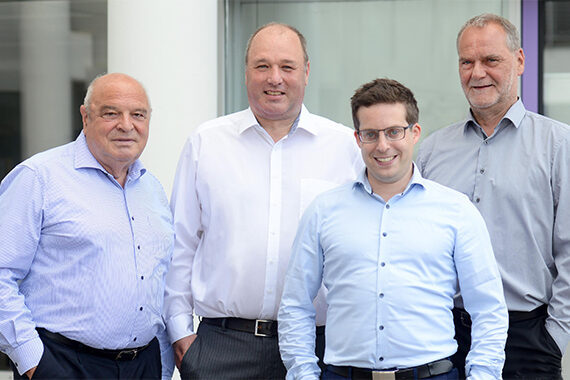
Directors l to R: Horst Rau, Nils Langer,
Dr Sebastian Schaubach and Jens Ole Wund
Today, DataPhysics Instruments is run by four shareholders: founder Horst Rau, Nils Langer, Jens Ole Wund and Dr Sebastian Schaubach. The interest in functionalised surfaces has only grown in importance over the past decades, as Managing Director and Sales Manager Nils Langer explains: “Today, research institutions and companies are developing more and more methods to functionalise surfaces. Plasma treatments and nanostructured surfaces are just two examples. It is therefore all the more important to provide researchers and product developers with measurement technology they can use to analyse the changed functional properties of such surfaces.”

For this reason, DataPhysics Instruments is focusing on the further upgrade of the existing devices as well as new developments. For the optical contact angle meters of the OCA series, the company introduced the new dpiMAX software at the beginning of 2022. The dpiMAX has a clearly structured, intuitive user interface and intelligent functions, which make the devices even easier to operate.

“We achieved another major success with the market launch of the ZPA 20 zeta potential analyzer with its patented measurement method,” adds Managing Director and Head of Development Jens Ole Wund. The ZPA 20 can determine the surface charge, or more precisely, the zeta potential of samples in aqueous solution by measuring the streaming current or streaming potential. To do this, it uses a patented measuring method, for which the solution is flowing over the sample alternately from opposite directions.

Shaping the future together.
Dr Sebastian Schaubach, Managing Director and responsible for innovation management, has a clear vision for the future: “We see ourselves as a partner who wants to refine the scientific analysis of interfaces and surfaces continually. In the future, our developments will therefore be conducted in even closer cooperation with our customers, because it is important to us that our devices can reliably solve our customers’ challenges.”

But it is not only the product portfolio that has grown steadily over the years. In its anniversary year, 45 employees work at DataPhysics Instruments. Further employees are being sought for the development, manufacturing, and sales department. In addition, the premises at the headquarters in Filderstadt near Stuttgart (D) have steadily expanded. Recently, the in-house Application Centre, with laboratory and training spaces, grew and was newly equipped. Dr Schaubach explains: “There, we offer test measurements for prospective buyers and contract measurements with all our devices. In addition, we conduct training courses for device operators.”

The company has always remained true to its native place – and yet is at home all over the world. An international network of sales partners ensures that customers all over the world can receive advice locally and in their preferred language. To be better represented in some target markets, DataPhysics Instruments founded its own companies in several countries: DataPhysics Instruments India was founded in 2020. In addition, the US subsidiary DataPhysics Instruments USA has existed since 2018.

Over the past 25 years, DataPhysics Instruments has developed an ever-expanding range of instruments for the analysis of interfaces and surfaces. At the same time, the company has grown in terms of personnel and space. For years, it has maintained a close relationship not only with sales partners around the world, but also with its customers in research and product development. These relationships have helped to develop market-driven products and to optimise the existing portfolio according to customer requirements. DataPhysics Instruments looks forward to expanding and deepening these relationships in the future.

@PresseBox #DataPhysicsInstruments #Laboratory #Surface #TandM

Tuesday, 13 April 2021

Easy-to-use display interface board.

KARD enables simple, straightforward evaluation of optical performance.

KOE (Kaohsiung Opto-Electronics) has announced the introduction of an easy-to-use display interface board. KARD, which is derived from a combination of ‘KOE’ and ‘Card’, has been designed and developed to provide a convenient, efficient solution to drive and evaluate KOE TFT display modules.


KOE are actively developing and introducing a series of value-added support tools to enable customers to assess and appraise the optical performance of an extensive range of LVDS-enabled medium-size TFT display modules. The KARD interface board allows optical performance characteristics such as contrast, brightness, colour saturation and viewing angle to be reviewed and tested within a design and development environment.

Benson Huang, marketing manager, KOE said “We are very keen to ensure our customers have access to easy-to-use, cost-effective design support solutions when using KOE TFT display modules. We are proactively enhancing an expanding range of value-added services and solutions that include touchscreens, optical bonding, high brightness backlights and display interface boards.”

The fully embedded GPU (Graphics Processing Unit) on the KARD display interface board supports both HDMI and DisplayPort input interfaces and generates a video output signal via a 20-pin LVDS interface to drive TFT display modules with a display resolution of 640 x 480 pixels up to 1920 x 1080 pixels.

An additional on-screen display (OSD) control board, which connects to the KARD driver board via an OSD interface cable, features five micro push-button switches supporting Power On/Off, PWM (pulse width modulation) backlight brightness control, a HDMI/DisplayPort input signal selector, and display resolution configuration.

Closely resembling the size of a standard business card, the KARD interface board features compact external mechanical dimensions of 55mm (w) x 90mm (h) x 14.5mm (d). The KOE KARD display interface board provides support for a range of KOE TFT display modules, from 5.7-inch up to and including 12.3-inch, which feature a 20-pin LVDS data interface.

Offering flexibility for specific market and application needs, KOE can support bespoke custom design requirements for the KARD including alternative data interfaces, display connections and touch functionality.

@KOE_Europe #PAuto #TFT

Completely new user interface.

The highlight of the Eplan Platform 2022 is a completely new user interface that significantly improves the overall ease of use. The focus here is on simplicity and clarity, with optics and functionality based on state-of-the-art apps for mobile devices and internationally established desktop applications. Variable tabs give users direct access to important and often-used functions. 

A completely new user interface
The practical multifunctional toolbar with modern ribbon technology flexibly adapts to the application, for instance when switching from 2D to 3D. It also combines different menus and toolbars into one, making daily work easier for experienced users while at the same time enabling an efficient (re)introduction to the software. Furthermore, Eplan has completely redesigned the user interface for both 2D and 3D engineering. The overall result is a modern application with an optimal look and feel, not least via the support of dark and light modes.

Strong performance even for large projects
A completely new graphics module in the 2D area ensures optimal performance, even for large projects. Processing has been significantly accelerated, particularly when importing DXF or DWG files. The new centralised device management also serves as a performance driver and additionally offers more flexibility for converting device data by way of object-oriented data management. The integrated variant management allows users to save all device properties with the individual variant. Now devices can easily be assigned different macros in no time at all – for easy processing of external device data, even in combination with Excel.

Good overview at the project level
The new Backstage view lets users edit all aspects of an Eplan Project from a central location – for instance opening and creating projects, importing DWG files, and exporting PLC or manufacturing data. A list of the recently used projects provides an excellent overview – as does the logical organisation of all project-related actions. And the newly integrated insertion centre unifies all the functions for inserting symbols, macros and devices, including a graphic preview – everything that is needed for efficiently creating schematics. Frequently used components can be marked as favourites and tagged for individual workflows.

Eplan eManage combines Platform with the cloud
The new Eplan Platform 2022, which is being launched this summer under the motto “It’s in your hands”, features many more innovations. One of them is the direct connection of on-premise and the cloud. Now with Eplan eManage, projects from the Eplan Platform can be uploaded directly into the cloud environment and be shared and managed from there. The free version has been available since mid-March. The fact that the Eplan Platform 2022 is being offered exclusively as a subscription once again underpins the clear focus on the future. Especially in volatile times, the investment risk for companies is reduced by way of low entry prices and more flexible planning options for individual software use.

Eplan presented a first look at this Eplan Platform at Hannover Messe Digital Edition.

@EPLAN_DE @mepaxIntPR #Pauto #HM2 #HMI