Showing posts with label Computers. Show all posts

Wednesday, 19 March 2025

Innovation award in nanoelectronics and digital technology.

Johny Srouji, Apple’s senior vice president of hardware technologies, is to receive the 2025 imec Innovation Award*. The award recognises Srouji’s pivotal role in shaping Apple’s technology roadmap through his leadership in the development of Apple silicon. In doing so, he has not only redefined Apple’s products, but has also had a major impact on the broader semiconductor ecosystem, spurring the advancement of chip technology that elevates features, experiences, and AI to new heights. Johny Srouji will receive the imec Innovation Award at the ITF World conference in Antwerp (b) next May.

Since joining Apple in 2008 to lead the development of the A4 chip – the company’s first in-house designed system on a chip (SoC) – Johny Srouji has built and led a world-class team of engineers driving innovation across Apple’s hardware technologies. Their work has fueled major advancements in Apple silicon, batteries, cameras, storage controllers, sensors, displays, and other critical components that define Apple’s product lineup.

After consistently leading the smartphone market with SoC designs prioritizing performance per watt, Srouji and his team brought their scalable architecture to the Mac, offering faster performance, enhanced capabilities, and category-leading battery life. Earlier this year, Apple launched C1, its first ever cellular modem system delivering excellent 5G and satellite connectivity while being far more energy efficient. Across all these innovations and more, the discipline to create and maintain a scalable architecture has yielded enormous benefits, and Apple’s chip designs are driving new strategies in the industry.

“As artificial intelligence integrates into nearly every aspect of modern technology – from personal planning tools to digital assistants – the demand for high-performance, energy-efficient and battery-powered hardware such as smartphones, tablets, laptops and smartwatches has never been greater. Meeting this demand requires advanced semiconductor technologies and architectures that deliver superior performance while minimizing power consumption. Johny’s vision in leveraging deeply scaled semiconductor technology to achieve this is driving the next wave of chip architectures that will revolutionize consumer electronics and edge computing. For these contributions, Johny Srouji is a deserving recipient of this year’s Innovation Award,” said Luc Van den hove, CEO of imec. “It is a great honor to be recognized by imec and receive its most prestigious Innovation Award, which I humbly share with my colleagues at Apple,” said Johny Srouji. "Our goal is always to create differentiated technologies to enable the world’s best products. Creating and incorporating bleeding-edge advancements while maintaining our intense focus on power efficient performance, we look forward to solving hard problems and unlocking new possibilities through our continued partnership with imec and collaboration across the industry."

Before joining Apple, Johny Srouji held senior positions at Intel and IBM, where he contributed to processor development and design.


*Since its launch in 2016, the imec Innovation Award has become a prestigious recognition for pioneers in the semiconductor industry. 

@imec_int @Apple @MarcomWittig #AI #Automation #Computers

Tuesday, 19 November 2024

Display kit bundle.

Immediate availability of a new pre-assembled kit bundle - a Raspberry Pi 5 Board, a 10.1" Capacitive Touch Screen Display, and PowerPRO, a 5.1V Power PCB and USB-C Adaptor designed specifically for the Raspberry Pi 5, has been announced by Inalco Hunter.

The PowerPRO board solves the problem of needing multiple power supplies when integrating the Pi5 with a display. Any additional peripherals can be effortlessly added, consolidating the power management into one convenient hub.

Engineered to streamline the Pi 5 set-up, the PowerPRO is an innovative solution allowing connection of the new Pi 5 to a display using the PowerPRO as the single power source (5v to 18v). Multiple output connections deliver a consistent 6A rating. Inelco Hunter’s new 10.1” TFT (D90101 series) Touch Panel offers a “ready to go” integrated display solution with the Pi 5.

Also included in the kit is a Connector and Cable Accessory Pack and a Mounting Pack for Raspberry Pi board – everything that's needed to get the display up and running. The seamless Pi 5 integration offers an extensive range of application possibilities, such as building management systems, precision in medical laser equipment, efficiency in fleet vehicle tracking systems, or innovation in laser welding equipment.

A versatile range of mounting accessories and cables provides flexibility for placement in various configurations. The PowerPRO features standard RPI mounting hole spacing, and multiple output connections are provided: USB-C, 2.54mm, 6-pin JST. The maximum continuous current is 6A and there is built-in thermal shutdown protection for overcurrent situations. The PowerPRO is UL recognised and RoHS compliant.

The kit offers cost savings compared with purchasing the items individually and is available from the Inelco Hunter warehouse for prompt delivery.


@InelcoHunter @Raspberry_Pi #PAuto

Wednesday, 17 August 2022

Predictive maintenance of computers for IIoT.

Predictive maintenance of computers is critical to IIoT-Enabled systems says Johnny Fang, a Product Manager with Moxa.*

Businesses are striving to achieve intelligence at the edge of their industrial networks by deploying computers that can collect, process, and analyze data in unmanned or remote sites. The consequences are dire when these computers have a performance issue or run out of memory, therefore preventing them from performing their role efficiently, if at all. Industrial processes come to a halt, leading to huge financial losses. If an industrial process malfunctions because of a failure to detect and fix computer issues on time, it could also lead to accidents that result in employee injuries. For these reasons, computers used in IIoT- enabled systems must be treated as critical equipment that require a higher level of maintenance strategy than non-critical devices.

Traditionally, manufacturers have maintained their assets using manual processes that are time-consuming and resource-intensive. The IIoT brings with it a paradigm shift with respect to the operation and maintenance of industrial equipment. Now, instead of waiting for equipment to fail before fixing it, or scheduling time-based maintenance that sometimes leads to unnecessary maintenance of equipment and downtime, companies are adopting predictive maintenance strategies to stay ahead of the game. These same practices should be applied to industrial computers.

Predictive maintenance tools for a computer can keep track of any variance from expected behavior for key parts, such as CPU usage, CPU temperature, memory usage, and disk usage. Predictive analytics empowers users to explore potential root causes and apply appropriate remedies. By identifying issues early on and allowing repairs to be scheduled in an orderly fashion, predictive maintenance provides lead time to purchase parts for the necessary repairs and reduces the need for maintaining an inventory of key parts. Hard drives, processors and other damaged parts are replaced before failures occur, and since maintenance work is only performed when needed, production capacity is likely to increase as well.

The goal of any predictive maintenance program is to enable proactive access to data for each piece of critical equipment, enabling the monitoring of its realtime health status, analyzing historical trends, and planning maintenance downtime based on the data.

Predictive maintenance tools for industrial computers monitor its health in order to make repairs well in advance to maximize system uptime. The tools will feature a well-designed dashboard that helps operators keep an eye on key indicators such as CPU loading and memory usage, plus an alarm function to trigger audio or visual alarms and SNMP traps when parameters go over predetermined thresholds.

Additional tool capabilities that aid in predictive maintenance are:

  • Easy-to-use remote monitoring functions
  • A ready-to-use tool that runs on a Windows or Linux OS
  • RESTful APIs that give access to key-part parameters.

Predictive maintenance in action.
Below are demonstrated the importance of predictive maintenance for rail, marine, and power segments using remote-site scenarios.

Railroads: In a metro transit system, computers are widely deployed in onboard control and video recording systems. Because space is limited on refurbished traincars, computing systems are often installed in places that are hard to reach and even more difficult to maintain such as cabinets, compartments under passenger’s seats, or on the ceiling. Having ready access to a computer’s current condition so that you can implement a preventive maintenance routine is an important aspect of ensuring a smooth transit system.
Marine Bridges: An electronic chart display and information system (ECDIS) is one of the most important systems on a ship’s bridge. An ECDIS system takes real-time information from sensors deployed on equipment, including speed logs, radar, wind stations, AIS, and gyrocompasses, into consideration when planning the ship’s voyage. It combines the data from sensors with information on dangerous areas or areas of special attention on the route to chart a safe course for the ship. Therefore, a reliable and durable computer is crucial for running the ECDIS system. Information on the status of the key parts of the ECDIS computer can be monitored by integrating the computer’s key-part data with the bridge system using monitoring APIs or by another means. In addition, an alert function can help provide warning messages when a parameter associated with a key part goes over a preset threshold. One example is when CPU usage exceeds a threshold due to system software errors. When this happens, an alert message is sent out so that the crew can deal with the problem.
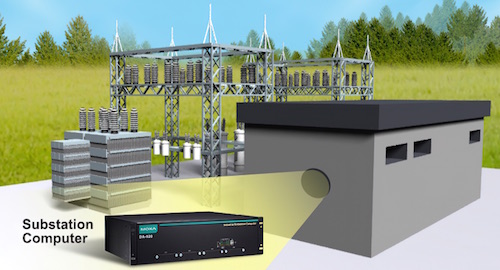
Power Stations: Unmanned power stations are increasingly becoming the norm, and are often located in remote, hard-to-reach sites. A predictive maintenance tool is required to monitor, control and maintain critical equipment, including computers, in an unmanned substation so that it functions smoothly.

Built-in Maintenance tool.
Rugged industrial computers typically feature built-in proactive monitoring solutions that help reduce the costs of remote system maintenance and maximize system uptime. The computer's dashboard may graphically display CPU usage, memory usage, storage partition usage, operating temperature of the CPU and motherboard, and the redundant-power monitor, and trigger relay outputs to provide either visual or audio alarms, or send out SNMP traps. Most of these tools also provide for setting-up the threshold and time period for the key parts to monitor.

The relentless pursuit of excellence in the IIoT world has renewed an interest in predictive maintenance solutions that ensure higher equipment reliability and system uptime. Since computing systems are the pillars of the IIoT, implementing predictive maintenance for them is essential to realizing the full potential of the IIoT.


*See also Countries Investing the Most into Predictive Maintenance from Automation-com (15/8/2022).

@MoxaInc @OConnell_PR #PAuto #IIoT 

Tuesday, 5 July 2022

Board for digital signage and automation.

3.5-inch single board computer supports up to four 4K displays

A 3.5-inch subcompact single board computer (SBC) from AAEON is now available from Review Display Systems (RDS).

The GENE-TGU6 features the latest 11th Generation Intel Core i7, i5, i3 and Celeron SoC processors and can deliver performance enhancements of up to 20% over previous generations of embedded processors. Additional on-board features are designed to support digital signage, automation, AI processing and Edge IoT applications.

Featuring compact mechanical dimensions of just 146mm (l) x 101.7mm (w) and implementing an innovation thermal design, the GENE-TGU6 has been developed to manage harsh industrial and embedded environments with an operating temperature range of -40°C to 85°C and a wide input voltage range of +9V to +36V.

The integrated embedded Intel Iris Xe graphics enables support for high-definition video, with the GENE-TGU6 providing five video outputs capable of simultaneously supporting up to four 4K displays. Video output is provided with a HDMI 2.0b, two DisplayPort 1.4a, a DisplayPort 1.4a via Type C, and an on-board LVDS/embedded DisplayPort.

Peter Marchant, embedded business manager, RDS said, “The processing capability, integrated on-board graphics, and scalable expansion support of the GENE-TGU6 enables the 3.5-inch SBC to deliver the computing performance needed for a wide range of applications such as digital signage and public information displays, IoT gateways and AI processing.”

To enhance speed and flexibility, the board supports four USB3.2 Gen 2 ports and USB3.2 Gen 2 Type-C. The board has two LAN ports, one powered by the Intel i225 chipset delivering speeds up to 2.5 Gbps, alongside an Intel i219 Gbps port. Expansion is supported with multiple M.2 slots, and a Mini Card supporting functions such as Wi-Fi, high speed NVMe storage, and AI scalability with modules such as the AI Core XM2280.

Additionally, the Intel Iris Xe is designed to be compatible with Intel distribution of OpenVINO toolkit, allowing it to perform AI acceleration tasks. Along with Intel Deep Learning Boost, the GENE-TGU6 is capable of AI compute performance 30 to 40% greater than previous generations.

@ReviewDisplays @AAEON @ReVis_Solutions #PAuto #Display

Monday, 11 October 2021

Small form factor line replaceable unit computers.

Abaco Systems announced the DAGRX and SAYBRX small form factor (SFF) line replaceable unit (LRU) computers featuring Intel™ processors and flexible I/O delivering high performance in a compact package. The modular I/O approach in both rugged and lab variants empower users to select what is necessary for the application, optimizing size, weight and power (SWaP). 

Pete Thompson, vice president of product management for Abaco Systems, said, “The DAGRX and SAYBRX show Abaco is committed to leading the industry in commercial off the shelf rugged processing for all size, weight and power applications. By filling this gap and providing an ultra-small form factor, we are uniquely positioned to provide a system level solution to customers at every entry point of the SWaP-C spectrum. Our innovative team is focused on technology advancement, quality, and attention to design in an effort to ensure our customers are able to succeed in every environment.”

The DAGRX and SAYBRX provide modular and scalable approaches to system design and architecture. When a 3U VPX system is either too large for the given space constrictions or too costly, the new systems allow developers to focus their resources and priorities on software and intellectual property. The rugged units are designed to be deployed in harsh environments (up to IP67). Lab variants can be used for development and test as well as full deployment in moderate environments (up to IP54). These computers address the need for ultra-compact, rugged computer systems for data and I/O processing in 8-36VDC applications in both commercial and military sectors and are ideal for use on mobile applications including industrial AGVs, off-road utility equipment (forestry, agriculture, construction, mining, etc.), railway, maritime, and avionics applications.

The DAGRX incorporates Intel’s smallest footprint CPU, the Intel ATOM® E3845 Quad Core 1.91 GHz, and is a best-in-class ultra-low SWaP-C solution. Power consumption depends on configuration but is typically around 13W@28VDC. The lab variant has an operating temperature range of -20°C to +60°C (baseplate), while the rugged variant has an operating temperature range of -40°C to +85°C (baseplate). DAGRX has extensive I/O flexibility and can be configured with: MIL-STD-1553, ARINC 429, GPS, serial I/O, Wi-Fi, digital I/O, 12-bit A/D, and CANbus, and up to five 1000BASE-T ports. All variants come standard with USB2.0, USB3.0, RS232. A single or multiple combination of I/O are available. Onboard memory starts at 64GB and is expandable through 2.5” SSD and mSATA options. The lab variants feature commercial style connectors for power and I/O. Rugged variants feature MIL-DTL-38999-style connectors for power and I/O. DAGRX supports Linux and Windows operating systems.

The SAYBRX features the Intel i7-9850HE @ 2.7 / 4.4 GHz TurboBoost and optional NVIDIA® Quadro® P2000 GPU. It offers all I/O available in the DAGRX but adds more USB, serial, DVI-I, and DisplayPort options. Expansion is via XMC/PMC, mPCIe and M.2. SAYBRX offers BIOS to support Windows, Linux, OpenGL, DirectX, NVIDIA® PhysX®, and NVIDIA 3D Vision®.

@AbacoSys #Pauto 

Thursday, 3 October 2019

Laptops for refugees.

Delta has announced that as part of its corporate social responsibility activities, it has donated 57 laptop computers to five refugee camps in Serbia. The donations have been made in cooperation with the Tzu Chi Foundation, a Taiwanese international humanitarian and non-governmental organisation.


The laptops enable refugees to maintain contact with their family and friends overseas and to stay up to date with local and global events. It also helps them to gain essential skills, like learning a new language or participating in online courses to further their education, thus helping them to prepare for a new life and career opportunities beyond the refugee sites.

Delta began providing the laptops at the beginning of the year. In January, it donated 12 laptops to the Principovac refugee site. In March, it donated 15 laptops to the Kikinda and Sombor refugee sites, while in September, it donated 30 laptops to the Adasevci and Obrenovac sites. Delta was present onsite to ensure the successful installation of the laptops. To show its appreciation for Delta’s contribution to the refugees, a donation celebration was organised by the Tzu Chi Foundation to reflect its gratitude for Delta’s support.

Mr. Dalip Sharma, President & Regional Head of Delta Electronics Europe, Middle East & Africa (EMEA) region, said: “At Delta, everything we do is centred on protecting the environment. Of course, a better tomorrow is equally important to people who have been caught up in events beyond their control. We believe that we have a responsibility to help to improve their situation by providing them with the tools they need to open up new opportunities and improve their quality of life. That’s why we were so keen to help the refugees in Serbia by donating laptops to the sites, and we’re thrilled to hear they’re being used to help them in their quest for a better future that we all strive for.”


@DeltaEMEA @mepaxIntPR

Monday, 9 April 2018

Industrial edge computer.

Harting’s MICA modular industrial edge computer is at the heart of a system for workflow optimisation at warehouse packing stations that offers the benefits of process optimisation for increased productivity as well as integrating incompatible hardware and software and simplifying the jobs of the packing operatives.
The system, requiring minimal outlay for fast return on investment (ROI) and ongoing reductions in operating costs, has proved its value in successful trials at Harting’s own warehouse packing facility in the company’s state-of-the-art connector manufacturing plant at Espelkamp in Germany.

The system is designed to address the challenges that are typically encountered where a customer order requires a wide range of separate component parts to be packed and shipped in one or more cartons. Previously, packers might have to interface with a range of different stand-alone computer control devices such as a weighing scale, a PLC that controls the packaging machine, and a printer for the labelling of the packaging films. In such a configuration, the employee would have to operate all these devices individually, enter the values manually into the management ERP system, and manually adapt work instructions.

By integrating a MICA edge computer at the packing station, the new Harting approach combines all these actions, automatically executing the intermediate steps and transferring all the data from one system to the next and into the ERP system. For example, using SAP data transfer via OPC UA to SAP MII (SAP for Manufacturing Integration & Intelligence), the work instruction can be transferred from ERP via RFC, transferred to MICA via JSON, translated in STEP 7 and loaded into the PLC.

The packer now has only one user interface. The number of manual work steps is drastically reduced by the integration, and the packaging process is significantly accelerated. By utilising other features of the modular MICA device, successive additional KPIs and extra processes can be captured through its operating software. For example, by integrating an RFID antenna function module with dual antenna ports, it becomes possible to identify both the tagged transport containers of packed parts and the employee’s personal ID card. The MICA computer can thus automatically log on and assign the packed parts to the employee’s unique identification record. As a result, the packing process information can be integrated directly into a piecework payment system.

By adding a single MICA device into the packaging process at a typical packing station, it becomes possible to reduce the overall packer’s process time by a factor of at least ten, representing a major productivity improvement.

Three key benefits of the system may be summarised as follows:

  1. Increased productivity at the packing station: Several separate operations that were previously carried out independently and manually are now automated and integrated by the MICA computer.
  2. Integration of incompatible hardware and software: The open software architecture of MICA allows communication between incompatible devices and integrates them into the factory ERP/MES system.
  3. Simplification of the packer’s workstation job: Several operations that were previously carried out separately and manually are now integrated and automated, leading to a tenfold improvement in productivity.

Further benefits of the MICA system result from the fact that the hardware is very compact and meets IP67 environmental protection standards, allowing it to be located in harsh factory and warehouse environments. In addition, the modular hardware design allows further enhancements and modifications to meeting changing application requirements.

#Harting #Pauto

Thursday, 27 October 2016

ICE Box-PC building block system!

Rugged computing is a must for lots of new IoT, M2M and Big Data applications deployed in extreme environmental conditions. Hardly any embedded computing hardware, however, is equipped to operate in minus 60°C, let alone - 100 °C or to be immersed in water. To enable passively cooled standard hardware to nevertheless be operated in such extreme environments, ICOP Technology has developed the ICE Box, a new modular building block system with IP67 protection (majorly hosting PC-104 form factor boards inside) and active heating, which automatically activates if the temperature drops below a configurable minimum temperature (standard value is -20 C).”

Owing to the modular build of the building block system, OEMs can order their individual ICE Box-PCs in numerous different configurations. Any required system configuration can be ordered from batch sizes of just one, including individual I/O covers and laser engraving of the housing and can be delivered within one week after specification approval. Applications can be found in outdoor, vehicle and marine deployment, as well as in refrigerated warehouses.

Amongst the standard components, which ICOP Technology offers for the ICE Box-PC building block system with passive cooling and active heating, are around 20 different standard CPU components with SFF, low power DM&P Vortex86 processor technology, power supplies as well as numerous I/O extensions for Ethernet and wireless (IoT) interfaces, USB, digital and analog I/O, fieldbuses as well as motion control applications. The interfaces can be mounted on the front or back panel according to requirements, paving the way for highly individual OEM configurations. The ICE-104 building block enclosure is suited for OEMs without MOQ needed.

Customers opting for ICOP Technology’s systems with DM&P Vortex86 processors profit from a rich, established ecosystem which has been developed over decades and can be immediately deployed. Besides these extremely energy-efficient x86 processors – which are equally suited to new IoT applications and long-tail deployments including ISA support – there exist countless special “off the shelf” solutions which still have to be developed for comparatively less established processor technologies. OEMs can also expect a much more stable expansion of the ecosystem, the advancement of DM&P Vortex86 processors caters for the long-term requirements of industrial computing with x86 technology and not for commercial mainstream demands, where tomorrow completely different features could be relevant.

@iCOPTechnology #PAuto 

Tuesday, 31 March 2015

Validate rugged computers by joining partnership!

JLT Mobile Computers has announced it has joined the Navis Ready partner program and will initiate validation of its rugged vehicle-mount computers against the Navis N4 terminal operating system. Validation of JLT hardware is expected to be completed soon and will underline that the JLT products deliver the best possible performance and reliability in the most challenging working environments. 

"We are experiencing an acceleration in the number of customers within the port segment using our rugged computers," said Per Holmberg, CEO, JLT Mobile Computers. "By collaborating with Navis, whose terminal operating system is used by the world's leading container terminal operators, we can demonstrate that our solutions comply with Navis Ready requirements, providing an extra level of confidence to our customers." 

The Navis Ready Program is a validation program for suppliers of different technologies designed to operate within a marine container terminal operating environment. All devices designated Navis Ready have been tested in a simulated environment to ensure that specific messages have integrated effectively with a specific release of Navis N4 terminal operating system (TOS).

JLT mobile computers are already used extensively in this environment and by becoming validated under Navis Ready, both existing and future customers will be assured that the hardware and software have not only been designed to work together but have been validated to provide an optimal customer experience. 

Confidence boost
Validation is an important endorsement of quality and reliability. Shipping ports and terminals win and maintain business based on their up-time and their efficiency in moving containers from ship to shore and then onto their final destination. Reliable and efficient IT equipment is a critical element in the overall communication infrastructure, and instrumental in delivering quality of service. 

Whether tracking cargo through a port or enabling the automation of processes or equipment, the demands on computer hardware and wireless connectivity in ports are substantially higher than in the average operating environment. Validation and acceptance into the Navis Ready Program will demonstrate that JLT mobile computers meet and exceed these demands. 

Tuesday, 6 May 2014

Rugged vehicle computers!

JLT Mobile Computers has launched the VERSO+ 10 computer with QuickLock, a new class of rugged vehicle terminals. Equipped with an Intel® Core(tm) i5 processor, the VERSO+ 10 computer provides leading performance in the industry's smallest rugged form factor, making it a perfect choice for installations in tight cabins or other small areas.

With a quick-mount feature, QuickLock, the computer can easily be attached and detached in a vehicle to simplify service, being moved between vehicles or prevent theft by removing it at the end of the working day. With a 10 inch sunlight readable XGA display and scratch resistant multi-point touch, the VERSO+ 10 computer becomes an extension of the heavy-duty JLT VERSO series that also includes 12 inch and 15 inch computers. It provides the same high reliability as the rest of the VERSO series when used within very tough environments such as mining, ports, yard-logistics, freezer storage, forestry, and agriculture.

The VERSO series launched in the first quarter of 2013 and has since ramped quickly and been adopted by customers around the world with high demand for performance, ruggedness and reliability. With the new VERSO+ 10 computer, with QuickLock feature and a smaller form factor, customers now have a more flexible and compact alternative, but with the same outstanding performance and ruggedness.

As with all JLT computers, the VERSO+ 10 computer is built from the ground up to deliver maximum reliability and function in very demanding environments. It comes with an Intel Core processor or an Intel dual-core Atom D2550 processor. Built-in features include a 9-36 VDC power supply, a backup battery to ensure uninterrupted operation during power drops, WLAN communication with built-in highly sensitive PIFA antennas, custom-made for reliable Wi-Fi connectivity in environments with poor coverage. New with the VERSO+ 10 computer are Bluetooth PIFA antennas with a resulting reliable communication with low-power hand carried peripherals, and the option of external antennas for both WLAN and Bluetooth for very demanding environments such as ports and other wide areas. The VERSO+ 10 can also be equipped with 3G WWAN communication. The VERSO+ 10 computer can be ordered with Windows 7 Pro or Windows Embedded Standard 7, Windows 8.1 and Windows Embedded 8 Standard operating systems.

"With the new VERSO+ 10 computer, we build on the success of the VERSO series of heavy-duty vehicle computers that, since its launch in January last year, is being selected by customers within mining, sawing mills, off-shore, ports and other demanding applications," said Per Holmberg, CEO at JLT. "With the VERSO+ 10 computer, we reinforce our leading position within the high-end of the market by providing the smallest form factor and greater flexibility with the same high performance."

More and more customers also go for the JLT:Care Service Level Agreement. With this "No-Questions-Asked" service added, customers are guaranteed a high support level and short repair times to maximize the up-time of the computer at predictable cost.

The VERSO+ 10 computer is available now with a dual-core Intel Atom processor D2550 and can be ordered from JLT Sales Partners. The Core processor option will start shipping in the second half of 2014.