Showing posts with label Conservation. Show all posts

Friday, 21 April 2023

Historical textiles in focus.

New approaches to investigate damage due to environmental fluctuation on textile artefacts by image processing.

Preventive conservation plays an important role in the preservation of art and cultural assets. In order to preserve their condition for as long as possible, it is essential to slow down ageing processes and evaluate factors that alter materials. To do this, it is necessary to grasp and have a holistic understanding of the artefact. Cultural heritage science and engineering methods for understanding material behaviour require an interdisciplinary approach. Textiles are among the most sensitive art and cultural heritage objects. In the course of their production and handling, their presentation and storage, they are often exposed to influences that can have a damaging effect.
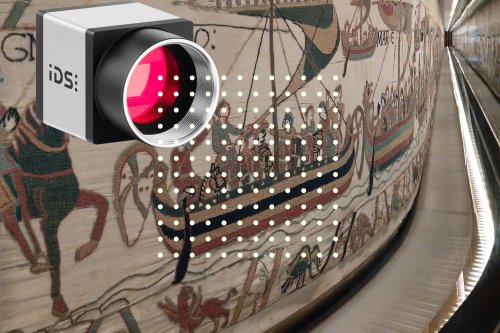
The French start-up company S-MA-C-H has studied the Bayeux Tapestry* as part of a research project and, with the help of IDS cameras, has developed a system that provides valuable insights for the conservation-optimised storage and presentation of this delicate and extraordinary artefact. The expertise of conservators, combined with state-of-the-art technology, helps to identify potentially damaging factors at an early stage, to minimise them or, at best, to exclude them altogether.

The system was designed for a comprehensive study looking at the mechanical behaviour of the Bayeux Tapestry - commissioned and funded by the Normandy Regional Office for Cultural Affairs. "We contributed our expertise in mechanical engineering by fully monitoring the stress and strain on the tapestry. In addition to monitoring, we helped to devise conservation solutions. This involved classifying and assessing the degree of risk and sensitivity of the tapestry in its surrounding indoor climate," explains Cécilia Gauvin, co-founder and managing director of S-MA-C-H.

A multidisciplinary team of textile and preventive conservators as well as heritage conservation scientists characterised the artefact's response to appropriate environmental fluctuations. "The project addressed two main questions: what are the optimal parameters for a presentation on sloping supports and how does the tapestry react to its microclimate?"

To be able to answer these questions, the tapestry was monitored by temperature and humidity sensors as well as by force sensors to record the gravity pressure. The heart and brain of the system: a non-contact 2D full-field Digital Image Correlation (DIC), consisting of an IDS camera and specially developed software for digital image correlation.

"Digital image correlation is an image processing technique that can be used to analyse movements and deformations of objects. For this purpose, high-resolution images of the object's surface are captured and then evaluated with the help of software algorithms to detect changes in the shape, position or size of the object," explains Patrick Schick, IDS Product Marketing Manager. In the search for the right camera model for the system, parameters such as interface, sensor and price-performance ratio were the main deciding factors. "For the analysis of the tapestry, extremely high-resolution images with low image noise are required to capture the smallest details.” The USB 3 uEye CP meets these requirements thanks to the particularly light-sensitive IMX183 rolling shutter CMOS sensor from Sony's STARVIS series. With BSI technology ("back-side illumination"), this sensor ensures outstanding image quality even under difficult lighting conditions. "The camera is thus ideally suited for demanding image evaluations such as this monitoring, which takes place in low light for conservation reasons. The USB3 Vision camera records high-resolution images at a very low frequency over a longer period of time," adds Patrick Schick. For the research project, for example, the monitoring ran around the clock for a month, with only one image capture per hour.

"The Python interface of the IDS peak API allowed us to quickly and easily develop software to parameterise the camera and capture images," explains Cécilia Gauvin. The images are then processed with DEFTAC3D, a software developed by the French Pprime Institute specifically for digital image correlation. This results in full-surface measurement data of the object's surface based on thousands of 2D or 3D coordinates with very high resolution. The displacement of the image points within the examination period is interpreted as a deformation that is due to a mechanical load or stress on the object. Based on the results, full-field strain maps as well as deformation maps are generated. Full-field strain maps illustrate the strains in a material over the entire surface. They therefore show whether and how the tapestry has deformed as a whole. Deformation maps, on the other hand, provide information about the local deformations in a material. They provide S-MA-CH staff with information on whether and how the tapestry has deformed at specific points.

The full-field strain maps are processed together with the environmental variation findings to understand the hygromechanical behaviour of the Bayeux Tapestry. Hygromechanical behaviour refers to the interplay between moisture and the mechanical properties of the textile. This can be influenced by a number of factors, including the type of yarn used to make the fabric and the type of weaving or embroidery technique used to make the tapestry, which adds to the complexity of the study. In order to incorporate scientific data into the decision-making process, tests were carried out on both facsimiles and the tapestry itself. On the facsimiles, the full-field strain maps were combined with the stress results from the force sensor measurement and the climate measurements (temperature and humidity). The results allow conclusions to be drawn about the climate regulation for optimal storage of the artefact.

The data collected by the sensors and camera system was documented in real time to analyse long-term trends. With the help of the information provided, it can be ensured that the climatic conditions in the Bayeux Museum are within the optimal limits to avoid damage to sensitive art objects or historical exhibits, such as the Bayeux Tapestry.

Outlook.

The market for the protection and preservation of cultural heritage is slowly opening up to structural diagnostic procedures. "Our goal is to develop appropriate systems for conservators in a plug-and-play system," explains Cécilia Gauvin. In addition, the French start-up wants to use vision systems to monitor structural damage to paintings in museum galleries and historical monuments in the future. This approach across disciplines makes it possible to assess the condition of exhibits so comprehensively that the appropriate conservation measures can be taken.

"Our knowledge of mechanical engineering, combined with industrial image processing, opens up new approaches, expands the range of actions and produces innovative solutions."

An elaboration of the conservation conditions for handling, storage or presentation of artefacts based on these interdisciplinary research results offers protection against further damage. Historical as well as modern products of textile art can thus be preserved in the best possible way for the future. Image processing components make a valuable contribution to this.


The Tapestry
• 68 metres long
• 52 cm high
• 9 panels of woven linen fabric
• 4 seams
• 10 colours of woollen yarn
• 58 individual scenes
• 623 people
• 202 horses
• 55 dogs
• 505 other animals
• 27 buildings
• 41 ships and boats
• 49 trees
* The Bayeux Tapestry, is an embroidered work created in the second half of the 11th century on a strip of cloth about 52 centimetres high. Depicted in images and text over 68 metres in 58 individual scenes, the Conquest of England is considered one of the most remarkable pictorial monuments of the High Middle Ages because of its abundance of detailed individual depictions, well thought-out iconography and quality of craftsmanship. Despite its name, the Bayeux Tapestry is not actually a tapestry but a narrative embroidery. It consists of images and text inscriptions and comprises nine interconnected linen panels.


@IDS_Imaging @BayeuxMuseum @mepaxIntPR #France #Heritage #Conservation

Thursday, 18 August 2022

Sustaining a fen and capturing carbon dioxide.

In 2001, five organisations came together to set out a vision for the Great Fen, with the aim of providing a more sustainable future for the area. In many respects, this work focuses on restoration by managing water levels, so a network of monitoring wells has been established. In this article, Wendy Strain from OTT HydroMet explains how this monitoring program is helping to achieve the ambitious goals that have been set for the Great Fen.

Background.
The Great Fen is an expanse of nationally significant fen landscape between Peterborough and Huntingdon in the East of England. The area contains many farms and villages as well as two National Nature Reserves; Woodwalton Fen and Holme Fen. Holme Fen and Woodwalton Fen are both part of the Great Fen, a habitat restoration project, involving the local Wildlife Trust, Natural England, the Environment Agency, Huntingdonshire District Council and the Middle Level Commissioners.

The Great Fen covers 14 square miles of land that is being restored to wild fen over a 50-100 year timescale, creating a huge nature recovery network, providing a Living Landscape for fenland species including threatened fen wildlife, such as bitterns and otters. A mosaic of different wetland habitats has been established to support a wide variety of wildlife, such as dragonflies, butterflies and amphibians. This habitat is also suitable for flowers and other plants, some of which are found almost nowhere else in Britain such as the Fen violet and the Fen woodrush.

In 1630 a group of wealthy landowners, headed by the Earl of Bedford, set out to drain the fens for agriculture and to minimise winter flooding. Many of the local people were fiercely opposed to the draining, believing it would deprive them of their traditional means of livelihood from wildfowling, fishing and reed cutting, and a group known as the ‘Fen Tigers’ vandalised the dykes, ditches, sluices and reedbeds. Nevertheless, by the end of the 17th Century the drainage project was complete.

This drainage caused more problems, such as peat shrinkage, and more drainage projects followed. In the 1800s, conscious of the likely shrinking effect of draining the peaty soil around Whittlesea Mere, William Wells, another wealthy landowner, instigated the burial of a measurement post at Holme Fen, which was anchored in the bedrock and cut off at the soil surface. Today, around 4 metres of the post is showing above ground, recording the ground subsidence since 1852. The ground level at Holme Post is now 2.75 metres below sea level – one of the lowest land points in Great Britain.

Several issues have arisen as a result of the drainage. Firstly, there has been a huge impact in local ecology and biodiversity with the loss of a large area of wetland. Also, as the ground level subsided it became less sustainable to pump water up into the main drain. The loss of peat has become a major concern, because, as a carbon sink, peat is hugely important in the fight against global warming.

Peat forms in waterlogged, acidic conditions when layers of partially decomposed mosses and other bog plants accumulate. The process is very slow; it can take up to 1,000 years to form just one meter of peat. Nevertheless, around 60% of the world’s wetlands are made of peat. The plants which form peat capture carbon dioxide from the atmosphere and as a result, large quantities of carbon are trapped in the peat. However, if the peat is drained, it decomposes much faster; releasing the stored carbon. Peat burning has the same effect, but much faster.

It has been estimated that the reduction of peat loss in the Great Fen, coupled with the capturing of carbon by vegetation is saving 325,000 tonnes of CO2 from being released each year.

The project is also a good example of natural flood management (NFM) because it provides extra water storage after heavy rainfall, which slows water flow and helps to protect surrounding towns, villages and farmland from the risk of flooding.

Water level management.
The drainage of the fens incurred widespread ecological harm, but the solution is significantly more complicated than simply raising water levels to create wetlands. Henry Stanier explains: “There are a number of factors that impact the restoration process. Firstly, the geology of the area is like a layer cake, and each layer has different hydrological properties. Secondly, the Great Fen includes a number of commercial farms, so it is important to understand and manage their groundwater status. Thirdly, the surface water requirement varies according to the time of year, due to the needs of a wide variety of flora and fauna, including breeding birds. Fourthly, along with various partners, we are conducting numerous research programs, most of which are affected by water level. For example, we have trial plots with raised water levels, in which we are investigating the performance of different plant species. These include Sphagnum or ‘bog moss’ which stores water, prevents the decay of dead plant material and eventually forms peat, and we are also trialling the wetland cropping potential of Glyceria fluitans, a robust perennial aquatic sweet grass.”

Water level monitoring.
Working with a team of over 60 volunteers Henry delivers a monitoring program for the project area, which is currently around 3,700 Hectares. 40 wells have been installed in strategic locations, each to a depth of around five metres. 37 of these have OTT Orpheus Mini water level loggers, which record groundwater level every hour, every day of the year. Henry collects the data from these loggers once or twice per year, or more frequently where the data is of greater significance.

Three of the wells have been fitted with OTT ecoLog water level loggers. These devices have the ability to transmit both stored and live data to a secure website which Henry can access with any internet-enabled device at any time, and from anywhere. “This is a tremendous advantage,” he explains. “With such a large area to cover, field visits can be time-consuming and therefore costly, so we install the OTT ecoLogs in the wells of greatest interest, so that we can, for example, view the effects on groundwater levels when we transfer surface water into an area.”

Henry’s team operates a number of trial plots by the dipwells; investigating how the vegetation is changing. His team also correlates groundwater levels with vegetation growth, in order to better understand optimal growing conditions.

The Great Fen area includes a number of commercial farms, which operate both drainage and irrigation processes, so the groundwater monitoring program also helps to understand the effects of these activities. In addition, new farms are regularly acquired and incorporated into the Great Fen, so the monitoring work helps to manage the restoration of this land from agriculture to fenland.

Summary.
Henry says: “Fenland restoration depends heavily on a deep understanding of the geology and the water table, and the effects of water status on the local ecology. The water level monitoring that we undertake provides the data that underpins the science that informs the important management decisions that are made. The quality and reliability of the OTT water level loggers is therefore vital, and we look forward to expanding our network of monitors as the project continues to grow.”

@OTTHydromet @WildlifeTrusts @_Enviro_News #Environment #Britain

Thursday, 22 January 2015

A smart way of reducing energy consumption!

A smart way of helping OEMs achieve their energy efficiency and sustainability targets of machinery, the MS6-E2M module from Festo monitors and regulates the compressed air supply in new and existing systems fully automatically. As opposed to conventional service units, the MS6-E2M energy efficiency module, or E2M, actively intervenes in the air supply.

“Saving energy is easier than ever thanks to the MS6-E2M energy efficiency module,” says Steve Sands, product manager at Festo. “For the first time, the air preparation system is monitoring, diagnosing and notifying maintenance teams based on actual requirements.”

MS6-E2M completely blocks air flow 
when the machine is stopped
When the E2M detects a standby status on the basis of predefined data, the compressed air supply is shut down automatically – similar to energy-saving start-stop systems in cars. At the same time, the automatic monitoring of important operating parameters such as flow and pressure ensures a reliable production process. Not only is this module suitable for new, energy-efficient machines but, thanks to the simple connection of the sensors to a PLC, it can also be used as an easy retrofit on older installations which now need to operate more energy-efficiently.

The energy efficiency module can be adjusted manually by the operator or via Profibus to the requirements of a particular installation. The parameters can be quickly and easily specified on the basis of what the E2M detects, whether the machine in question is currently in production operation or not. During downtime, the compressed air supply to the machine is shut off, thus preventing any air escaping through leakages on the machine.

During shut-off mode, the E2M checks the installation for leaks. If the energy efficiency module detects a pressure drop equal to a value predefined by the operator, it signals this to the machine’s control system via Profibus – in the event of leaks in the piping system being detected, maintenance can be carried out promptly. The module also has an option whereby the compressed air supply can be switched on and off manually; this feature can be used in particularly complex production processes, enabling the automatic standby function to be deactivated so that plant operators can specify themselves via a PLC whether a machine is in production operation or not.

A further important advantage of the E2M energy efficiency module is active condition monitoring, which gives plant operators instant access to energy- and process-related data. The module can be integrated fully into a machine control system via Profibus and exchanges important data such as energy consumption and machine availability cyclically with the control system.


Measured values for flow rate, air consumption and pressure can be called up at any time. Plant operators can use this information as the basis for continuous intelligent energy monitoring of a machine. With the E2M it is possible, for example, to determine whether equipment is consuming more air now than a year ago, how much compressed air is needed for a production batch, whether the pressure is correctly adjusted or how high the pressure and flow rate were at the time of a machine breakdown.

Wednesday, 17 October 2012

Wireless lowest power consumption

WirelessHART & internet protocol wireless sensor networks achieve industry’s lowest power consumption at less than 50µA per Node

Linear Technology’s Dust Networks® product group introduces the SmartMesh™ LTC5800 (system-on-chip) and LTP5900 (module) families, the industry’s lowest power IEEE 802.15.4E compliant wireless sensor networking products. SmartMesh ICs and modules enable tiny sensor “motes” to be designed with a battery life of over 10 years, while companion network manager components enable the development of highly robust and secure wireless sensor networks (WSN).

SmartMesh networks use a “triple-play” of wireless mesh technologies—time diversity, frequency diversity, and physical diversity—to assure reliability, resiliency, scalability, power source flexibility and ease-of-use. At the core of this technology is an intelligent mesh network with advanced algorithms and power saving technologies that enable powerful features unavailable from other WSN providers. These include deterministic power management and optimization, auto-forming and self-healing mesh technology, zero collision low power packet exchange and scalability to large, dense, deep networks.

Two communication standards are supported: the SmartMesh IP™ version is compliant with the 6LoWPAN standard, providing native IPv6 addressability to every node. The new SmartMesh WirelessHART IEC62591 compliant products double the battery life over the prior release.

The SmartMesh family consists of several products to simplify system development. The LTC5800 system-on-chip (SoC) includes robust sensor networking software in an easy-to-integrate 72-pin 10mm x 10mm QFN package. The LTC5800 integrates all radio circuitry components, including an onboard power amplifier and an ARM Cortex M3 32-bit microprocessor, requiring only power, ground and an antenna for robust wireless connectivity. The LTP5901/LTP5902 mote modules provide an easy-to-integrate surface-mount printed circuit board (PCB) that has undergone FCC, CE and IC modular radio certifications. The LTP5901 module includes an onboard chip antenna, while the LTP5902 module includes an MMCX antenna connector.

Joy Weiss, President of Linear Technology’s Dust Networks product group, stated, “Our primary goal is to enable our customers to confidently place sensors anywhere data needs to be gleaned. The advent of SmartMesh WirelessHART systems and the addition of IP-enabled wireless sensor networks reflect Linear Technology’s continued commitment to that goal.”

Bob Karschnia, Vice President, Wireless for Emerson Process Management, and business leader of its SmartWireless product line, stated, “Dust Networks is unique in its intense focus on simultaneously delivering ultralow power and extremely reliable wireless networks. We have over 1 billion hours of successful operation of Emerson’s SmartWireless instruments in the field, utilizing Dust Networks’ SmartMesh WirelessHART components. We are very excited about the promise of the LTC5800, providing twice the battery life and enabling new applications within the industrial process market.”

Mark Housley, CEO of Vigilent, stated, “The data center environment is extremely harsh to RF, and our customers demand that our energy management and data center analytics systems are deployed with minimum disruption to the data center. Dust Networks-based wireless sensors help ensure that Vigilent technology will continue to deliver solutions for mission-critical facilities with no impact on data center operations.”

SmartMesh WirelessHART was purpose-built to serve the extraordinary low power and reliability requirements of the industrial process market. These attributes serve the needs of many diverse applications, and SmartMesh IP maintains comparable performance while adhering to the 6LoWPAN standard.

Professor Steven Glaser, with University of California, Berkeley, is responsible for the ambitious SierraNet program, enabling measurement of temperature, humidity, snow depth, soil moisture, and solar radiation levels in remote environments using SmartMesh-enabled sensors. He stated, “Our goal is to provide accurate, remote environmental monitoring to track the status of California’s water supply. With a SmartMesh IP IPv6 routing node able to run at under 50µA average power consumption, SmartMesh IP represents a new paradigm for sensor networking, combining the ease of web programming with the long life and reliability of Dust Networks’ industrial products.”

All SmartMesh networks are centrally managed, which provides comprehensive security and network management capabilities. The SmartMesh WirelessHART manager (LTP5903) can support up to 500 nodes per network, SmartMesh IP managers can support up to 100 nodes per network, and multiple instances of SmartMesh subnetworks can be deployed side-by-side to create very large networks.

Tuesday, 16 October 2012

Whence energy?

Future Energy: Opportunities and Challenges

Tom Kerlin retired as head of the Nuclear Engineering Department at the University of Tennessee in 1998, after serving on the faculty for 33 years. His professional interests include instrumentation, nuclear reactor simulation, and dynamic testing for model validation. He has published extensively on these topics. 

In addition to his university service, Dr. Kerlin founded a spin-off company, Analysis and Measurement Services Corp., to provide the nuclear industry with the testing capability that he invented for safety system sensors. His method has been used hundreds of times in nuclear power plants throughout the world. Upon retiring, Dr. Kerlin studied the literature on energy production and use and concluded that there was a need for a comprehensive book on our future options that even non-specialists would understand. This book is the result.

The entire world faces daunting questions about how energy is produced and how it is used. Conservation and improved energy efficiency can help in reducing energy requirements, but cannot halt the steady increase in energy consumption. Increasing world population and increasing energy appetites in emerging economies are creating competition for energy resources for all nations.

The possibilities for future energy production include fossil fuels (oil, natural gas, coal, oil sands, and oil shale), biofuels, solar, wind, hydroenergy, geothermal and nuclear (probably fission and possibly fusion). Each of these sources has relative advantages and disadvantages. The problem is to produce enough sustainable energy while avoiding unacceptable environmental consequences, especially climate change.

This new 644 page book will help in informing decisions about which energy production technologies to support and which energy use technologies and lifestyle options to implement.

Future Energy: Opportunities and Challenges
by Thomas W. Kerlin, ISA Publication, Hardback, ISBN: 978-1-937560-28-7

Dr Kerlin is the co-author, with Mitchel Johnson, of the recently published, Practical Thermocouple Thermometry, Second Edition, (ISBN 978193756-0270)

Wednesday, 10 November 2010

Smart energy harvesting at Electronica 2010

Linear Technology and Energy Micro have combined their expertise in energy harvesting power supplies and ultralow power 32-bit microcontrollers to produce a ground-breaking demonstration at Electronica 2010, showcasing the opportunities for smart energy harvesting applications.

Based on Energy Micro's low cost starter development kit, the demonstration relies on Linear Technology's LTC®3588 piezoelectric energy harvesting power supply and Energy Micro's ARM® Cortex™-M3 enabled EFM32 Gecko microcontroller to create a wireless sensor node acquiring data from a 3-axis accelerometer and transmitting it over a Zigbee RF transceiver.

The energy harvested from a piezoelectric transducer is stored on a capacitor bank for later consumption by the accelerometer and radio according to the MCU's optimized sequencing software.  The EFM32 Gecko spends the majority of its time in sleep mode until woken by the LTC3588's 'power good' signal.  The MCU monitors energy levels at all times to ensure total circuit consumption stays below harvested energy levels.

"Using sustainable kinetic, photovoltaic and thermal energy sources to power microcontrollers requires energy harvesting power supplies capable of both very high efficiency conversion and very low quiescent power loss," said Don Paulus, Vice President & General Manager of Power Products at Linear Technology.  "At the same time, microcontrollers have to play their part, offering very low power operating modes and the application software flexibility to make the best use of the harvested energy – the EFM32 Gecko MCU provides such attributes."
 
Øyvind Janbu, CTO, Energy Micro said, "Linear Technology's ultralow power energy harvesting power supplies match perfectly well with the needs of the EFM32's energy modes.  This demonstration illustrates the tremendous opportunities open to designers of smarter energy harvesting products.  There is no penalty for using 32-bit microcontrollers in such applications, the component technology already exists and it's available off-the-shelf."

Thursday, 11 February 2010

Preserving priceless art!


Michell Instruments has loaned two instruments to the National Needlework Archive (NNA) (GB) to help preserve an iconic mural. Designed by Constance Howard for the Festival of Britain in 1951 "The Country Wife" is considered to be one of the 20th Century’s most important textile works. However, after nearly 60 years, the mural is in urgent need of restoration work to ensure its survival.

Part of the preservation process involves storing the work in an anoxia bubble where levels of oxygen are maintained at 1% with a relative humidity of less than 50% at 23°C. In order to monitor this environment, the NNA is using two of Michell’s instruments: an XTP600 Oxygen Transmitter and a DM509 RH handheld device.

The XTP600 uses the highly stable thermo-paramagnetic sensing technology to measure levels of oxygen in gases. With its high reliability and low maintenance requirements it is ideal for applications such as this where an instrument is needed to monitor conditions over a long period of time.

The DM509 is a versatile hand-held relative humidity and temperature transmitter. It is not only lightweight and portable, but also easy to operate. This is a vital feature for the NNA staff who want to focus on the restoration work rather than the instrumentation.

The restoration project on this and other textiles is planned to take several years to complete, with the instruments on loan from Michell helping to maintain the environmental conditions throughout.

Thursday, 4 February 2010

Wireless flow system promotes conservation

“Intelligent Design Enables Conservation” (pdf) by Gerald W. Knudsen, General Manager of AgriTech Consulting, describes an application where open ditch irrigation was replaced by a closed pipe system and precise flow control via wireless communications.

Open ditch irrigation canals were replaced with a closed poly pipe water distribution system. The piping system saves water by reducing evaporation, cutting seepage and eliminating end of channel water losses.
The transit time flow meters use two transducers mounted on the outside of the pipe, both of which function as an ultrasonic transmitter and receiver.
The system was employed by the Montezuma Valley Irrigation Company (MVIC) in Cortez, Colorado, U.S., to save water in the arid region. As much as 60% of the water that enters an open ditch irrigation canal is wasted via evaporation, seepage and losses at the end of the canal. By replacing five miles of open irrigation ditches with closed polyethylene pipe and flow control, MVIC is saving 1,000 acre-feet of water per year.

Each branch turnout from the main header to a farm has a Dynasonics ultrasonic flow meter and two butterfly valves. The meter measures the amount of water passing through the turnout. The first butterfly valve is controlled by the MVIC and is used to set flows according to the number of shares of water allocated to that particular farmer. The second butterfly valve can be used by an owner to shut off or reduce water volume.

Flow control and measurement is implemented via a wireless supervisory control and data acquisition (SCADA) system. The SCADA system consists of a telemetry receiver and master control center in the main office connected to field equipment via a wireless data link.

Each flow meter is either solar or battery powered, providing substantial savings by eliminating power wiring. This green feature not only saved on installation, but will also provide ongoing savings in the form of lower energy use. The key component of each branch turnout is the flow meter.

The closed pipe network project has been so successful that the US Bureau of Reclamation is providing $2.1 million in stimulus grants to the MVIC for construction of a second similar 7-mile pipeline project.

Here is the the story (pdf)