Showing posts with label Museum. Show all posts

Friday, 21 April 2023

Historical textiles in focus.

New approaches to investigate damage due to environmental fluctuation on textile artefacts by image processing.

Preventive conservation plays an important role in the preservation of art and cultural assets. In order to preserve their condition for as long as possible, it is essential to slow down ageing processes and evaluate factors that alter materials. To do this, it is necessary to grasp and have a holistic understanding of the artefact. Cultural heritage science and engineering methods for understanding material behaviour require an interdisciplinary approach. Textiles are among the most sensitive art and cultural heritage objects. In the course of their production and handling, their presentation and storage, they are often exposed to influences that can have a damaging effect.
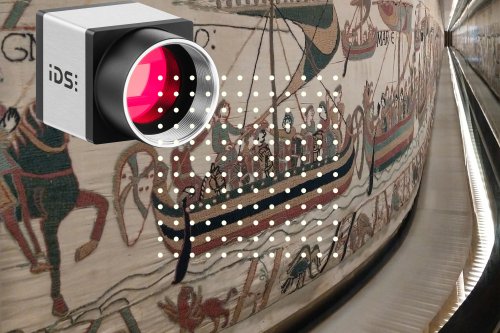
The French start-up company S-MA-C-H has studied the Bayeux Tapestry* as part of a research project and, with the help of IDS cameras, has developed a system that provides valuable insights for the conservation-optimised storage and presentation of this delicate and extraordinary artefact. The expertise of conservators, combined with state-of-the-art technology, helps to identify potentially damaging factors at an early stage, to minimise them or, at best, to exclude them altogether.

The system was designed for a comprehensive study looking at the mechanical behaviour of the Bayeux Tapestry - commissioned and funded by the Normandy Regional Office for Cultural Affairs. "We contributed our expertise in mechanical engineering by fully monitoring the stress and strain on the tapestry. In addition to monitoring, we helped to devise conservation solutions. This involved classifying and assessing the degree of risk and sensitivity of the tapestry in its surrounding indoor climate," explains Cécilia Gauvin, co-founder and managing director of S-MA-C-H.

A multidisciplinary team of textile and preventive conservators as well as heritage conservation scientists characterised the artefact's response to appropriate environmental fluctuations. "The project addressed two main questions: what are the optimal parameters for a presentation on sloping supports and how does the tapestry react to its microclimate?"

To be able to answer these questions, the tapestry was monitored by temperature and humidity sensors as well as by force sensors to record the gravity pressure. The heart and brain of the system: a non-contact 2D full-field Digital Image Correlation (DIC), consisting of an IDS camera and specially developed software for digital image correlation.

"Digital image correlation is an image processing technique that can be used to analyse movements and deformations of objects. For this purpose, high-resolution images of the object's surface are captured and then evaluated with the help of software algorithms to detect changes in the shape, position or size of the object," explains Patrick Schick, IDS Product Marketing Manager. In the search for the right camera model for the system, parameters such as interface, sensor and price-performance ratio were the main deciding factors. "For the analysis of the tapestry, extremely high-resolution images with low image noise are required to capture the smallest details.” The USB 3 uEye CP meets these requirements thanks to the particularly light-sensitive IMX183 rolling shutter CMOS sensor from Sony's STARVIS series. With BSI technology ("back-side illumination"), this sensor ensures outstanding image quality even under difficult lighting conditions. "The camera is thus ideally suited for demanding image evaluations such as this monitoring, which takes place in low light for conservation reasons. The USB3 Vision camera records high-resolution images at a very low frequency over a longer period of time," adds Patrick Schick. For the research project, for example, the monitoring ran around the clock for a month, with only one image capture per hour.

"The Python interface of the IDS peak API allowed us to quickly and easily develop software to parameterise the camera and capture images," explains Cécilia Gauvin. The images are then processed with DEFTAC3D, a software developed by the French Pprime Institute specifically for digital image correlation. This results in full-surface measurement data of the object's surface based on thousands of 2D or 3D coordinates with very high resolution. The displacement of the image points within the examination period is interpreted as a deformation that is due to a mechanical load or stress on the object. Based on the results, full-field strain maps as well as deformation maps are generated. Full-field strain maps illustrate the strains in a material over the entire surface. They therefore show whether and how the tapestry has deformed as a whole. Deformation maps, on the other hand, provide information about the local deformations in a material. They provide S-MA-CH staff with information on whether and how the tapestry has deformed at specific points.

The full-field strain maps are processed together with the environmental variation findings to understand the hygromechanical behaviour of the Bayeux Tapestry. Hygromechanical behaviour refers to the interplay between moisture and the mechanical properties of the textile. This can be influenced by a number of factors, including the type of yarn used to make the fabric and the type of weaving or embroidery technique used to make the tapestry, which adds to the complexity of the study. In order to incorporate scientific data into the decision-making process, tests were carried out on both facsimiles and the tapestry itself. On the facsimiles, the full-field strain maps were combined with the stress results from the force sensor measurement and the climate measurements (temperature and humidity). The results allow conclusions to be drawn about the climate regulation for optimal storage of the artefact.

The data collected by the sensors and camera system was documented in real time to analyse long-term trends. With the help of the information provided, it can be ensured that the climatic conditions in the Bayeux Museum are within the optimal limits to avoid damage to sensitive art objects or historical exhibits, such as the Bayeux Tapestry.

Outlook.

The market for the protection and preservation of cultural heritage is slowly opening up to structural diagnostic procedures. "Our goal is to develop appropriate systems for conservators in a plug-and-play system," explains Cécilia Gauvin. In addition, the French start-up wants to use vision systems to monitor structural damage to paintings in museum galleries and historical monuments in the future. This approach across disciplines makes it possible to assess the condition of exhibits so comprehensively that the appropriate conservation measures can be taken.

"Our knowledge of mechanical engineering, combined with industrial image processing, opens up new approaches, expands the range of actions and produces innovative solutions."

An elaboration of the conservation conditions for handling, storage or presentation of artefacts based on these interdisciplinary research results offers protection against further damage. Historical as well as modern products of textile art can thus be preserved in the best possible way for the future. Image processing components make a valuable contribution to this.


The Tapestry
• 68 metres long
• 52 cm high
• 9 panels of woven linen fabric
• 4 seams
• 10 colours of woollen yarn
• 58 individual scenes
• 623 people
• 202 horses
• 55 dogs
• 505 other animals
• 27 buildings
• 41 ships and boats
• 49 trees
* The Bayeux Tapestry, is an embroidered work created in the second half of the 11th century on a strip of cloth about 52 centimetres high. Depicted in images and text over 68 metres in 58 individual scenes, the Conquest of England is considered one of the most remarkable pictorial monuments of the High Middle Ages because of its abundance of detailed individual depictions, well thought-out iconography and quality of craftsmanship. Despite its name, the Bayeux Tapestry is not actually a tapestry but a narrative embroidery. It consists of images and text inscriptions and comprises nine interconnected linen panels.


@IDS_Imaging @BayeuxMuseum @mepaxIntPR #France #Heritage #Conservation

Friday, 8 November 2013

More news from Boston this time in fine arts!

People in Conamara, where Read-out resides, have been full of the news of the election of the new Mayor in Boston, both of whose parents came from the area. Here we have another story from that historic city.

The conservators at the Museum of Fine Arts in Boston (MFA) and the application engineering team at Headwall Photonics collaborated on a hyperspectral project to analyse some of the world's most treasured paintings, artifacts, and documents.  

Utilising Headwall's large-format Hyperspec Scanning System which is specifically designed for museums and libraries, artwork and antiquities were scanned with Hyperspec sensors for both the VNIR (Visible - Near-Infrared) and SWIR (Short Wave Infrared) spectral ranges. The benefit of using dual sensors is that a particular artifact or document can be thoroughly scanned across the VNIR and SWIR range, yielding a wealth of valuable and never-before-seen spectral information relative to pigments, inks, materials, and features. Classifying this spectral data gives collection-care experts around the world new insight into the valuable assets they manage.

Matthew Siegal, Chair of Conservation and Collections Management at the Boston's MFA, indicated that "hyperspectral collaboration with Headwall yielded a wealth of information; additionally, the research team jointly worked to establish the necessary work procedures and protocols to protect the historical artifacts throughout the scanning process."

"For the purpose of cultural preservation, hyperspectral imaging is an invaluable tool that offers conservators the ability to analyze and assess the current state of the historical objects over time," said Headwall Engineering Director, Peter Clemens. "Additionally, there is a wealth of new research information on these historical objects that becomes uncovered through the use of these spectral imaging techniques." With both vertical and horizontal scanning system orientations possible, and the use of non-destructive illumination, conservators utilize hyperspectral imaging to provide additional analysis of artifacts and antiquities that may hold answers to long-held secrets and cultural insights.


During the project collaboration with Boston's MFA conservators, the Headwall engineers scanned a wide range of objects including famous paintings, a Mayan vase, wood block prints, a chessboard, and a marble relief sculpture. Hyperspectral sensing is applicable not just for flat art such as paintings and documents, but for pottery and other artifacts as well. Scanning of an important Mayan vase yielded the presence of cracks never before seen allowing for better preservation steps for the valuable piece.

Thursday, 27 May 2010

Assists supersonic flight without leaving the ground

Powerstax has supplied an AC power source to the famous Brooklands museum as part of an ongoing project to restore the original flight simulator used to train pilots for Concorde.

Brooklands was the world’s first purpose-built motor racing circuit, constructed at Weybridge, Surrey (GB) in 1907. More than a great sporting arena, Brooklands was the birthplace of British motorsport and aviation, home of Concorde and the site of many engineering and technological achievements throughout eight decades of the 20th century.

The Concorde simulator has been donated to the museum and is gradually being restored to the point where all of its major flight-deck instrumentation, including the legendry MACH meter will function. Aircraft control systems require 26VDC @ 400Hz and initially a number of small, second hand power supplies had been bought at auction to get the project off the ground. As more of the flight deck has been brought to life a single, more reliable power solution which could provide enough power for the current level of activity and planned future needs was required.

Gordon Roxburgh, the volunteer in charge of this project (see his website on "Concorde: Celebrating an aviation icon"), comments; "We needed a more powerful AC power supply that could meet the aircraft power specifications and provide enough output for our existing and future needs. As a charity the cost was also an important factor and the Behlman AC power source and special price offered by Powerstax met all of our needs".

The Concorde flight simulator now at Brooklands was decommissioned in 2004 and the volunteers are being assisted by the University of Surrey to replace the original control systems. Visitors to the museum can “take a flight” in the simulator and eventually be able to experience a functioning Concorde flight-deck

The Behlman range of AC Power Sources available from Powerstax are ideal for cost-effective conversion from and to any single-phase shipboard, avionics or world-wide power requirement. Behlman products provide a comprehensive AC-AC product range from 1350VA up to 120kVA. These offer variable AC voltage and frequency (45-10kHz) plus optional features such as Three-phase input, IEEE-488, RS232, Extended Frequency, extra output voltages and are CE marked.

Powerstax designs and manufactures high power density, high efficiency AC-DC and DC-DC power supplies and DC-DC Converters. Served markets include Defense, Avionics, Industrial, Medical, Telecoms, Datacoms, IT, Test & Control & Transportation.