Showing posts with label Injection. Show all posts

Friday, 18 February 2022

PoE++ Injectors for networks

Added connectivity, versatility and cost-efficiency to factory automation systems with a new line of Gigabit PoE++ Injectors is being broght by Antaira Technologies. These new injectors will be capable of transmitting both high-speed data and up to 100W of power per port on the same Ethernet cable. PoE++ injectors provide PoE power to Ethernet connections coming from standard Ethernet switches extending their functionality and providing high power to a new generation of PoE clients, including sensors, IP PTZ cameras, Wi-Fi Access Points and thin clients, without the expense of upgrading to a new switch.

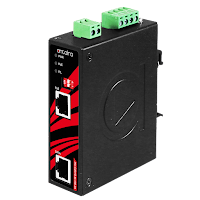
INJ-C201G-bt Series PoE Power Injector
Comprising four individual models, Antaria INJ-C201G-bt Series injectors represent a flexible solution for automation system designers, helping them achieve seamless network migration and easier upgrades to infrastructure capacity. Backward compatible with 802.3af/at PoE standards, these injectors eliminate the requirements of locating network devices close to power outlets, while protecting existing investments in legacy, non-PoE switches. Versatility is further extended by DIN-rail or wall mount options, as well as a compact footprint that requires only minimal space. Environmentally hardened, these IP30-rated injectors will operate over a temperature range of -40°C to 75°C (-40°F to 167°F) and are standards compliant ensuring compatibility with existing network devices. All four are UL Pending.

INJ-C201G-bt-T: This entry-level unit supports power input from 48VDC to 55VDC, ensuring full 90W PoE output in compliance with 802.3bt, making it ideal in the automation, surveillance and vehicle industries.

INJ-C201G-bt-24-T: In addition to supporting power input from 48VDC to 55VDC, ensuring full 90W PoE output, this model features power boosting technology for increasing low-voltage up to the required 802.3bt PoE requirements of 55 VDC, a common situation in light-duty industrial environments, building automation, and telecommunications.

INJ-C201G-bt-100-T: Designed specifically for higher powered network equipment, this injector supports power input from 48VDC to 55VDC, ensuring full 90W PoE output, along with an Enhanced PoE mode to offer up to 100W to higher-powered equipment such as digital signage displays, touch PCs, and lighting.

INJ-C201G-bt-100-24-T: This versatile model has the PoE budget to handle the requirements of low, standard and high voltage equipment. It ensures full 90W PoE output, while offering both power boosting technology and Enhanced PoE mode. A dip-switch setting enables PoE mode and dual PD signature verification process. The first PD verifies backwards compatibility with PoE and PoE+, while the second PD confirms there are two power negotiations before releasing 90W power.

@AntairaTech @OConnell_PR #PAuto Communications

Thursday, 17 February 2022

Wireless switchgear for injection moulding.

Wireless switches and sensors from .steute guarantee safe, reliable and cable-free signal transmission in a wide range of applications. One interesting application for this solution is plastic injection moulding, especially multi-component processes which often involve machines with rotary plates. These plates enable the main part of the construction element to be moulded first and then – after rotating the plate by 90 or 180° – injection of the second part. This prevents distortion and accelerates the production process.

A challenge here is monitoring the slide positions and thus ultimately the correct closing of the injection moulding tool. If the slides are not in the correct position and the tool closes, this can lead to repairs which cost not only money, but – almost more importantly – time.

In order to prevent this from happening, while at the same time eliminating the effort of installing cables, which are then also susceptible to wear and tear, users can opt for a wireless position switch or wireless inductive sensor from steute. The wireless switch or sensor registers the end position of the slide and transmits a corresponding signal to a wireless receiver unit inside the control cabinet. The next injection moulding process is not started until the receiver unit transmits the signal "slide closed" to the machine control system.

The RF 96 Rx Sensoren is the most elegant way, simple to install and free of wear and tear, to achieve signal transmission from a rotating machine element, it is already being used by leading plastics processors. Most of them have opted for a position switch from the steute range (ES 13, for example) which is then "wireless-compatible" in combination with a wireless universal transmitter (RF 96 ST or RF I/O). Alternatively, wireless inductive sensors from the RF IS range are also available.

The cost of installing a wireless switch or sensor (including receiver and integration in the machine control system) is very manageable, whereas the benefits are enormous, due to the fact that this option is a very simple and reliable way to avoid tool damage. Incidentally, similar solutions are also in use for metal processing – for example to monitor the positioning of workpieces in press brakes.

@mepaxIntPR #PAuto #.steute

Monday, 14 September 2015

Maximum speed and energy efficiency with hybrid design!

Tisse and Kollmorgen have together developed an electric-hydraulic Hybrid Machine. The Hybrid Machine can manufacture difficult and sensitive products at high speeds; its power and quality eliminate problems like ejection errors and high quantity of wastage. It also increases the production rate and provides energy efficiency up to 35-40% compared to the competition.

Kollmorgen AKD Servodrive
eS-Drive450 Tisse is the result of the cooperation between Kollmorgen engineering and Tisse Plastic Injection Molding Machines Company. It is the first hybrid plastic injection molding machine, whose injection part includes an electric system and a hydraulic system comprised of clamping and conveying as well as an ejection unit. The hybrid design provides speed and energy saving in manufacturing. The entire software of the machine was written by Kollmorgen, in house, from scratch.

The injection part of the hybrid machine consists of 2 servo motors, whereas clamping, conveying and ejection parts form the hydraulic system. However, because the pump of the hydraulic system is driven using servo motor, the machine may be called a full electric hybrid.

The reason why servo motors were used in the injection part was to provide crucial acceleration and sensitive pressure balance, making it easy and quick for the liquid plastic to be injected in to the mold.. Speed is of great importance especially for molding thin-walled packaging products. For instance, because products, such as the lids of yoghurt pots cool very quickly, the process is required to be completed immediately.

Seref Karaoglan, project manager of Kollmorgen Turkey, speaks about the machine performance: “We often witness that manufacturers have difficulty in manufacturing such products. We designed the hybrid not only to provide energy efficiency but also to increase speed. People think it is not easy to manufacture such machine because, for instance, we apply 10 different speed stages and 10 different pressure stages in accordance with the type of mold in order to make a movement of 90mm (P/Q). It is really not easy to do this just with any servo motors but we used Kollmorgen’s S600 drives and PDMM controllers.”

Ömer Sengelen
Omer Sengelen, Production Manager of Tisse Machine, summarized their position in the sector: “We are endeavoring to add remarkable features even to typical machines. Actually, we quit manufacturing injection molding machines in 2000. In 2008, however, we noticed that there was a need for blow molding machines and we started manufacturing again. With the expertise and high product quality that we developed through our partnership with Elsim Kollmorgen, we have become capable with very high-level injection molding machinery. ”

Clamping systems in normal injection molding machines are usually problematic. The injection molding might be fast but the clamping is the negative side. The compression ratio is less, but they cause great expenses at high speed. The clamping part in hydraulic injection machines is always as per specifications, but complaints about the injection speed predominate. Their maximum speed is between 100mm/h and 200mm/s. This hybrid machine has the best side of those 2 systems. While it enables the clamping and other parts of the machine which require power to run fast, it is also able to reach a speed of 300mm/h by getting the injection system to work with servo motors. In addition to these advantages, it provides energy saving in the pump of the hydraulic system by using servo motors.

Project manager of Kollmorgen Turkey, Seref Karaoglan says, “The reason why electric machines are liked is that they are energy efficient unlike AC motors, in the hydraulic part of old machines, that keep cycling even while the machine is off and consume energy even if you do nothing.”

Special Valve Technology
Regeneration is provided through the special valve used in the hydraulic system of the machine. Suppose that the grease taken from the tank and injected into the system, supplies 100 units of energy in the classical systems. Thanks to this valve, the grease coming out of the system is re-injected into the system, instead of transferring it into the tank. Thus, you obtain extra power up to 60%. According to Seref Karaoglan, you get extra speed as well as extra power, and “It is like the generator of a car charging the accumulator. We could have used standard valves for the clamping parts because we had acceleration in the injection part. But thanks to this special valve, we use the clamping system as if it is electrically operated, and increase the speed thanks to regeneration.”

Parallel Power through Two Different Motors
Another stellar feature of the machine is that 2 different motors are used in the injection process, getting parallel power through each other. The motors are connected by very special screws that run synchronously. These screws enable the motors to cycle with high-precision in less than 1/10mm, and they provide stable running even at high speed.

Efficient Communication System
The speed doubles because the injection nozzle in the machine is pushed and pulled by twin motors. Seref Karaoglan says, “Kollmorgen communication systems allow the synchronous work of two motors on the same mechanical system but running independently. If one of the motors runs at a speed slower than 1/10mm, it might damage the screws, which are very special and expensive. The communication time and synchronization of the motors takes less than 1 m/s."

High-Tech Braking
The motors used in the machine are quite heavy and powerful. “We took all kinds of measurements in the event of any communication problems between each other. 6.5kW of braking resistance is used in the system because the flywheel effect comes out while the screws and balls gain acceleration.” Seref Karaoglan also points out that it gets really difficult to control the speed and says, "The products we use here are those developed by Kollmorgen and include plates providing stepped braking. It would have been impossible for me to succeed in this project with standard braking resistances.”

Special Pump Software
There are 2 important elements in grease-powered systems: Speed and Pressure. The software developed for this machine, ensures the desired pressure at the desired speed. Seref Karaoglan says, "We can use 10 different PQ distances. We are also using this advantage on the clamping system. Thanks to the servo motored pump software, we reach the desired speed within 150-200ms and despite this speed, we provide the desired pressure on an error band of 2 or 3 bars.”

Kollmorgen’s machine automation solution brings highly integrated and intuitive software programming platform, top of the range movement components and extraordinary co-operated engineering services in order to create highly differentiated machines and more profitable business organizations. It has been proven that Kollmorgen Automation Suite™ accelerates the development process, raises the machine manufacturing, reduces wastage and increases hardware efficiency (OEE).

Monday, 14 October 2013

Achieving 100% quality injection moulding even faster with Kistler's CoMo #PAuto

The new firmware upgrade V2.4 for Kistler's CoMo Injection process monitoring system offers better functionality and new features that will help processors achieve zero-defect production even faster.

The integrated, automatic mould recognition function of the CoMo Injection system makes mould connection and setting easier and faster with automatic loading of mould data during mould changes. Connection errors are detected quickly and can be remedied before they can cause any damage. Kistler has made the synchronized processing of uniform evaluation objects for pressure monitoring of multi-cavity moulds significantly easier. Evaluation objects of the same type can be selected across channels and processed synchronously afterwards.

The MultiFlow, the automatic hot-runner balancing function of the CoMo Injection system, now offers more options. Tip temperatures can now be controlled with higher precision with Smooth Control mode. This enhancement allows injection moulding processes involving polymers with a viscosity that is significantly affected by temperature changes to be controlled more accurately. These improvements will be of particular benefit to operators of multi-cavity moulds for thermoplastic elastomers and other temperature-sensitive polymers. Individual process variations are detected reliably and their effect on process control is eliminated. MultiFlow now also offers an automatic start-up function, which is triggered automatically during production start-up and after production downtimes.

The CoMo Injection system's output channels for controlling reject gates or removal robots are now easily tested via One Touch check. This function ensures the reliable separation of rejects and allows network-based data management for easier data handling.

As an industrial process monitoring system, CoMo Injection is equipped with connectors for multichannel technology as standard. However, in some cases the use of sensory equipment for testing purposes may require a higher level of connective versatility. Fitted with modules of the new Lab Conversion Kit (LabKit), CoMo Injection can now offer more connection versatility which allows the direct connection and exchange of individual sensors as required. Modules for individual charge and voltage signals and modules with integrated amplifiers for thermocouples Type K or J are also available. Easy assembly and disassembly allows operators easy switchover and full use of the benefits of multichannel cable technology or separate connections versatility. The modular design of the CoMo LabKit allows easy adaptation and enhancement as needed.

Thursday, 6 September 2012

Aiming for zero defects


Birmingham (GB) based Barkley Plastics produce 6.5 million injection moulded parts each month, every month, making quality control an essential part of the business process.  With many end user customers now demanding “zero parts per million defects”, just a few out of spec parts in a delivery can incur significant costs.  This is a major problem, especially for export orders, when the parts are needed to keep a production line running.  The only solution is for the end user to manually sort the consignment and bill the cost, which can be more than the value of the order, to the supplier.  Like many injection moulders, Barkley have been using cavity pressure monitoring for several years to try to identify out of spec parts before they get into the delivery system.

For the past 10 years, Barkley had been using a simple 2-channel peak cavity pressure monitoring system that was difficult to set-up and had become problematic.  To protect its reputation and bottom line, two of the old systems have now been replaced with the latest 4-channel CoMo Injection systems from Kistler Instruments.  Interestingly, this new, state-of-the-art system cost about the same as the old system did 10 years ago making the much more sophisticated CoMo Injection system very good value for money.

According to Barkley’s Business Development Manager, Matthew Powell, by monitoring all aspects of the cavity pressure curve during the moulding process, the CoMo system ensures that all out of spec parts are rejected quickly and reliably.  “Because the CoMo system automatically provides perfect rejection of faulty parts,” he says, “it is possible to run the moulding machines in the dark with little or no supervision.” 

In addition to monitoring the process, the CoMo system can be used to balance the hot runners, which Matthew Powell describes as a “massive bonus” that is essential to maintaining consistently high quality parts.  This feature alone makes life much easier for setters and technicians, a benefit that is not always obvious.  The availability of accurate data about the performance of the moulding machines allows communication between departments to be based on hard facts, rather than experience and intuition.  Typically, mould design is part science and part knowledge and the precise data supplied by the CoMo system compliments the high quality tooling manufactured by Barkley Plastics in its in house toolroom and design facility.

Matthew Powell again, “Although the new system is much more sophisticated than our old system, it is actually easier to use.  However, to get the best results in the shortest time demands expert training, which is what Kistler supplied.  We have already minimised the number of rejects and can see the potential to eliminate rejects totally as we become more familiar with the CoMo Injection system”.

The injection moulding industry is very competitive with quality and zero defects often being more important than price, especially when the economy is far from buoyant.  A reputation for delivering a first class product will win new and retain existing customers more effectively than a low price.  With production running at around 80 million parts per annum, minimising rejects can make a major contribution to Barkley Plastics’ reputation and profits, which is why the company is now planning to install more CoMo Injection systems from Kistler.

Friday, 7 May 2010

Controling injection moulding

The CoMo Injection system from Kistler Instruments, widely used by the injection moulding industry to achieve maximum productivity by minimising rejects, uses cavity pressure to monitor and control the injection process. This system has now been extended with the addition of the MultiFlow option to provide automatic hot runner balancing.

Cycle by cycle, CoMo Injection with MultiFlow monitors the pressure profile of each cavity of a hot-runner mould from injection, through compression and holding, to the cooling phase.

During the injection and holding pressure phases, the MultiFlow software analyses the pressures curves in all cavities. The synchronous rise in pressure in all cavities is achieved by the system automatically calculating the optimal set-point temperature for each hot runner tip, which is then transferred via an interface to the hot runner controller.

The mould is automatically balanced during process start-up, and continuous optimisation keeps it stable during production. The balanced mould always exhibits congruent cavity pressure curves during the injection and holding pressure phases. At the same time, CoMo Injection continuously monitors the quality of all of the parts produced and signals any need for automatic separation of rejects.

Hot-runner balancing with MultiFlow completely eliminates the need for time-consuming manual optimisation and adjustment of the hot-runner temperatures during set-up and production.