Showing posts with label Machining. Show all posts

Wednesday, 27 July 2022

Rounding fir-tree slots.

Turbine and compressor discs have so-called fir-tree mounting slots into which the turbine blades are inserted. The established production methods for these mounting slots are broaching, wire cutting or milling. But these techniques produce burrs and sharp edges in the fir-tree slot. For flawless assembly and to prevent injuries, the edges of the fir-tree slot and blade root must be burr-free, with a defined radius. This is the only way to guarantee that the components function properly. In particular, the pressure surfaces that blade roots and discs are in contact with during operation are subject to very narrow tolerances of 10–20 µm. For the blades to be perfectly positioned, it is essential to prevent shape variation in pressure surfaces during deburring and rounding.

Repeatability.
Standard engineering practice for this process step is mechanical, semi-robotic deburring and rounding with grinding wheels or brushes. These tools used wear over time, producing inconsistent machining results over their life span. For example, sharp edges can slice off brush tips, make brush wear hard to predict, and therefore lead to varying results as well as heavy process contamination due to the brush residues. Likewise, grinding wheels are subject to uneven material removal, which the robot movements have to compensate for, and the abrasion causes process contamination.

On complex workpiece geometries, rounding results are often asymmetrical because the grinding wheels or brushes cannot be fine-tuned to the exact geometry of the fir-tree slot, or because they cannot get into hard-to-reach areas at all. These asymmetrical and inconsistent rounding results often fail to meet tolerances, cause shape variation and therefore increase both your reject rate and your costs.

Comparing alternatives.
In the quest for an alternative process with convincing finishing results, an engine manufacturer worked with OTEC to evaluate two different mass finishing technologies.

The first process, in a round vibratory trough, proved inexpedient for the application:
even after several hours of processing, it was unable to bring all the edge breaks within the tolerance range. The rounding produced in the tests was neither symmetrical nor repeatable. Furthermore, the increased noise level and associated vibrations were a problem given that sensitive measuring devices are used close by.

The second process, in the OTEC stream finishing machine, quickly achieved very promising results at the first attempt:
By positioning the component precisely, all the edge breaks were within tolerance in just 15 minutes, with highly symmetrical rounding along the entire edge. Additional runs confirmed that the process was repeatable and stable. Shape variation was less than 1 µm – so low that not a single adjustment was required in upstream broaching. Lastly, the low-noise, low-vibration process was suitable for use near sensitive measuring devices.

These advantages have already convinced several engine manufacturers:

  • Minimal process time of just 15 minutes
  • Highly symmetrical, uniform rounding
  • Reliable, repeatable process results
  • Residue-free burr removal
  • Minimal shape variation in fir-free slot pressure surfaces
  • Reliable, measurable compliance with narrow tolerances of less than 1 µm
  • Purely mechanical material removal, without the use of chemical process accelerants

How does stream finishing work?
In mechanical stream finishing, which was developed in-house by OTEC, components such as turbine discs and turbine or compressor blades are clamped in a holder and immersed in a rotating container filled with an abrasive or polishing medium (media). The workpieces can also be rotated or set at specific angles in the media flow.

The relative motion between the component and the media produces an even finish. The enormous machining forces of up to 9 tons used in stream finishing can remove material faster and more precisely than any other type of surface finishing process: depending on component size, initial state and preparation (e.g. pre-chamfering) they can produce a radius of up to 700 µm within 15 minutes. And because the media granules are so fine, the rounding process is also suitable for complex, hard-to-reach geometries.

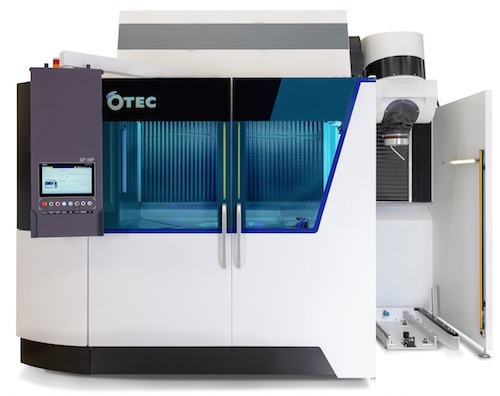
OTEC is the only supplier of stream finishing machines with integrated automation for large and heavy components: the newly developed SF-HP is suitable for workpieces up to 650 mm in diameter and weighing up to 200 kg.

Their stream finishing technology is an ideal choice for components with similarly demanding post-processing requirements. Examples include turbine and compressor blades, turbine blade roots, blisks, servo valves, gear wheels, ball screw nuts and landing gear components. The OTEC Finishing Centre is ready to assist in defining processes – whatever the geometry, surface quality or rounding requirements. They will help to identify exactly the right process for each component.

@Pressebox #OTEC #Manufacturing, 

Thursday, 14 July 2022

Advanced Machining Cell and Software solutions.

The new OmniVance™ Machining Cell and Machining Software solutions, launched by ABB, are bringing greater flexibility and simplicity to a range of applications including sanding, polishing, cutting, and surface finishing.

Part of the new OmniVance portfolio of standardized application cells, the new Machining Cell is the first to market that can perform up to eight different applications in one cell, while its intuitive Machining Software simplifies programming and reduces set-up time by up to 92%.

“The OmniVance Machining Cell and Machining Software are our latest innovations in ABB’s growing robotics portfolio to make automation more accessible, flexible and faster,” said Marc Segura, ABB’s Robotics Division President. “As consumers’ appetite for a greater range of products grows and product lifecycles shrink, manufacturers need to to make quick and cost-effective changeovers to stay ahead in the market.”

An IRB 2600 robot, a controller, and a turn table combined with pressure and level sensors and other equipment make up the OmniVance Machining Cell, with all components pre-tested to guarantee compatibility. 90% of the cell is already built, meaning users only need to focus on tooling and robot calibration. This level of ‘pre-engineering’ results in a faster set-up and more compact footprint to ensure that cells can easily integrate into a wide range of production environments. The use of a standardized design also makes it possible to run up to eight different functions on a single cell often by simply changing the end effector.

The OmniVance Machining Cell has been shaped by real-life stress tests on 2,400 cells. The result is a highly durable and stable solution suitable for harsh conditions and capable of running unsupervised for 20,000 hours before maintenance is needed. Simplify automation with Machining Software

ABB’s Machining Software is the first to integrate auto-calibration and path-tuning functions into a single intuitive tool. This simplifies the process of setting up new products while maximizing accuracy in machining applications including sanding, deburring, polishing, and dry ice cleaning. The Machining Software is a standalone tool that supports the IRB2600 robot used in the Machining Cell as well as a wide variety of robots from ABB. The Machining Software calibrates tools and work objects automatically, reducing re-calibration time from three hours to just ten minutes. Integrated path tuning functionality enables users to easily edit thousands of path points in just half a day, compared to the two days typically needed to obtain a high-quality surface such as that of a cellphone case or an aluminium wheel.

Non-programming experts can easily perform and monitor machining operations with an intuitive and user-friendly interface. Faster programming of the machining operation is achieved through simple drag and drop functions, minimizing the risk of errors. Copying and pasting programs between multiple machining stations can further reduce the time it takes to scale up operations.

“Our OmniVance Machining Cell and Machining Software provide new opportunities for unlocking new levels of efficiency, accuracy, and flexibility for businesses across a wide range of sectors, from wood and metals production through to electronics and automotive,” added Segura. “As product design becomes more complex and labor shortages impact, our Machining Cell and Machining Software together can enable businesses to transform their productivity in even the most intricate tasks.”

The OmniVance FlexArc Compact is one of the latest offerings as part of their new OmniVance brand, that unifies all ABB standardized application cells. By combining robot, gripper, controller, software, and other components into a single application-specific solution, OmniVance cells require minimal integration effort and reduce the potential for errors. The standardized design of OmniVance cells, coupled with ABB’s global footprint ensures quick changeovers, easy expansion, and timely support.

@ABBRobotics @NapierPR #Manufacturing #PAuto

Thursday, 31 January 2019

Scanner for laser micromachining.

Aerotech is introducing a new high-performance Galvo Scanner. The AGV-SPO offers a larger field of view than conventional 2D scanners, reduces laser spot distortion, and is flexible enough to accommodate a wide range of laser wavelengths thanks to a large variety of mirror surfaces. As a result, the laser scanner is suitable for a wide range of applications, from additive manufacturing to medical devices.

With just one pivot point for X and Y deflection, Aerotech's AGV-SPO Galvo Scanner significantly increases the field of view, reducing laser spot distortion in critical laser micromachining applications. Due to the special optical design, the entrance pupil of the laser beam coincides with the X and Y deflecting mirrors, increasing the effective numerical aperture of the scanner system. The design immediately increases the field of view for a given focal length and reduces laser spot distortion throughout the working area. With the new Galvo Scanner, even larger parts can now be processed faster and with improved uniformity.

The AGV SPO scanner provides a range of mirror coatings and focusing optics to support a variety of commonly used laser wavelengths and focal lengths. Also, customer-specific optics and optical mounting options can be adapted as a special solution. Optional air-cooled mirrors and/or water-cooled motors ensure constant temperature conditions and continuously good work results even with high laser power or highly dynamic motion profiles.

The laser scanner benefits from the high performance of the Aerotech’s controllers with their advanced motion control and position synchronised output (PSO). In addition, path control functions such as acceleration limitation offer the ability to automatically reduce scanning speed in tight bends or small radii to minimise overshoot. In addition, the laser can also be triggered based on the position feedback of the mirrors via the PSO. This ensures a consistent laser spot overlap when the scanner changes speed. Aerotech's Infinite Field of View (IFOV) feature seamlessly combines servo drive and scanner motion to extend laser marking across the entire servo axis travel range. This avoids stitching errors that can occur during the move expose repeat process.

 @aerotechmotion #Manufacturing