Showing posts with label Current Transducers. Show all posts

Thursday, 27 January 2022

The most accurate current measurement transducer.

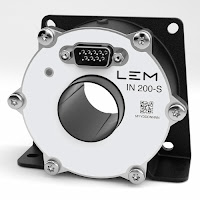
The IN 200 current measurement transducer, from LEM, is offering record levels of accuracy performance in current sensing with the launch of its IN 200 current measurement transducer.

As the most accurate sensor of its kind on the market, the IN 200 is ideal for use in such demanding applications as high-precision test & measurement (T&M) equipment used to analyse the efficiency of inverters fitted to hybrid electric vehicles (HEVs) and electric vehicles (EVs).The IN 200 is able to offer significant performance improvements – particularly in terms of linearity, offset and noise immunity – over traditional fluxgate transducers through its use of a new kind of digital technology.

Unparalleled levels of accuracy are achieved in linearity and electrical offset. While the IN 200’s data sheet quotes 0.6 parts per million (ppm) and maximum 10ppm respectively, in-house tests have shown that the sensor can achieve linearity below 0.5ppm and offset of +/-5ppm.This compares with competitors’ transducers offering +/-20-25ppm.

With the new transducer fitted to automotive test benches, manufacturers will be able to improve the testing efficiency of inverters and validate their performance levels through access to the most accurate data. In turn, because inverters will reduce power losses, designers will have the potential to tackle the issue of “range anxiety” by enabling EVs to go further than is currently possible.

The IN 200 completes LEM’s IN family of High Precision sensors which now covers a current range from 100A to 2000A. The IN 200 itself is effectively three products capable of matching nominal currents of 100A, 200A and 400A.

The single biggest factor that sets the IN 200 apart from the competition is LEM’s switch from reliance on analogue circuitry to digital integration technology. To achieve the increasingly high levels of accuracy demanded by the T&M market, LEM is reinventing fluxgate technology. Traditionally, many analogue circuits would be required to cancel out noise and other impacts of having different fluxgate coils but LEM’s innovative solution makes it possible to reduce substantially the number of analogue circuits within the transducer through digital integration, transforming the signal. By operating in the digital domain, the new sensor offers a wider range of capabilities – including ripple compensation, detecting second harmonics and voltage regulator excitation.

LEM believes that the IN 200 is a long way ahead of its nearest competitor in virtually every single parameter. While the market has shown that it can manage with the lower performance levels offered by other power measurement transducers, the IN 200 offers manufacturers the potential to take accuracy and efficiency figures to hitherto unachievable highs.

“The trend is very clear,” says Horst Bezold, founder of Signaltec. “The increasing electrification of transport is putting huge pressures on test benches for inverters in the automotive sector and has generated a boom in demand for T&M equipment. LEM has come up with a market-leading solution that will help to ease these pressures. By eliminating traditional reliance on analogue technology, we have made it possible to reach levels of accuracy that nobody in the market has ever been able to reach. This is great news for the T&M sector.”

The IN 200 offers users many additional benefits, including significant noise reduction and outstanding immunity to external fields. The device’s digital technology ensures immunity to temperature effects, interference and supply voltage variation while its top-quality metallic housing (previous models used a plastic casing) improves EMC immunity, reduces temperature drift and enables high-precision operation over an extended temperature range (-40°C to +85°C). Other features of the IN 200 include very broad frequency bandwidth – DC to 1.1 MHz (-3 dB) – compact design with a 28mm aperture for cables and busbars, and a status signal to indicate transducer state.

@LEM_Inc @mepaxIntPR #Pauto #TandM

Tuesday, 19 May 2015

High-accuracy current transducers!

The new series of IT xx5 transducers for non-intrusive and isolated nominal measurements of DC, AC and pulsed currents from 60 A to 600 A has been announced by LEM. This extends the company's range of high-accuracy current transducers. The range includes 4 new models: IT 65-S, IT 205-S, IT 405-S and IT 605-S.
These new models offer an extended operating temperature range of -40 to +85°C, compared to the +10 to +50°C temperature range of previous IT models, allowing their use in a wider range of applications, including high precision power supplies, medical equipment, calibration units, precision and high stability inverters, power analysers and metering.

These new models provide the high performance of fluxgate technology based transducers across the extended temperature range, delivering extremely high accuracy with linearity over temperature range better than 12 ppm, and a low offset over temperature range between 36 to 400 ppm (according to the model). The fast response time to di/dt step changes is less than 0.5 µs, due to a precise and consistent winding process.

The IT xx5 series has been designed to operate from a bipolar +/-15 V DC power supply and will accommodate round primary conductors of 26 and 30 mm diameter, depending upon the model used. In addition to their normal current output, the transducers offer an additional output indicating the transducer state (low or high output levels) and an external LED showing normal operation.

The new IT xx5 range is also fully compatible with the previous LEM IT range, fitting the same footprint. These transducers can be easily retrofitted into old installations while maintaining the various compact sizes for each current range and a variety of panel mounting topologies (flat or vertical), without compromising the high insulation level provided between the primary and measurement circuits.

Tuesday, 8 April 2014

Current transducers offer more flexible mounting in small packaging! #PAuto

LEM has added three new members to its HO series of PCB-through-hole mounting current transducers, which provide an aperture of 8 x 8 mm to carry the primary conductor under measurement, extending the options for this form-factor. The new models, for 6, 10 or 25 A nominal measurements of DC, AC, and pulsed signals benefit from the revised LEM Open-loop Hall-effect ASIC (Application Specific Integrated Circuit) introduced several months ago with the launch of the HO 8, 15 and 25-NP & –NSM models.

Using the latest LEM-developed ASIC, combined with Open-loop Hall-effect technology, the new devices meet the demand for high performance and quality at a lower cost.

The HO 6, 10 and 25-P models’ offset and gain drift are twice as accurate (over the temperature range -25 to +85ºC) as the previous generation. A high level of insulation between primary and measurement circuits, due to the high clearance and creepage distances of more than 8mm and a CTI (comparative tracking index) of 600, allows a test isolation voltage of 4.3 kVRMS/50Hz/1min.

In addition, the HO xx-P series delivers better performance in other areas such as response time, power supply and noise, allowing the development of more technically advanced power electronics applications.

The transducers require a PCB mounting area of only 2.88cm2 and weigh only 10g. They can measure up to 2.5 times the primary nominal current but also incorporate an additional pin providing an over-current detection set at 2.63 x the nominal current IPN (peak value). The products also provide fault reporting in the case of memory contents being corrupted. LEM's HO xx-P transducers operate from a single supply voltage at 3.3 or 5V.

The new range delivers its output as a scaled analogue voltage; in most systems this will be converted to a digital value by an analogue/digital converter (ADC) which requires a reference voltage. The HO xx-P series can also be configured to make measurements relative to an external reference.

LEM’s HO xx-P models are ideal for a range of applications where mounting flexibility offered by the aperture and a small size is needed, such as in solar combiner boxes and solar-power inverters, as well as small smart meters, variable speed drives, uninterruptible and switch-mode power supplies, air conditioning, home appliances, static converters for DC motor drives, and robotics.


The transducers are CE marked, conform to the EN 50178 standard and are recognised for industrial applications with a wide operating temperature range of -40 to +105°C.  LEM offers a five-year warranty for each transducer.

Friday, 25 January 2013

High-accuracy 130A and 150A current transducers

LEM has introduced the LA 130-150 series of current transducers for use in motor drives, inverters, power supplies and general industrial applications. These printed-circuit board (PCB) mounted devices share a common, compact case outline, and are available to measure nominal full-scale currents of 130 and 150 ARMS. Thanks to the application of LEM's established expertise in Closed-Loop Hall Effect transducer technology, the LA 130-150 series offers high-accuracy, extremely linear measurements at a very competitive price.

The new series series measures DC, AC, and pulsed currents, providing an output in the form of a current signal proportional to the measured (primary) current. Two conversion ranges – a factor of 1000 or 2000 – are offered, with two mounting styles; the transducers can be supplied with an open aperture through which the current carrying the primary current is routed: or they can be supplied ready-fitted with a primary conductor that will connect direct to the host PCB. Within the 33.5(H) x 37(W) x 16(D)mm outline, the conductor aperture is a generous 13.5 x 10 mm. In form, footprint and function the LA 130-150 series is backward-compatible with LEM's prior-generation devices.

These transducers feature a wide maximum bandwidth of DC to 150 kHz (-1dB point) and an accuracy of better than 0.5% at the primary nominal RMS current and at ambient temperature. Typical linearity error is ±0.1% at nominal current and the maximum offset temperature drift is ±0.46% of nominal current from -40 to +85˚C. The Closed-Loop Hall-effect technology results in zero insertion losses and a fast response time of less than 500 nsec.

The LA 130-150 series will find application at multiple points within variable-speed AC motor and servo motor drives; in static converters for DC motor drives; monitoring currents in battery-supply installations, and in uninterruptible power supplies (UPSs); in specialist power supplies, for example, welding PSUs; and in switch-mode power supplies in general, together with a wide range of other industrial, domestic-appliance and HVAC (heating, ventilating and air-conditioning) applications.

Safety has been addressed as a primary design objective by LEM's engineers. Large creepage and clearance distances of 8 mm, together with a high CTI (Comparative Tracking Index) of 600 provide a high level of safety insulation with an isolation test voltage of 4.3 kVRMS at 50Hz for 1minute.

The LA 130-150-P series, is CE marked, comes with a five-year warranty, and conforms to the EN50178 standard.

Friday, 14 September 2012

Current monitoring relays with IO-Link

The Sirius 3RR24 current monitoring relay for IO-Link enhances the switching technology portfolio of the Siemens Industry Automation Division. The new Sirius 3RR24 monitors motors over the complete torque curve and is also dimensioned for current monitoring of the overall plant. The device detects load shedding, for example when a belt snaps, or motor overloads due to overloading of the driven conveyor belt or crane. Sirius 3RR24 also detects current imbalances, phase sequences, ground faults, as well as any cable breaks. The current data can be read off the device locally on a display. The current monitoring relay can be integrated into the load feeder without incurring wiring costs by mounting it on a Sirius 3RT2 contactor.

In addition to the autonomous monitoring function, measured values and data are transferred from the relay to the higher-level control over the IO-Link interface. This simplifies detailed troubleshooting and diagnostics. Communication over IO-Link also makes commissioning much easier. The Sirius relay can either be parameterized directly on the device, or from the PLC, which shortens commissioning especially in the case of repeated parameterization. If a device has to be replaced, the new relay will be parameterized automatically through data comparison with the parameter server. Work can then continue immediately after replacement, and no special knowledge of controllers or monitoring relays is required for replacement. This reduces the overhead involved in maintaining the plant. Sirius 3RR24 expands the current portfolio of monitoring relays for IO-Link that monitor variables such as temperature, speed, power factors and even voltages.

Wednesday, 9 May 2012

User-programmable current transducers

The HO series of current transducers, from LEM, is setting a new standard of performance, programmability and ease-of-use for designers of the latest generation of motor drives and inverters. The HO series of open-loop ASIC based current transducers deliver better performance in areas such as thermal drift, response time, power supply and noise driven by technology advances in power electronics applications.

LEM's HO series are open-loop devices, based on Hall-effect current sensing technology, that measure AC, DC or pulsed currents with a nominal value of 8, 15 or 25 ARMS, with a response time of 2 to 6 μsec. Both of these parameters, and several others, are user-programmable by a simple serial digital bit-sequence, generated by the system's host microcontroller. Other parameters that are user-programmable include reference voltage, over-current detection limits, fault reporting and low power mode.

This series delivers its output as a scaled analogue voltage; in most systems this will be converted to a digital value by an analogue/digital converter (ADC) which requires a reference voltage. The designer can program the LEM HO-series transducer to output a reference of 0.5, 1.5, 1.65 or 2.5V on a dedicated pin. Alternatively, the HO-series can be configured to make measurements relative to an external reference.

For the HO models, LEM designed a completely new ASIC (application-specific integrated circuit). The HO provides offset and gain drift figures twice as good (over the temperature range -25 to +85ºC) as previous-generation open-loop Hall-effect-ASIC based transducers. It achieves a typical accuracy of 1% and 2.8%, at +25°C and +85°, respectively, without offset, and with a high level of insulation between primary and measurement circuits.

An innovative feature of the series is programmable over-current detection, separate from the main current measurement. Using a single measurement range (for both detection and measuring functions), if the transducer must detect an over-current condition at (say) five times the nominal full-scale value, the measurement range must extend up to the over-current limit, reducing available accuracy within the nominal range. Separate over-current detection, with programmable threshold, ensures maximum resolution is maintained up to the nominal full-scale value.

LEM's HO-series transducer operates from a single supply voltage at 3.3 or 5V. It occupies a PCB-mountable, small (12 mm wide x 23 mm long x 12 mm high), lightweight (5g) package which incorporates three separate primary conductors to allow for multi-range measurement configurations (enabling nominal measurement as low as 2.67 ARMS when programmed at 8 ARMS for the nominal range). Versions of the HO-series transducers will be available for both
through-hole and surface-mount assembly. The construction provides long creepage and clearance distances (8 mm) and a CTI (comparative tracking index) of 600 for excellent insulation.

The high degree of programmability and flexibility of the HO series means that designers can use a unique reference in a wide range of circuit configurations, simplifying designs and reducing parts stock-holdings. As well as contributing to the efficiency of variable speed drives, LEM’s HO model is also ideal for a range of applications including solar-power inverters, solar combiner boxes, uninterruptible and switch-mode power supplies, air conditioning, home appliances, static converters for DC motor drives, and robotics.

The transducer is CE marked, conforms to the EN 50178 standard and is recognised for industrial applications with a wide operating temperature range of -40 to +115°C. LEM supplies example microcontroller code to configure the serial bit stream and program the HO series' parameters. LEM offers a five-year warranty for each transducer.

Wednesday, 25 January 2012

Transducers in space!

With the growing importance of Britain's expanding space and satellite industry, demand for specially manufactured transducers from RDP Electronics is increasing.

The completely sealed transducers use low outgassing materials to standards specified by NASA for applications in space. In particular avoiding the potential for contamination of other components on a space vehicle for example optical devices such as mirrors or cameras, due to expelled gases from transducers.

RDP’s manufacturing process mimimises the risk of damage to the transducer by means of slow pressure changes and also by modifications to ensure that there are no sealed cavities in which a pressure differential could cause damage. Out-gassing into the vacuum of vapour escaping from internal adhesives and varnishes is reduced by controlled ‘baking’ of the transducer to thoroughly dry out such materials.Transducers for the space industry are also fully welded ensuring any residual vapours are sealed inside the unit.

According to a report by the British Department for Business, Innovation and Skills, “UK companies have developed significant competitive advantages in different segments of the space value chain which enable it to successfully compete in global markets. Like other technology intensive sectors, the space sector exhibits above- average innovation, skills and productivity levels.”

Wednesday, 23 November 2011

Current transducers

LEM has announced the ITC series of transducers for galvanically-isolated, high-precision current measurements in rail-traction applications, setting new standards in measurement accuracy for DC, AC and Pulsed currents.

This new transducer series comprises three models, ITC 1000-S, 2000-S and 4000-S, with corresponding nominal current measurement ratings of 1000, 2000 and 4000 ARMS. LEM designed the ITC series for the rail-traction industry sector, reaching the Class 0.5R measurement accuracy when Class 1R is required by the prEN 50463 standard for on-board energy monitoring. The ITC series features linearity error of under 0.05% with offset currents of less than +/- 20µA.

The rail-traction industry requires unprecedented accuracy necessary of course to maintain optimum control of traction motors, but mainly in energy metering to log energy usage for fiscal purposes, for example in billing power costs for trains that cross regional borders. The industry is working to a provisional (“pr”) standard designated prEN 50463.

Precise energy metering depends on accurate current and voltage measurements, and LEM has a complete offering for prEN 50463. Used together with highly-accurate voltage transducers such as the LEM DV series (available in Class 1R or Class 0.75R certified accuracy), and an energy meter such as LEM's EM4T, ITC-series current transducers bring the necessary class accuracy.

LEM's measurement specialists determined that Hall-Effect-based measurement techniques could not provide the required accuracy, and instead used its expertise with the closed-loop fluxgate, resulting in a design with excellent accuracy and linearity, low thermal drifts and which also eliminates insertion losses. ITC transducers are insensitive to the position of the primary conductor within their large measurement aperture, offer high insulation test voltage of up to 14 kVRMS/50 Hz/1 min, and have excellent immunity to transient overloads (100kA for 100msec) and to external interferences (such as magnetic fields typical of the rail environment).

Current consumption varies from less than 80 mA to under +/-340 mA across the measurement range, from a +/- 24VDC supply. Bandwidth for the ITC 4000-S is 82 kHz (3 dB) and the transducers’ apertures allow the insertion of large conductors: 102 mm diameter (for the ITC 4000-S) or 63 mm diameter (for the ITC 2000-S). A test winding allows the operation of the ITC transducers to be easily checked with no primary current flowing.

LEM offers the ITC series in either a one-piece housing (ITC 4000-S model), or a split construction (ITC 1000 and 2000-S models) with the measurement head in a case, and the measurement circuitry mounted remotely in a metal enclosure, to facilitate locating the measurement head in confined spaces such as the train roof space.

ITC transducers operate over the range –40 to +85°C, and meet or exceed all relevant standards for safety and for the railway operating environment, such as EN 50124-1 and EN 50155.

Their high accuracy also makes the ITC transducers ideal for use in a broad array of differential current-measurement applications where 0.5% accuracy, over 5 to 150% of nominal current, is required.

ITC models are CE marked and, in common with all LEM industrial transducers, carry a five-year warranty.

Thursday, 19 May 2011

Current transducers

LEM has introduced the CTSR family of current transducers for use in a range of safety-critical applications including solar installations. Two transducers in the new series measure AC or DC leakage nominal currents, from values as small as 300 and 600 mARMS, with spectral components up to 9.5 kHz. The residual or leakage currents that the CTSR family is designed to measure can arise in fault conditions in a number of industrial or power-generation scenarios. Examples include solar panels that are coupled to an earthed grid, or in failure modes such as a short circuits or earth faults. The connection of a solar panel to the grid raises safety concerns; if a fault occurs there is a potentially serious safety issue around any human contact with the system.

The CTSR family of transducers has been specifically designed to meet the latest safety standards that have been issued in respect of solar installations and inverters, namely VDE 0126-1-1, UL 1741, and IEC 60950-1. The devices are PCB mountable, lightweight (28g) components, with a 20.1 mm diameter aperture that easily accommodates multiple conductors. The residual-current capability measures the sum of all of the instantaneous currents flowing through the aperture, in single- or three-phase configurations. Conductors may be carrying primary currents of up to 30A/wire (AC or DC).

The CTSR 0.3-P and CTSR 0.6-P safely measure nominal currents of 300 and 600 mA respectively, to a maximum accuracy of 1.9% and 1.5% respectively at +25°C ambient temperature, without offset, providing an analogue output to trigger a safety system in the event of a high leakage current. They both provide a high overload capability up to 3300A (for a pulse duration of 100µs, and with risetime of 500 A/µs), as well as a very high level of insulation between primary and measurement circuits, thanks to long creepage and clearance distances (11 mm), coupled with a CTI (comparative tracking index) of 600V.

These products can also be supplied with a primary inserted conductor (made up of 4 individual conductors), and in that configuration have the designation “CTSR xxx-TP”.

CTSR-series transducers operate from a +5VDC supply and have a typical current consumption of just 17.8 and 18.1 mA unipolar when measuring 300 and 600 mA respectively as nominal primary residual current (CTSR 0.3-P and CTSR 0.6-P models); They provide access to their internal reference voltage, and to options such as self test and demagnetisation.

Models with higher nominal current range up to 3 ARMS to meet the needs of specific customers can be developed on request.

As well as ensuring safety in solar inverter installations, LEM’s CTSR range is also ideal for a range of applications that includes symmetry fault detection in medium power inverters, failure detection in a range of power sources.

The transducers are CE marked, conform to the EN 50178 standard and are recognised for industrial applications with an operating temperature range of -40 to +105°C. LEM offers a five-year warranty for each transducer.