Showing posts with label DataPhysics. Show all posts

Monday, 24 June 2024

New dosing system.

DataPhysics Instruments and the start-up droptical from Nuremberg *D) are bringing the FlexDrop dosing system to market. The FlexDrop dosing system is compatible with all contact angle meters of the OCA series and can dose tiny drops in the picolitre and nanolitre range. The two companies are thus setting new standards for contact angle and 1-click surface energy measurements, especially on very small surface areas.

The start-up droptical, which develops drop dispensers and camera technology in miniature format, and the measuring device manufacturer DataPhysics Instruments are jointly setting new standards in liquid dispensing for surface science applications. With the FlexDrop, an innovative dosing system has been developed for the contact angle meters of the OCA series from DataPhysics, which can dispense particularly tiny drops on smallest surface areas.

The contact angle measuring devices in the OCA series are high-precision systems for characterising interfaces and surfaces. They combine high-quality optics, pinpoint dosing, and precise sample positioning to create high-performance, reliable measuring systems. The FlexDrop dosing system expands the possibilities of liquid dosing for contact angle and surface energy measurements.

Measurement on the smallest surface areas possible.
The innovative piezo dosing technology of the FlexDrop dosing system and its precise drop control make it possible to position drops on smallest surface areas. The FlexDrop dosing system can reproducibly dispense drops with minimal volumes, in the picolitre and nanolitre range, and with pinpoint accuracy. For the first time, users can carry out measurements on two drops which have a distance of just two millimetres, without having to reposition the dosing unit. Such close positioning of droplets was not possible with previous dosing systems as a one-click measurement. This way, the smallest surface areas can be analysed quickly and precisely – on electronic components as well as on curved or structured surfaces.

The simultaneous dosing of two drops with minimal spacing is particularly advantageous for determining the surface energy of solid surfaces, for which at least two test liquids are required. With contact angle meters from the OCA series, equipped with a FlexDrop dosing system, it is possible to measure the surface energy with just one click.

Outstanding user-friendliness: easy cleaning and quick cartridge change.
The small droplet size makes cleaning the sample particularly easy, as the droplets evaporate from the surface. This is a particular advantage if the measurement is part of the quality control of components, which are subsequently used further.

The FlexDrop dosing system is equipped with interchangeable cartridges for the test liquids. Users can change the cartridges in a few simple steps; cleaning is not necessary. The use of individual cartridges for different liquids also eliminates the risk of cross-contamination.

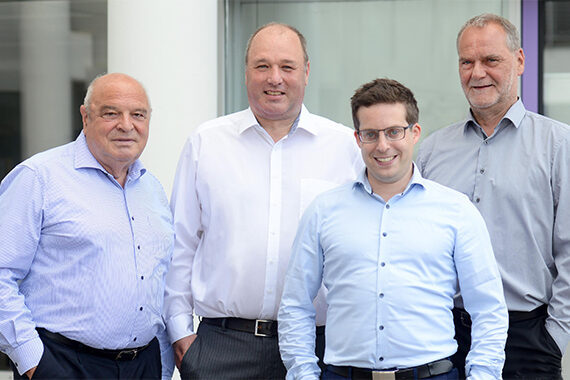
Standing at back:Dr Sebastian Schaubach and Nils Langer Managing Directors of DataPhysics Instruments ans seated from left: Daniel Föste, Jonas Heelein and Matthias Leininger, the founders of droptical.

Successful collaboration between droptical and DataPhysics Instruments.
    With FlexDrop, droptical and DataPhysics Instruments have realised the first joint product ready for series production. “During development, the focus was on ensuring that the dosed drop volumes can be generated reproducibly. This enables users to achieve extremely precise dosing, especially for particularly small droplets,” says Matthias Leininger, co-founder of droptical, and continues: “In collaboration with DataPhysics Instruments, we were able to develop the prototype of our droplet generator into a market-ready product.”

    Dr Sebastian Schaubach, Managing Director of DataPhysics Instruments, adds: “We are delighted that, together with droptical, we have achieved this breakthrough in the development of dosing systems for contact angle measurements. We believe that we can offer our customers a tangible advantage over other systems with the FlexDrop dosing system. This concerns both the reduction of sample cleaning processes after the measurement and the 1-click measurement of the surface energy.” 

FlexDrop allows extremely accurate measurements on the smallest surface areas with reproducible drop volumes in the picolitre and nanolitre range. The superior technology makes FlexDrop a valuable tool for laboratories, research institutes and development departments.


@PresseBox #DataPhysics #droptica. #PAuto

Tuesday, 9 May 2023

Analysis at Sub-Zero temperatures now possible.

The MultiScan MS 20 dispersion stability analysis system from DataPhysics Instruments can now also analyse dispersions at sub-zero temperatures down to -10 °C. The extended temperature range enables users to carry out measurements under real environmental and storage conditions. This enhancement is particularly interesting for product developments in the fields of pharmaceuticals, food, lubricants, and paints.

Many products consist of complex multi-component mixtures. Often, long-term homogeneity and durability of such mixtures is of high priority in product development, as separation processes have a negative impact on product quality. Traditionally, separation processes are observed with the naked eye in a so-called “shelf-life test”. However, this procedure is subjective and often several weeks of testing are necessary for each optimisation round.

Measurements at sub-zero temperatures possible for the first time.
To solve this problem, the German laboratory instrument manufacturer DataPhysics Instruments offers the MultiScan MS 20 dispersion stability analysis system for an automatic stability and ageing analysis of liquid dispersions. The device was specially developed for the characterisation of suspensions and emulsions and enables a time- and position-resolved analysis of separation processes. With the MultiScan MS 20, such processes can be quantified more precisely and evaluated in more detail than with a conventional shelf-life test. The MultiScan MS 20 consists of a base unit, to which up to six sample chambers can be connected.

Up to now, measurements at constant temperatures and temperature profiles between 4 °C and 80 °C were possible with the MultiScan MS 20. Now, DataPhysics Instruments has succeeded in lowering the minimum temperature for measurements to -10 °C. To measure at sub-zero temperatures, the tower-shaped sample chambers of the MultiScan MS 20 are encased with an insulation sleeve. To prevent humidity from condensing on the samples, the sample chambers are flooded with dry inert gas during the measurement. The sleeves can be ordered in the desired quantity when purchasing a new device. Existing devices can be retrofitted for measurements at low temperatures.

Replicate real storage conditions of many industries.
Temperature is one of the factors that influence separation processes in dispersions. Therefore, when investigating new or improved mixtures, it is essential to examine them under real storage conditions. Dr Sebastian Schaubach, Chief Innovation Officer at DataPhysics Instruments, says: “We are particularly pleased to be the first manufacturer in this field to succeed in carrying out measurements at sub-zero temperatures.”

The enhancement of the MultiScan MS 20 makes it possible to examine dispersions under real storage conditions even for products that must be stored refrigerated. The European Medicines Agency, for example, requires in its 2007 guidelines on the "Declaration of Storage Conditions" that medicinal products are tested for stability and then labelled accordingly. Here, storage in the refrigerator is based on a temperature of approximately 5 °C, in the freezer below 0 °C. The extended temperature range is not only interesting for the pharmaceutical industry, but also in the food sector. Here, products are often stored refrigerated during production, transport, and in the home of the customer. The typical temperature of a refrigerator is often cited at 4 °C or lower. These conditions can now easily be replicated with the MultiScan MS 20.

Similarly, the MultiScan MS 20 can be used for outdoor products. This includes lubricants as well as paints and agricultural products. “The experts in our in-house laboratory combine an in-depth understanding of our measurement methods with a broad knowledge of specific applications in many industries,” explains Schaubach. And he continues: “We are also happy to accompany customers on new, exciting measurement tasks at sub-zero temperatures.”

Measuring principle of the MultiScan MS 20.

The MultiScan MS 20 analyses separation processes by measuring light intensities in a time- and position-resolved manner. The experimental setup is as follows: A sample is filled into a glass vial, which is then placed into a sample chamber. Two light sources and a light detector move up and down along the sample simultaneously. During the measurement, the entire height of the sample is scanned. The software analyses the light intensities that pass through or are backscattered by the sample. The intensities of transmission (i.e. the light that passes through the sample) and backscattering (i.e. the light that is reflected from the sample) depend directly on the number, size and type of dispersed droplets or particles.

Particles can settle on the bottom of the sample container, so more particles interact with the light in this layer. Particles can also cream and collect at the top of the liquid, so that more particles interact with the light in the upper layer. The sample then shows decreasing transmission intensities in the respective region of dispersion, while the backscattering intensities increase. In addition, particles can aggregate and droplets agglomerate, which can be observed as global changes in transmission and backscattering intensities.

@PresseBox #DataPhysics #PAuto #Pharma

Wednesday, 7 December 2022

Laboratory measuring instruments for 25 years.

The laboratory measuring device manufacturer DataPhysics Instruments turns 25. Nils Langer, managing director, says: “This birthday is an important milestone for DataPhysics Instruments, especially after the challenges posed by the Coronavirus pandemic. Over the past 25 years, we have expanded our product portfolio steadily. In our anniversary year 2022, we have customers in over 80 countries and 45 employees. We are very well established in the worldwide market for measuring devices that characterise interfaces and surfaces. Now, it is our task to continue the company's successful path.”

Since August 1997, DataPhysics Instruments has been developing, manufacturing, and distributing laboratory measuring devices for the characterisation of interfaces and surfaces. From the beginning, the focus has been on the development of innovative and modular measuring instruments as well as user-friendly software. This product philosophy will remain at the core of the company.
Modular design as founding principle.
DataPhysics Instruments was founded in August 1997 by Dr Ulrich Busch, Thorsten Holz, and Horst Rau. From the beginning, the company's laboratory measuring devices were modular in design. This enabled customers to configure their measuring devices according to their specific use cases. They were also able to analyse their data immediately after the measurement using the device’s software. At the time, such a modular configuration was unheard of. To this day, the company has remained true to their commitment for a modular design.

With their measuring systems for the investigation of interfaces and surfaces, the three company founders had the finger on the pulse: in the 1990s, materials research made big strides. Examples include composites based on carbon fibres, but also other multicomponent materials for use in the construction and automotive industry, medical technology, as well as in electrical engineering. With the focus on new materials, the properties of their surfaces became crucial. The buzzword at the time was functionalised surfaces, i.e., surfaces optimised for their intended use with the help of surface structuring or various pre-treatments.

The product portfolio grows.
The company's first product was the OCA 20 optical contact angle meter together with the SCA analysis software, which were both developed in-house. Together, they could conduct contour measurements of pendant and sessile drops. In addition, the software could automatically evaluate the obtained data to calculate contact angle, surface tension, and surface energy. Founder and Managing Director Horst Rau recounts: “The first year and a half we concentrated on product development in order to be able to present our first, market-ready contact angle meter.” At the Analytica trade fair in 1998, DataPhysics Instruments successfully presented its contact angle meter for the first time. Over the years, the company continued to expand its OCA series, so that suitable solutions for many applications are now available, from an entry-level to an expert model.

Just in time for the turn of the millennium, DataPhysics Instruments expanded its product portfolio with the force-based tensiometers of the DCAT series and a newly developed software for the series. Through the years, the DCAT series has grown to contain different models, as well.

In 2002, a third device joined the product portfolio: the SVT 20 spinning drop tensiometer, which can measure ultra-low interfacial tensions. Ten years later, DataPhysics Instruments launched the humidity generators of the HGC series. They can be used to set and control the relative humidity within small and medium-sized measurement chambers. Since 2015, the MultiScan MS 20 stability analysis system has also been part of the product portfolio. It is used for the optical stability and ageing analysis of disperse multiphase mixtures.

Developing tomorrow's products today.

Directors l to R: Horst Rau, Nils Langer,
Dr Sebastian Schaubach and Jens Ole Wund
Today, DataPhysics Instruments is run by four shareholders: founder Horst Rau, Nils Langer, Jens Ole Wund and Dr Sebastian Schaubach. The interest in functionalised surfaces has only grown in importance over the past decades, as Managing Director and Sales Manager Nils Langer explains: “Today, research institutions and companies are developing more and more methods to functionalise surfaces. Plasma treatments and nanostructured surfaces are just two examples. It is therefore all the more important to provide researchers and product developers with measurement technology they can use to analyse the changed functional properties of such surfaces.”

For this reason, DataPhysics Instruments is focusing on the further upgrade of the existing devices as well as new developments. For the optical contact angle meters of the OCA series, the company introduced the new dpiMAX software at the beginning of 2022. The dpiMAX has a clearly structured, intuitive user interface and intelligent functions, which make the devices even easier to operate.

“We achieved another major success with the market launch of the ZPA 20 zeta potential analyzer with its patented measurement method,” adds Managing Director and Head of Development Jens Ole Wund. The ZPA 20 can determine the surface charge, or more precisely, the zeta potential of samples in aqueous solution by measuring the streaming current or streaming potential. To do this, it uses a patented measuring method, for which the solution is flowing over the sample alternately from opposite directions.

Shaping the future together.
Dr Sebastian Schaubach, Managing Director and responsible for innovation management, has a clear vision for the future: “We see ourselves as a partner who wants to refine the scientific analysis of interfaces and surfaces continually. In the future, our developments will therefore be conducted in even closer cooperation with our customers, because it is important to us that our devices can reliably solve our customers’ challenges.”

But it is not only the product portfolio that has grown steadily over the years. In its anniversary year, 45 employees work at DataPhysics Instruments. Further employees are being sought for the development, manufacturing, and sales department. In addition, the premises at the headquarters in Filderstadt near Stuttgart (D) have steadily expanded. Recently, the in-house Application Centre, with laboratory and training spaces, grew and was newly equipped. Dr Schaubach explains: “There, we offer test measurements for prospective buyers and contract measurements with all our devices. In addition, we conduct training courses for device operators.”

The company has always remained true to its native place – and yet is at home all over the world. An international network of sales partners ensures that customers all over the world can receive advice locally and in their preferred language. To be better represented in some target markets, DataPhysics Instruments founded its own companies in several countries: DataPhysics Instruments India was founded in 2020. In addition, the US subsidiary DataPhysics Instruments USA has existed since 2018.

Over the past 25 years, DataPhysics Instruments has developed an ever-expanding range of instruments for the analysis of interfaces and surfaces. At the same time, the company has grown in terms of personnel and space. For years, it has maintained a close relationship not only with sales partners around the world, but also with its customers in research and product development. These relationships have helped to develop market-driven products and to optimise the existing portfolio according to customer requirements. DataPhysics Instruments looks forward to expanding and deepening these relationships in the future.

@PresseBox #DataPhysicsInstruments #Laboratory #Surface #TandM